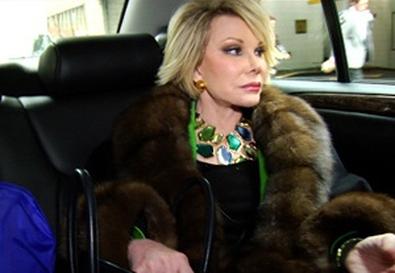
At 75, this former megastar and groundbreaker continues to do her standup shtick virtually anywhere there is an opening, including the most ghastly, out-of-the-way dives, some of which have chipped and peeling plaster and torn seats held together with masking tape. Filmmakers Ricki Stern and Annie Sundberg have done a brilliant job of revealing a contradictory character: driven, jealous, petty, generous, and, at moments, vulnerable. They've also brought to light the brutality and vagaries of the entertainment industry and the cult of celebrity.
Money is a motivation. Rivers is not willing to give up her oversized and gilded apartment overflowing with staff. "It's what Marie Antoinette would have had if she had money," Rivers quips. Nor is she willing to forgo her chauffeured car service, her only form of local transportation since 1968. But then, everything about Rivers is on a grand scale, especially her determination to resurrect her largely dormant career. The quest is all grist for comedy and her self-promotion mill—from her troubled relationship with her daughter Melissa to appearing on Donald Trump's "The Celebrity Apprentice" to her botched plastic surgery.
The film explores a year in the life of the comic icon while interweaving her life story as a Brooklyn, N.Y., native who graduated from Barnard College, made the comedy club circuit, and established herself as one of the early, outspoken feminist comics. In an era when abortion was not material for standup, Rivers insisted it was, loudly talking about a girl who had to leave the state 14 times for serial appendectomies. To this day, she is not above the raunchy. Her material is peppered with expletives, politically incorrect language, and an extremely off-color—and very funny—bit on the joys of anal sex. She explains that anal sex allows her the freedom to do many other things simultaneously, like checking her email. Bending over, butt to the sky, she demonstrates how the multitasking works.
Rivers is smart and sharp and capable of great joy. But she's also a sad woman who has had many regrets and losses. She talks about the defining role that Johnny Carson played in her career and how she became a national sensation when she appeared on "The Tonight Show" with him. There is no secret that his stamp of approval—leading to her guest-hosting his show hundreds of times—made her a household name. She recalls the special bond they forged, which was irreparably broken when she decided to branch out on her own, becoming Carson's competition on Fox television. It was a wretched move, professionally and personally.
The film also deals with Rivers' husband, Edgar Rosenberg, who served as her manager and who committed suicide. It was an odd marriage from the beginning; they wed four days after meeting. "Was I madly in love with him?" Rivers asks. "No. Was it a good marriage? Yes." After his death, her career and life began to plummet. Her one constant was an assistant with whom she worked for many years. He was her closest friend and confidant. As she tells it, ultimately he unceremoniously abandoned her too, leaving her almost bereft of all connection to her past.
But Rivers is determined to have a future. Her age and our youth-oriented culture—in which she is undoubtedly an anomaly—will not deter her. The passion is still there, perhaps stronger than ever. Rivers is ready to start anew and, if need be, reinvent herself. This is one comic who won't go gently into that good night.
Genre: Documentary
Directed by Ricki Stern and Annie Sundberg