John Cho has a defense for actors’ diva tendencies.
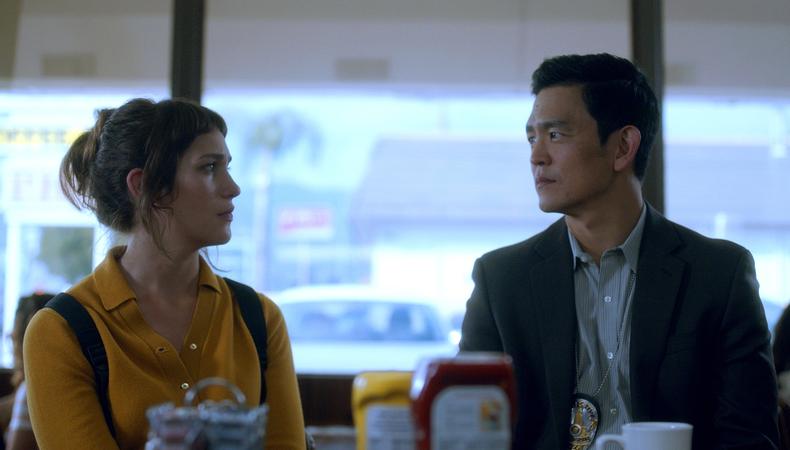
The topic comes up discussing his new indie flick “Gemini,” a neo-noir from Neon led by director Aaron Katz that focuses on the uneasy relationship between an actor named Heather (Zoë Kravitz) and her assistant, Jill (Lola Kirke). In real life, Cho has been privy to that kind of codependent alliance in Hollywood; in the film, his character, Detective Edward Ahn, pops in to investigate after the two women are involved in a twisty murder mystery we won’t spoil here.
Cho’s career has taken him from stoners to spaceships to suave leading men. In “Gemini” he’s an unnerving force, brimming with suspicion. Backstage sat down recently with the star and his director in New York for an illuminating conversation about their industry.
Aaron, what made John right for this particular role?
Aaron Katz: When I wrote the role I didn’t know who should play it. I wrote with Lola in mind and then everyone else I didn’t know who that should be. As we were working on casting the movie, Lola said, “What about Zoë for Heather?” Lola gets casting director [credit].... From there we started filling out the rest of the cast. I felt like in the hands of some actors [the detective] could be not a very exciting role and I wanted it to be something that had a whole arc to itself. Again, I have to give credit to someone else. It was Andrew Reed, our director of photography: “What about John?”
John Cho: Reed! I knew I liked him!
What was your reaction when you got ahold of the script, John?
Cho: First of all, I just loved the read. It was a great story, a great plot. And then the vibe was great. I loved how it was an L.A. It was this subculture that I recognized—the assistant-actor relationship that was so interesting. I loved the detective. We weren’t sure what he was thinking. He’s seems super smart. I didn’t know whether to believe everything that he was saying. I thought it was interesting how he was doling out little bits of himself and letting you see things that he saw but not the whole thing.
Was there any sort of audition process?
Cho: He made me do a comic musical monologue. [Laughs.]
Katz: From “The Pirates of Penzance.” No, that’s funny, we were just talking on our last call about auditions. I’ve seen John in other things. I think John’s a really good actor. We met up at a cafe and we hit it off. To me it’s just about feeling like we are going to be on the same page creatively. Developing a relationship of trust is really important.
You mentioned the familiarity of the assistant-actor relationship? Is that something you’ve seen a lot in your time in Hollywood?
Cho: You don’t see it initially. It takes a while to notice sometimes.
Katz: Especially if the assistant is really good at their job, it feels really effortless. No one is pulling the strings, but in fact they’re paving the way in all directions so everything goes smoothly.
Cho: People don’t wear name tags either on film sets so you don’t know who is doing what. I remember one of my first jobs—I got my SAG card on “Wag the Dog,”—I remember this blonde woman who seemed, from what I could gather, strictly in charge of tea for Robert De Niro. I didn’t think anything of it, but now I realize that was probably his personal assistant.... In defense of brat actors, I will say that taking care of small bodily needs and modulating your happiness so that you can focus—I’ve become a little bit of diva that way. Getting your coffee when you ask for it rather than 20 minutes later can actually affect how you do the scene. I can see why that position emerged.
Katz: Yeah, there’s a reason why it’s ubiquitous and it’s because it is really necessary. Making a movie is such a strange endeavor and it requires you to emotionally get into the headspace of a person that’s not you. So if you’re also worried about where’s your coffee and “I’m really hungry,” it’s really hard to get rid of these earthly needs and be like, “I’m just here living as who this character is.”
Cho: At some point I started seeing the similarities between filmmaking and war. If you go out to the front it is sort of similar. You’ve got to establish lines of communication in a base camp. Where are the telephones? Where are the tents? It’s just making a functioning thing out of nothing. I see now, if you walk on to a set you see thousands and thousands of decisions and small tasks that have happened and need to happen.
Is that experience is difference working on a smaller, more intimate production like “Gemini” versus a “Star Trek” movie? Or is the balance always the same?
Cho: They feel generally the same. To me, it’s just the size is different. On a “Star Trek” there’s just so many other departments; there’s a room on “Star Trek” that’s devoted to a bunch of guys and all they do is control the images that are on the Enterprise that come up on the screens. And that’s just what they do.
READ: 9 Tips for Your First Time on Set
In “Gemini” you’re filtering this modern idea of Hollywood with Instagram and assistants through this classic, noir form. Why did you want to do that?
Katz: It felt like it was living in a really strong tradition of noir set in Hollywood. I’m thinking of what to me is probably the greatest of all, which is “In a Lonely Place.” I feel like anything set in Los Angeles is going to touch on Hollywood because it’s an industry town. I was really interested in this relationship between an assistant and the person that they are helping. We’ve been talking about maybe the cynical side of that, but it’s really not meant in that way.... I really wanted to live in that tradition where it’s like the movie has something to say about the relationship between Heather and Jill but it’s not so clear. There are things that are really laudable about both of them and things that are really troubling about both of them. So I wanted it to be a human relationship.
Cho: By extension I was going to say I’ve seen sour, more on the abusive end of assistant-employer relationships. [In “Gemini”], even though it’s not totally professional, I feel like she has a healthy respect for her assistant.
Katz: One thing I wanted this movie not to be more than anything else was a satire of Hollywood [like] “The Player” and I guess “Wag the Dog,” where it’s like this send-up of something. I don’t want to have that distance from it. I like movies that take characters and worlds at face value and not have this distance of like, We’re so smart we’re going to point out how stupid this all is!
John, in terms of getting that tone was there anything you did in particular?
Cho: For Detective Ahn, [it] was just remembering not to show his hand. That was a lot actually to play, to remember line to line. It was never about, “Here’s what I want.” It’s, “What are you thinking? What are you going to give me?” That was, in its own way, intense. It typically resulted in not doing much, but it was intense in that I felt it required a lot of focus to remember that he was there only to observe and get something from them, whilst showing as little of himself as possible.
Katz: It’s funny, Lola and I did an interview a couple of weeks ago where someone was like, “So were you almost scared of John on set because he’s so intense in the movie?” [Cho laughs.] And Lola was like, “No, John’s really fun on set....” It was funny because I feel like you do have this very singular kind of focus on Lola and this quiet intensity about it.
Cho: I mean the wording is interesting in that scene too. “I know what you’re going through?” Do you? Normal people follow it up with, “I had a cousin that....” That’s what a normal human being does. He’s almost a little bit like a computer, [in a robotic voice] “Remember you must act like a human being. What would a human being do? HA HA HA.”
Check out Backstage’s film audition listings!