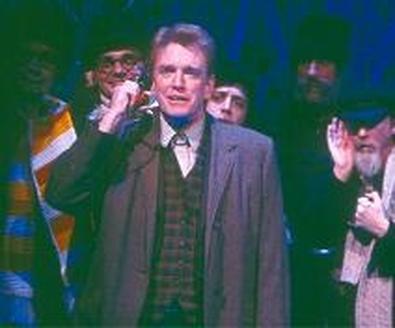
Actor William Atherton is a frequent presence in mega-hit movies like "Ghostbusters" and the "Die Hard" series. In the latter three flicks he played, most memorably, the unendurable newscaster, a preening wimp of a man whom Bruce Willis finally (and justifiably) gets to belt, and the audience cheers.
Nonetheless, Atherton stresses, his artistic soul is in the theatre. And he is now tackling the dauntingly complex role of "K" in Franz Kafka's "The Castle," a multi-leveled piece that is open to scholarly debate and interpretation.
"I felt I had to do this role," the good-humored 54-year-old Atherton asserts during a phone interview. "Otherwise, I'd be fraudulent. It's a difficult and complicated work, rarely done. And for that reason alone, it behooved us to do it. Not to do it--for good or ill--the Gods of Art would frown. They would frown if it's not done well, but more so if it's not done at all."
"The Castle," which bowed Off-Broadway at the Manhattan Ensemble Theatre Jan. 17, tells the story of K, a land surveyor, who has been hired by an unseen employer to work at a castle. When K arrives at a nearby village in search of some direction, he encounters vacant, puzzled, and/or suspicious faces. No one will help. Responses to the simplest questions make no sense. They are arbitrary. K travels in circles. The set is a revolving cube flanked by an arctic landscape. In the end, K wonders if the castle even exists. Still, he continues.
The novel was written in 1922, adapted into a play by Kafka's editor Max Brod, and then re-adapted--following a translation from the original German script--by Manhattan Ensemble Theatre's artistic director David Fishelson, its dramaturge Aaron Leichter, and the play's director, Scott Schwartz. Like the novel, the intermission-less, 90-minute, 12-scene play is deliberately ambiguous, its meaning up for grabs. K's journey may be an Everyman's quest for rationality in a bureaucratic--perhaps even totalitarian--state, or a search for religion (Does God exist?), or an exercise in existential despair.
Interestingly, unlike many actors who find philosophical and literary discussions counterproductive, Atherton feels that in a piece like "The Castle," they enhance a performance.
"I don't see this play as unreal or unearthly, but there are larger issues here, and I approach it as a mingling of the real--is going to the castle for a job--with the spiritual element, which becomes increasingly important to K. There is a point at which he faces the possibility that the castle may not be there at all, yet he feels honor-bound to go for it in order to have self-respect. Getting to the castle whether or not it's there becomes a validation of his existence. It becomes a trek [literal and metaphorical] against obstacles. And I believe K experiences it that way."
Atherton does not view the conclusion as pessimistic, yet another source of academic dispute and speculation. On the contrary, he considers the final moments an affirmation of sorts, suggesting that there is at least an element of liberation in acceptance, with its concomitant note of resignation.
"In some ways, K ends where he begins, but he perceives the world differently," Atherton points out. "He has changed. He is less precious, takes things less personally, yet has more feelings for others. He accepts certain realities in the universe and is at peace with them. It's not pie-in-the-sky, but, it is optimistic."
Extensive Analysis and Research
Atherton's layered performance evokes charm and even contentment at the close. He has struggled, will continue to do so (albeit less rigorously), and finds a certain satisfaction in just going on.
In pre-production preparation, the cast and director, Scott Schwartz, analyzed the piece in depth, Atherton comments. "But we were always talking to a point. These were energetic and impassioned conversations, not myopic grad school critiques."
Atherton did his own research as well, reading as much about Kafka's life as possible. "The more you read about him, the more accessible the material becomesa??his ongoing battles with his father, his conflicts over women, and his sense of himself in his society as an outsidera??the Jewish intelligentsia. Knowing where he was coming from made the play less abstract and gave K a personality."
A New Haven native, Atherton is a highly literate man, to say the least. He admits, for example, that he read a fair number of Kafka works in German. ("For that alone I should go to heaven," he quips.) He talks about the "Hegelian" elements in "The Castle," and he remarks on the "irony and paradox in the lovely, otherworldly set that makes the play's meaning clearer. The glowing vacuum leads to clarity."
And a wry sense of humor is evident. Asked to characterize K and his (Atherton's) relationship to his onstage alter ego, he doesn't miss a beat. "K is everybody I've ever met--and me. To play K, I begin with me, since I'm the only Everyman I know."
Atherton has spent the last 12 years in Los Angeles, and "The Castle" marks his first return to New York theatre in that time. But he is no novice to the stage. Indeed, he has originated roles on and Off-Broadway for an array of leading American playwrights. He won the Drama Desk and Outer Critics Circle awards for the title role in Daniel Sullivan's production of David Wiltse's "Suggs in the City," and an Obie nomination for David Rabe's "The Basic Training of Pavlo Hummel." For his Broadway debut in "The Sign in Sidney Brustein's Window," he earned a Theatre World Award. He starred in the original productions of John Guare's "The House of Blue Leaves" and "Rich and Famous."
To read about Atherton's training and road to success, go to the Members' Area