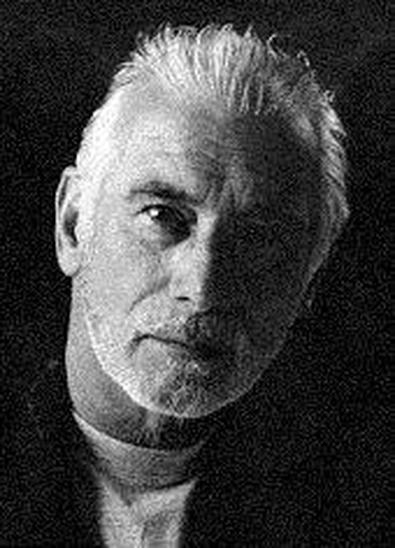
Gothic thrillers have their share of melodrama, veteran British actor Keith Baxter acknowledges during the course of a phone interview. But, he adds, the presence of poltergeists does not make the drama more implausible and thus more daunting for the actor.
"The motif of ghosts runs through all classical theatre--from 'Julius Caesar' to 'Hamlet' to the Scottish play ['Macbeth']," asserts the affable 68-year-old Welsh-born actor who speaks, not surprisingly, with a British accent.
"And you accept ghosts as part of the genre. The problem with the thriller is that the characters are often cardboard. That, of course, is not the case with 'Sleuth,' where the characters are complex and the dialogue witty. Similarly, with 'The Woman in Black'--I like the text, and each of the characters I play has his own narrative and an individual style of speech."
In Stephen Mallatratt's "The Woman in Black" (based on a Susan Hill novel), which bowed Off-Broadway at the Minetta Lane Theatre, June 4, Baxter assumes seven discrete alter-egos on stage, including a terrified coachman, a sniffling lawyer's clerk, and a man (Kips) haunted by a ghost he once encountered. Kips is the central figure, an aging attorney determined to exorcise that spectral presence. The scene: a Victorian England, awash in foggy bogs and moors.
The play is set in a gloomy dust-filled theatre--before it moves onto the foggy bogs and moors?and tells the story of Kip and a young actor (Jared Reed) coming together to enact Kip's trauma. The idea being (and here the play gets au courant) that in reliving his shocking experience, Kip will finally free himself from its emotional clutches. Without giving away too much, the ghost--that's the third performer--has other ideas.
At moments bringing to mind Henry James' "The Turn of the Screw," the play, translated into 22 languages, is now in its 13th year in the West End. But is there an audience for it in New York? Are American and British aesthetics in synch?
Baxter sure hopes so. He has signed up for a one year run in the play. That having been said, he admits London audiences have a traditional affinity for thrillers that may not exist (at least to the same extent) in the States, the success of "Sleuth" and "Deathtrap" notwithstanding.
Consider Agatha Christie's "The Mousetrap." After 49 years, it's still going strong in London's West End. But Baxter maintains that the world of eerie doings (especially coupled with who done it) has universal appeal. He points out that the current audience for "The Mousetrap" is tourists, specifically "the Japanese and Africans in traditional dress. I think audiences are audiences and they react pretty much the same all over." Nonetheless, Baxter says, "The Woman in Black" has been tightened, the intermission eliminated, and more opportunity for audience screams added. There are now four big ones.
Then and Now
Baxter, who has his roots in Shakespeare and the classics, is perhaps best known on Broadway for his award-winning performance (Drama Desk and Outer Critics) in the aforementioned "Sleuth." Earlier, he starred with Paul Scofield in "A Man for All Seasons," garnering a Theatre World Award. In London, Baxter performed opposite Maggie Smith in "The Country Wife," and with Margaret Leighton in "Antony and Cleopatra.
Movie gigs include Orson Welles' "Chimes at Midnight" and "Ash Wednesday" (with Elizabeth Taylor). Baxter is also a seasoned director and playwright; he has written three plays?"56 Duncan Terrace," "Cavell," and "Barnaby and the Old Boys"--and his memoirs, "My Sentiments Exactly," was published last year.
Baxter is the consummate theatre man, noting that he can't imagine doing anything else. And while he loves to talk about the theatre scene--how it has changed and is evolving--he finds discussing the craft of acting "pretentious."
"It's just a matter of discipline. You get up there and do it. Long runs are adventures. But then I come out of a tradition of long runs. I also come out of a tradition where actors are viewed as molding clay, conduits for the character. That has changed.
"My generation of actors became actors," he continues, "to become all the people we were not. We saw ourselves as colorless and theatre was the place where we could be colorful. Now young actors see themselves as personalities and worry about what they look like and what role they will play on TV and in the movies. And then they play that role over and over again. Our goal was to play as many roles as possible."
And indeed, he has. Still, he reveals unexpectedly that he has increasing stage fright--"terror"--with age.