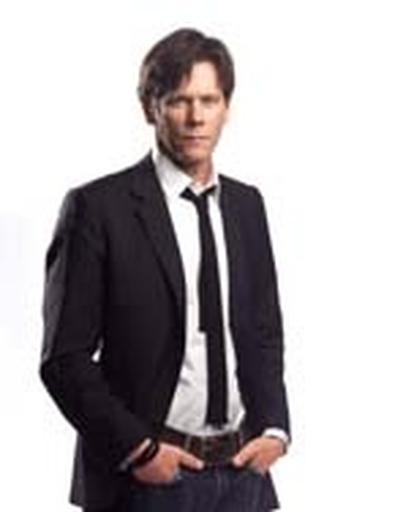
Evoking the improbable marriage of Frank Sinatra and Jerry Lewis, actor Kevin Bacon is by turns the slick, finger-snapping smoothie gliding across the stage and the rubber-necking goofy kid, dumb as a post -- the perfect foil to his suave sidekick, Vince (Colin Firth). Appearances notwithstanding, Bacon's Lanny is the man in charge -- at least offstage.
The film in question is Atom Egoyan's "Where the Truth Lies," released in New York and Los Angeles on Oct. 14. In this dark spin on Hollywood life in the 1950s, Bacon and Firth play superstar comic duo Lanny and Vince.
The juxtaposition of Lanny's onstage persona with his true character is fascinating, notes the easygoing Bacon, who is speaking in a Midtown hotel room. "Lanny is an extroverted, out-of-control, irresponsible, zany knucklehead. But in fact he's the one in the duo who is most together. He makes the decisions for the act -- and for the two of them outside the act.
"He's a self-made man and has the power of celebrity," continues the 47-year-old Philadelphia native. "Yet I imagine he was the kid from the poor family who kept getting beaten up. Fundamentally, he's still unhappy, still going after the young girls."
"Where the Truth Lies" tells the story of two joined-at-the-hip performers with ties to the mob who are spiraling downward in a frenetic, promiscuous, drug-filled world. At the center of this convoluted tale that moves backward and forward across the decades is a murdered girl who is discovered in the duo's hotel room. Comatose on booze and pills, neither man is entirely sure who killed her -- if either one is indeed culpable. Factor in blackmail and hints of homosexuality in an era that considered it unacceptable, and careers and lives are at stake.
For Bacon, tackling Lanny was engaging for several reasons, particularly the opportunity to play a comic-cum-song-and-dance man; indeed, in the film the character is an icon. "I usually play an everyman, not a performer, and I'm interested in the idea of a famous duo," Bacon says. "We don't have duos anymore, except on radio. But outside of radio, duos ended with the Lannys and Vinces."
Bacon insists the film is not biographical, despite the obvious evocation of Dean Martin and Jerry Lewis. Nevertheless, he studied their old clips, along with clips of Laurel and Hardy, Abbott and Costello, Rowan and Martin, even the Smothers Brothers. The Rat Pack, which included Martin and Lewis, informed Bacon's understanding of Lanny's onstage style and tone, especially in his sparring relationship with Vince.
"The Rat Pack was able to make audiences feel that they were hanging out with them," he observes, "that they were in on the joke: the smoking, the drinking, the women."
Behind the onstage cavorting and its self-referential allusions, however, the performers did in fact share a powerful bond -- one that was destructively symbiotic.
"When you're performing on stage together, there's a brotherhood, an intimacy," although it can't last if there are no other relationships or interests in the performers' lives, remarks Bacon. "The relationship has to implode, as it does with Lanny and Vince."
"One of the major challenges was to put together a viable '50s musical act that might have existed," he says. "I never did that kind of entertaining before. We were told to think Louis Prima." Prima's rollicking sound is far removed from that of Bacon, who, along with brother Michael, is a member of the laid-back country-rock band the Bacon Brothers.
"The other major challenge was jumping back and forth in time -- from the '50s to the '70s," says Bacon. "You can't play an era, although you can be affected by what's happening in the era. There was optimism in the '50s -- and that's gone in the '70s. But as an actor, it's more important for me to think about how Lanny was as a young man, and what has 15 years done to him? Does he walk differently? Does he talk differently? Does he see the world differently?"
In an effort to boost his sense of the '50s, Bacon wore dark brown contacts in the film, camouflaging his signature bright blue eyes. "The brown contacts give everything a kind of sepia tint," he says. "Also, because I'm identified with blue eyes, I look a little off. It suggests a secret."
A serious actor who is matter-of-fact and low-key in manner, Bacon has appeared in more than 40 feature films, most notably "The Woodsman," "Mystic River," "Apollo 13," "A Few Good Men," "JFK," "Footloose," "Diner," and "Animal House," which marked his feature debut in 1978. On Broadway he has appeared in "Slab Boys" and "An Almost Holy Picture," a solo drama. His first New York stage credit was a 1977 Equity Library Theatre revival of "Glad Tidings." He won an Obie Award in 1982 for two disparate roles: as a member of the Yale Whiffenpoofs in Paul Rudnick's "Poor Little Lambs" and as a drug-addicted male prostitute in Alan Bowne's "Forty Deuce" (repeating the role in the film version, directed by Paul Morrissey). He also starred in a production of Joe Orton's "Loot" at Manhattan Theatre Club in 1986.
"Acting on stage separates the boys from the men," Bacon notes. "You've got to do it all, even if there are only two people in the audience and a snowstorm outside. By contrast, performing in a movie is one big playground. It's all set out for you. When Lanny and Vince are performing, we look out and see an audience all dressed up as if it were the '50s. They're smoking cigarettes. It's a time warp. Getting into a period is much easier in a film."
Celebrity Run Amok
The son of a well-known Philadelphia city planner, Bacon always knew where he was headed. During his high-school years he attended the Pennsylvania Governor's School for the Arts and later he trained at Circle in the Square in New York City. "If I were not performing, I might have been an architect," he says.
Besides acting and singing, Bacon has also worn the director's hat ("Losing Chase," a 1996 TV movie, and the low-budget indie "Loverboy" this year), asserting that directing is simply a natural extension of his instinct and experience as a performer.
"I'm already spending half my life on a film set," he says. "My acting experience has helped me as a director. But as a result of my experience directing, I've changed as an actor. It's made me far less tolerant in dealing with bad directors and wasted time on a set."
Looking back at his career, Bacon says his role as the tormented pedophile in "The Woodsman" has been his most challenging to date. And it was that performance that convinced director Atom Egoyan to cast him as Lanny.
"I was always impressed with Kevin," says Egoyan. "But I was overwhelmed when I saw him in 'The Woodsman.' When I saw his emotional availability, I knew I had found my Lanny. He's brave, willing to go where other actors don't go. He's vulnerable [and] brings an emotional intelligence to his roles. And at the same time -- and this was very important for Lanny -- Kevin understands the performer's persona and the trappings of celebrity. He's exuberant and audacious."
Egoyan also praises Bacon's co-star Colin Firth and the connection and camaraderie the two actors established on the set: "Their rehearsals were unlike any I had ever seen. They knew what they had to do to conjure that personal bond. Their exchanges were so tender. They were able to create two performing artists who were highly sensitive to each other's neurosis."
In the end, arguably, it is their neuroses that ruin them, though the era's values also play a role in their demise.
What's constant among celebrities of any era "is the way they often define themselves by their status," says Bacon. "That's Lanny's tragedy. Once his act ends, once his friendship with Vince ends, they're both lost and isolated."
He adds, "I can understand the excitement of being a performer, the fun side of celebrity, but taken to the extreme, that's hard for me to relate to. I've managed to protect myself from that."