As we prepare for the 30th Screen Actors Guild Awards, Backstage is breaking down this year’s film and television ensemble work for your consideration. For more voting guides and roundups, we’ve got you covered here.
Main Cast: Tantoo Cardinal, Janae Collins, Robert De Niro, Leonardo DiCaprio, Jillian Dion, Lily Gladstone, Cara Jade Myers, Jesse Plemons, Scott Shepherd,
Sturgill Simpson
Casting by: Rene Haynes and Ellen Lewis
Directed by: Martin Scorsese
Written by: Eric Roth and Martin Scorsese (based on the book by David Grann)
Distributed by: Apple Original Films and Paramount Pictures
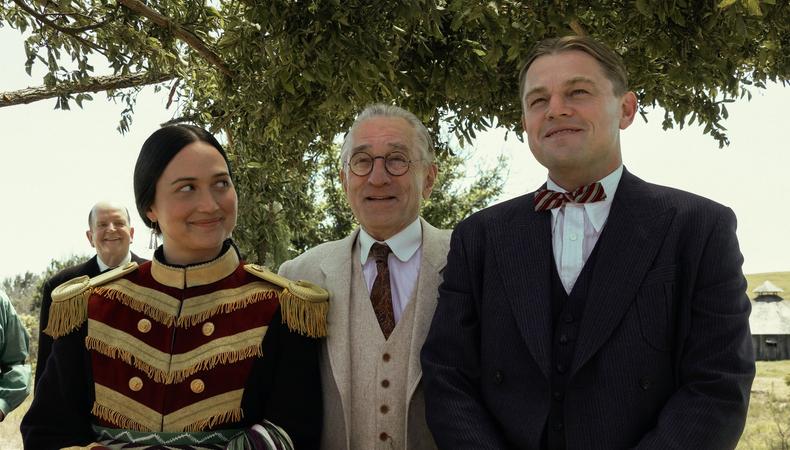
Martin Scorsese has his regulars—actors who return to work with him again and again. “Killers of the Flower Moon” brings together his early muse—Robert De Niro—and his more recent one—Leonardo DiCaprio—in a pair of roles that call on the two Oscar winners to play against type.
De Niro takes on a very different kind of villain than the ones we’re used to seeing him play as William Hale, a cattle rancher who conceals his dark motives beneath a folksy sheen. Meanwhile, DiCaprio tamps down his trademark swagger as Hale’s nephew, Ernest Burkhart, a bumbling fool who gets roped into his uncle’s murderous schemes.
But neither of these heavyweights make as big of an impression as Lily Gladstone, in her first collaboration with Scorsese. She portrays Mollie Burkhart, an Osage woman grappling with the limitations of her power in 1920s Oklahoma. She falls in love with and marries Ernest, only to find herself the victim of a scheme to murder her family and steal their fortune. Oil shares have made them rich, but as an Indigenous woman, she has little control over the money she’s entitled to.
These three are at the center of “Killers of the Flower Moon,” based on David Grann’s 2017 nonfiction book about the infamous Osage murders. But this is a sweeping epic, which means the ensemble extends far beyond the central trio. The cast is largely divided down the middle: the white men who commit senseless acts for the promise of wealth, and the Indigenous people who fall prey to their machinations.
To find their performers, Scorsese and his longtime casting director, Ellen Lewis, brought on Rene Haynes, a CD who specializes in finding actors from Indigenous communities. The result is a movie populated by both familiar faces and fresh ones, all of whom treat this harrowing true story with the respect it deserves.
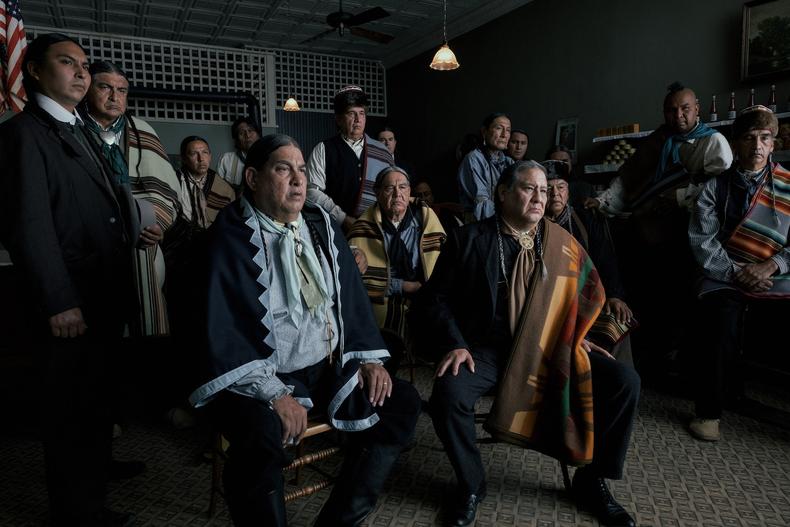
The actors who play Mollie’s family members function as a loving unit that’s ultimately torn apart by Ernest and Hale’s actions. Cara Jade Myers, Janae Collins, and Jillian Dion are gossipy and warm as Mollie’s sisters. Myers is a particular standout as Anna Brown, a party girl whose drunken antics make her both a liability and a target. As their mother, Lizzie Q, a community elder who sees her culture slipping away, Tantoo Cardinal lends the film some of its most emotionally resonant moments.
De Niro’s performance as Hale is anything but one-note; he brings nuance to the role of a real-life monster. The same goes for the actors who play his character’s allies, including Scott Shepherd as Ernest’s brother, Byron, and country musician Sturgill Simpson as the boozing Henry Grammer. (He’s not the only singer-songwriter in the film; Jason Isbell also makes an appearance.)
The cast grows even larger in the final act when law enforcement steps in to investigate. Jesse Plemons (who also made a wonderful late-film arrival in Scorsese’s “The Irishman”) is an anchoring force as FBI agent Tom White. John Lithgow and Brendan Fraser make notable appearances in courtroom scenes.
But it all comes back to De Niro, DiCaprio, and Gladstone. They form a cursed triangle: Hale pours venom into Burkhart’s ear, and he, in turn, enacts violence on the woman he claims to love. Together, these three brilliant actors bring an ugly chapter of American history to vivid life.
Want more? Stay in the loop with everything you need to know this awards season right here!