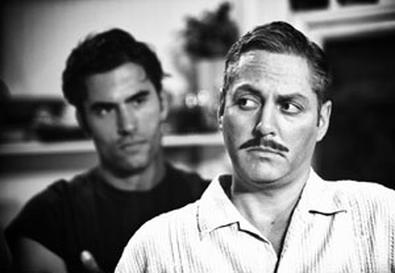
Photo Source: Mamood-Vega Photography
The play begins three days later, and Brando has still not arrived. Williams (Curt Bonnem), trying to ignore the inconvenience of a clogged toilet, is discussing his new play with his friend, director-producer Margo Jones (Alexa Hamilton). She loves "Streetcar," assumes she's going to direct it, and feels betrayed when she's displaced by Kazan. Meanwhile, Williams' jealous and paranoid live-in-lover, Pancho (Les Brandt), is making angry scenes because he's feeling neglected and unappreciated. He petulantly storms out to go drinking. Shortly after his departure, the fuses blow, and Margo sets off to join him. And Brando (Ignacio Serricchio) makes his belated appearance.
Williams at first mistakes the actor for an intruder, until Brando explains he used his bus fare for food and hitchhiked to Provincetown. Williams, unnerved by Brando's charisma and devastating good looks, insists he's too young to play Stanley Kowalski and refuses to let him read for the part. But Brando, persistent, repairs the clogged toilet and restores the electricity. In a volatile scene, there's much verbal sparring and game-playing, resulting in a "Streetcar"-like situation, with Brando playing Stanley to Williams' indignant Blanche. When it emerges that Brando has brought along a girl, Jo (Sasha Higgins), the situation turns triangular as they compete for her attention.
Ostrin sometimes departs from the facts, but his fictional treatment is persuasive and intriguing in its own way, and director Rick Shaw skillfully navigates its subtleties. The actors wisely don't attempt literal impersonation, though Bonnem nimbly captures Williams' manner and cadences. Serricchio doesn't look like Brando, but the actor possesses the requisite looks and magnetism. He doesn't employ the famous Brando mumble, though it's much talked about; perhaps intelligibility seemed more important than verisimilitude. The women's roles are less fully developed, but Hamilton and Higgins play them with charm and panache, and Brandt provides comic relief as the buff, tempestuous Pancho.
Presented by and at Two Roads Theater, 4348 Tujunga Blvd., Studio City. June 30–Aug. 7. Fri.–Sat., 8 p.m.; Sun., 7:30 p.m. (818) 762-2282. www.tworoadstheater.com.