Photo Source: Ashley Anderson
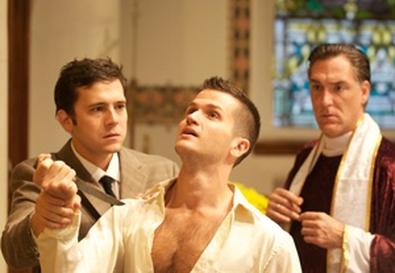
Scenic designer Andreea Mincic's artwork evokes the beauty of the Sistine Chapel and is illuminated to perfection by lighting designer Mark T. Simpson, creating an environment that is authentic without being stuffy. Director John Henry Davis stages the show on multiple levels, a strategy that is effective in delineating the class differences between the papacy and the "circus freaks" who perform for them. Neither of the actors who portray the castrati sings. Instead, Joseph Hill's renditions of selections from the Sistine Chapel repertoire give us a clear idea of what drew many to these concerts.
The unfortunate castrati, presented here as victims with very little ego despite having achieved near-divine status at the height of their popularity, are the "good" versus the church's "evil." The churchmen are portrayed either as repressed homosexuals like Lorenzo Perosi (Jonathan Tindle) or rigid politicians like Cardinal Sarto and Pope Pius X (both played smugly by Liam Torres with little differentiation).
While the similarity among the church characters is reductive, Glass' mirroring of relationships among his dramatis personae works superbly. Giovanni Cesari, a second castrato (played sublimely by Doug Kreeger) who worships Moreschi both professionally and romantically, savors a kiss between them in the same manner that Moreschi savors a kiss from Anna Lillie (Melissa Miller), his American apprentice. The pope downgrades Perosi in the same manner that Perosi downgrades Mustafa (Frank Anderson), the Sistine Chapel's choir director, who is forced into retirement. Both situations involve cycles of depression, loss, and oppression, but not everything is sad or forlorn. Mrs. Bristed, a recent convert to Catholicism, is played with such comical daftness by Bethe B. Austin that nearly every word that comes out of her mouth is a riot. She brings levity to an otherwise dismal situation.
Although "The Last Castrato" is a fictional work that bends time and circumstance as much as it bends genders, at its best it depicts real people during moments that stir genuine emotion.
Presented by Gap in the Wall Productions at the Connelly Theater, 220 E. Fourth St., NYC. Nov. 16–Dec. 4. Schedule varies. (800) 838-3006 or www.brownpapertickets.com. Casting by Robin Carus.