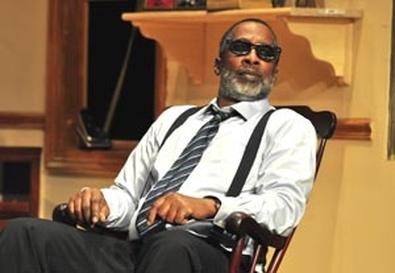
Photo Source: Tanja
It's the civil-rights generation versus the hip-hop generation once again in this new and occasionally insightful play written and directed by Jackie Alexander, who offers dismaying differences between the two groups, such as the casual use of what was once an abhorrent racial epithet, and also startling similarities: Black men still fight America's wars as a way out that doesn't always work. The scenes that compare and contrast—helped along by some pointed dialogue and stirring performances—suggest how good "Buster Neal" could have been had there been a more-thought-out story.
After that prologue confrontation with the Klan, Buster (Nathan Purdee) disappears and is presumed dead. But he mysteriously reappears six decades later in the New Orleans household of his descendants, three generations under one roof. Papa Melvin (Patrick Mitchell) has been blinded during combat in Vietnam. s son Ira (Stephen Hill) is separated from his wife and working three jobs to make ends meet. Ira's son Marcus (Dennis Johnson), a 16-year-old who has been kicked out of school, has quit his job as a burger flipper and joined with his best pal, 14-year-old Hubcap (Sidiki Fofana), and a drug dealer (Charles Anthony Burks) to finance a hip-hop music career. "It's just like a means to an end," Marcus tells Buster. "It's a means to an end alright," Buster replies.
What follows is a predictable, almost generic tragedy, with a confusing revelation: Though the Buster we see in 2010 pretends to be a friend and neighbor of the long-gone Buster Neal, he turns out in the end to be….what? An apparition of Buster Neal? Holes in the plot undermine a drama marked by some well-played moments, such as Mitchell's delivery of a monologue about Melvin's military service and the interaction between Johnson and Fofana, as two kids talking big to mask their fear and discomfort.
Presented by and at the Billie Holiday Theatre, 1368 Fulton St., Brooklyn, N.Y. March 3–27. Thu. and Fri., 8 p.m.; Sat., 3 and 8 p.m.; Sun., 4 p.m. (718) 636-0918 or www.thebillieholiday.org.