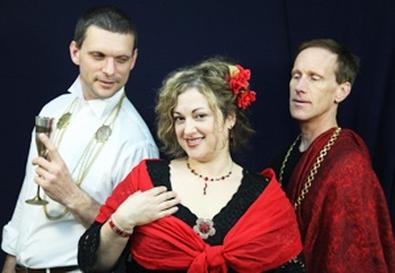
Photo Source: Alexander Romanov
Unfortunately, the charms here have little or nothing to do with Pushkin. Musical director Luiz Simas is a superb pianist whose playing of Mozart and others is a joy to hear. Nika Leoni is a ravishing singer of solos, and the choral interludes sung by all nine cast members are beautifully executed. Costume designer Gail Cooper-Hecht's tunics, trousers, and shifts work nicely for all four pieces, each set in a different country and a different century. But the playlets themselves, stretching across two hours and 40 minutes, are submerged in so much poetic and musical froufrou and folderol—however well done—that it's easy to forget Pushkin is supposed to be in there somewhere. He's not helped by acting that ranges from merely adequate to bad, or by a new, flat translation that panders to modern-day speech.
The translator, Julian Henry Lowenfeld, is also the director (in consultation with Natalya Kolotova of the Maly Dramatic Theater of St. Petersburg), the composer of most of the lovely music that isn't by Mozart, and an actor in the production, so laying blame and giving praise aren't hard to do. Lowenfeld's been so busy with all his chores that he's forgotten to illuminate Pushkin from the stage or give insight into his themes, much less to offer the actual tragedies (or comedies) of the overall ironic title. We do get that Pushkin was examining greed and envy—monetary, sexual, and artistic—but little else. It's odd that as a noted translator and scholar, Lowenfeld as director has paid so little attention to dialect, speech patterns, and accents among his players, most of whom seem to talk in a vaguely California accent (where "law" becomes "lah"). It's speaks volumes that Lowenfeld takes the only solo curtain call among the cast.
Especially disappointing among the four plays is "Mozart & Salieri," a two-hander set in Vienna at the end of Mozart's life. Simas gets to play Mozart on the piano, a plus, but is lacking in his portrayal of the composer. Lowenfeld himself essays Salieri, whom Pushkin believed had poisoned Mozart fatally, equally without elucidating the nuances of the complicated and fascinating relationship between the two men. Especially endless is a four-scene tale of Don Juan set in early 19th-century Madrid and called "The Stone Guest" because the lothario begins to woo the widow of a man he has killed at the deceased's gravesite. The relief here is that Leoni, as Don Juan's usual conquest in Madrid, gets to sing two nice songs. From none of the plays in the program do we get any sense of Pushkin's vaunted humor.
Presented by the American-Russian Cultural Cooperation Foundation and Green Lamp Press at the Howard Gilman Theatre at the Baryshnikov Arts Center, 450 W. 37th St., NYC. Nov. 5–14. Tue.–Sat. 8 p.m.; Wed. and Sat., 2 p.m.; Sun., 3 p.m. (212) 868-4444 or www.smarttix.com.