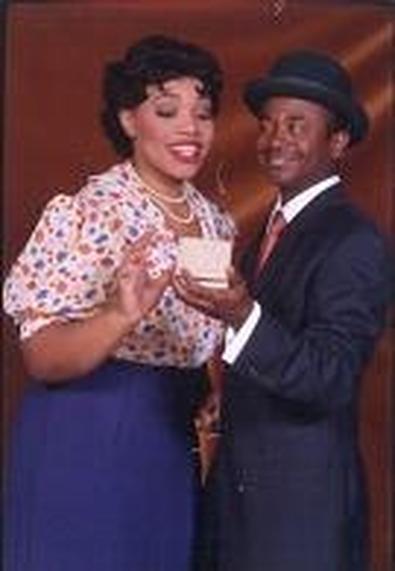
Although most--if not all--musical arrangers are also composers, an arranger/orchestrator is a breed apart, with a special set of skills. He also faces a host of challenges that are peculiar to his field. Ask 82-year-old Luther Henderson, pianist, conductor, composer, and, most notably, musical arranger-cum-orchestrator. During his 55-year-plus career, he has worked in various capacities on more than two dozen Broadway productions, including "Ain't Misbehavin' " and "Jelly's Last Jam." He is currently serving as the orchestrator/arranger for "Little Ham," a musical version of Langston Hughes' play, an AMAS Musical Theatre production now playing Off-Broadway at the Hudson Guild Theatre.
So what does an arranger do? Put simply, Henderson explains, he adapts the composer's music to accommodate the needs and/or desires of the singers, e.g., possibly changing a chord or key. If he also works on orchestrations, he re-conceives the music to accommodate the instrumentalists (who and how many will be playing). Case in point: revising a piece of music for a full orchestra that was originally composed for a small band.
"And you always have to keep in mind the rules of the proscenium stage," he adds. "It is not a jazz club, and there is little room for improvisation. Theatre is a collective effort. If the piece is not set and something unexpected happens, for example, all the light cues will be thrown. Freedom is abridged in theatre. But we try to offer as many opportunities for freedom as possible, while serving the music, the production, and its context."
Still, each project carries its own challenges, the knowledgeable and enthusiastic Kansas City-born Henderson points out during a phone conversation. "Little Ham," a work that had been produced years ago (in 1982), needed to be re-arranged and re-orchestrated "to serve the requirements of the new director and choreographer." He stresses that he wanted the music, composed by Judd Woldin (who wrote the music for "Raisin," the Tony Award-winning musical version of Lorraine Hansberry's "A Raisin in the Sun"), to highlight "Langston Hughes' vocabulary that was both scholastic and African-American. The challenge was to merge his hybrid expression with Judd's music."
Looking back, Henderson suggests that the most daunting project he ever worked on was "Jelly's Last Jam," not least because Jelly Roll Morton, the biographical figure on whom the musical was based, was "a piano player who composed music to show off his jazz and piano playing proclivities. He did not write for the theatre, he did not write lyrics, and he was not a tap dancer. Our lead, Gregory Hines, is [and much of the show featured Hines performing star turns as a tap dancer]. So all of the music had to be re-adapted and in some instances re-composed with that in mind. We added lyrics, and each song had to have the progressive effect of propelling the story along."
Henderson was one of the early arranger-orchestrators in musical theatre. He was also one of the first African-American behind-the-scenes creators to cross over and work with such luminaries as Andre Kostelanetz, Jule Styne, Carol Haney, Richard Rodgers, and Polly Bergen. He has straddled many worlds. Henderson is a Duke Ellington protege and a classically trained musician who graduated from Juilliard. He can play Chopin and do jazz riffs. And he loves, he says, both Ray Charles and Bach.
A Scion of Sugar Hill
Henderson grew up, middle class and educated, in the Sugar Hill section of Harlem, home of notables like Eubie Blake and Duke Ellington; Ellington's son, Mercer, was a childhood--indeed, lifelong--friend of Henderson's.
Henderson's father was a professor of education and his mother a public school teacher. "There was never any question that I wouldn't go to college," Henderson recalls, emphasizing that that goal--a higher education--was a given in the family. And, as Henderson tells it, he fulfilled that expectation and then some. "I was a good boy, I did what I was told, and I was a very good student. I got a 100% in my geometry regents and I went on to major in mathematics at City College."
He was also an accomplished pianist, having played since he was a youngster. Shortly after entering college in 1935, he realized that he really wanted a career in music (not math)--not that he knew what he'd do exactly, short of being "part of the scene that included Fats Waller, Benny Goodman, and Woody Herman, who were coming up at that time."
Henderson left City College and auditioned for and was accepted at Juilliard, where he specialized in the piano and majored in music education. "In those days, the school didn't offer musical composition. I might have studied that if it had, although I always composed my own music."
When he graduated in 1942, he launched his career as a piano player (and arranger) with the Leonard Ware Trio, a well-known jazz combo that performed throughout the West Village. His first theatre project was Duke Ellington and John Latouche's "Beggars Holiday" (a work inspired by John Gay's "The Beggars Opera"), where Henderson did both the arrangements and orchestrations.
He admits he was one of the fortunate few, always working in his chosen field without ever having to take a day job. Reviewing his life, he says he was as helped as he was hindered by his African-American heritage.
"I came out of jazz, under the aegis of Duke Ellington. That was my affiliation," he recalls. "And truthfully, I doubt I would have been hired by Jule Styne or Richard Rodgers had I not been black. Yes, I had talent. But I represented the culture that they were looking for. Being black was an asset."