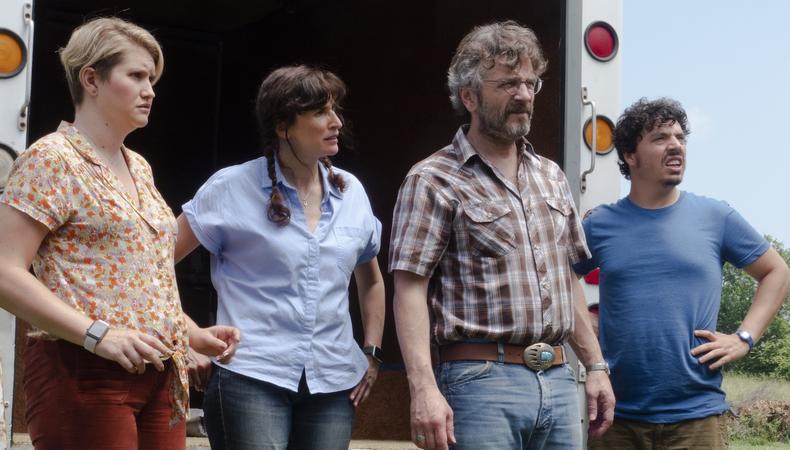
Lynn Shelton’s eighth feature, “Sword of Trust,” is the filmmaker both returning to her roots and tackling something unlike anything she’s done before. The loose, improvisational style of the movie recalls her best-known works, 2011’s “Your Sister’s Sister” and 2009’s “Humpday.” Meanwhile, the narrative thrust of the film is uncharacteristically slapstick, taking place in the rural South, a departure from Shelton’s Washington-based, relatively plot-free movies.
“It’s a little bit screwball and a little bit comedy caper,” Shelton says. “I wanted to unhinge a little bit from reality, so I could have some fun in that kind of realism, which I’ve never allowed myself to do before.” Co-written with Michael Patrick O’Brien, the film follows a pawn shop owner, Mel (Marc Maron), who gets approached by Mary (Michaela Watkins) and Cynthia (Jillian Bell), who have come into possession of a Civil War-era sword. The sword is supposedly proof that the South actually won that war, and it leads the characters down a rabbit hole of alt-right history.
In the way the film navigates conspiracy theories and the very specific group in this country that believes demonstrable lies, “Sword” feels like a movie that could only take place in the Trump era. Shelton said she set out to do just that—make a movie that feels relevant without beating people over the head with its relevance.
READ: Marc Maron’s 12 Steps to Enlightenment
The movie also exists because Shelton knew she wanted to write a role for Maron, best known for his podcast, “WTF With Marc Maron,” and Netflix’s “GLOW.” She describes riding in the back of a Lyft past a quirky-looking pawn shop, and it dawning on her that Maron should play a pawn shop owner. “It hit me like a bolt of lightning,” she says. “I just think he’s really compelling onscreen, and I know he’s capable of really great things he’s never had the opportunity to do before. I wanted to give him that opportunity.”
The movie’s script is more of a scriptment, where sections contain no dialogue and only a brief description of the scene. One such scene is actually the emotional hinge of the film; the written direction is simply that the characters get to know each other. “We discussed backstory; we knew ahead of time who these characters were, and [we] got together and talked about their hopes and dreams and what the history of their relationship was, so the actors would know that coming in,” recalls Shelton. “We spent nine hours on that. They were just so brilliant; if any one of those actors had not been an amazing improviser, the movie would not have worked.”
For Shelton, improvisation gets to the heart of people acting opposite one another. “I love it when actors are listening to each other. When you’re improvising, you literally have no idea what’s going to come out of the other person’s mouth, so you have to be in the moment. You’re being instead of acting, and you’re really just living the scene,” she says. “Improvisation adds a dynamic quality that’s difficult to get with a written script. That being said, it is a beautiful thing when you see two actors with a script and they’re still able to do that.”
When Shelton is auditioning actors for projects, she says the No. 1 thing she looks for is flexibility in the read. “They may come in with a great instinct for the first pass, but then you give them a note and if they can’t take it, that is death on set,” Shelton explains. “Don’t cling too hard to your initial read, and don’t over-rehearse so that you become too attached to it.” Shelton has seen a lot of this in directing for TV series such as Netflix’s “GLOW” and Hulu’s “Casual,” and it becomes challenging to work the scene around an actor who won’t adapt from their original plan for the read.
For her, the ability to inspire that performance in an actor is what brings her the most joy on set. “I think of it as this drawer that I open that’s full of little skeleton keys, and I’m looking for the right key to fit the right actor, because every actor is so different,” she says. “If I’m able to give that little note that helps to unlock something, if I get to participate in that, it’s just pure bliss.”
Ready to get to work? Check out Backstage’s film audition listings!