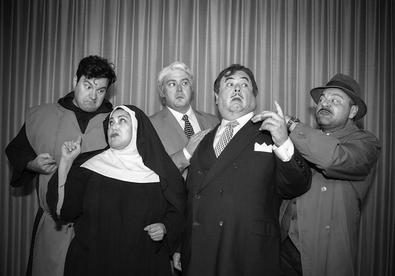
Since its founding more than 30 years ago, the Dallas-based Pegasus Theatre has produced more than 100 mainstage productions, but it’s the 31 “Living Black & White” shows—a trademarked term and patented makeup process—that has assured Pegasus’ reputation as an innovative producer of original comic mysteries, the most recent being the world premiere “Death is a Bad Habit!,” which runs at the Eisemann Center in Richardson through Jan. 24.
We spoke to Kurt Kleinmann, founder of Pegasus (as well as author and star of “Living Black & White”), and his wife and producer, Barbara Weinberger, about the company’s origins and how the makeup process affects everything from casting to direction.
Where did the idea for the “Living Black & White” “look” originate?
Kleinmann: I wrote “A Trifle Dead!,” in 1979, as a twist on the old Sherlock Holmes series [where] I decided to switch the roles [with the sidekick, the smart one, and the detective, an idiot]. I didn’t originally conceive of producing it in black and white, however—that came later. As I was getting ready to produce “A Trifle Dead!” [in April 1986], I thought that since the show was a spoof of an old black and white movie, I should make the parody complete by doing it completely in black and white. So the makeup effect and all the production effects have been there from the beginning. The idea of the makeup was mine, but I like the fact that implementing and perfecting the effect has been a collaborative effort.
Has the process evolved?
Kleinmann: We never stop tinkering with it, trying to make it better. And sometimes manufacturers change their formulation or discontinue a line, so we have to regroup. The most recent addition has been a makeup that tones down the red in the actors’ mouths.
The process is patented (cast and crew even sign nondisclosure agreements), but how long does it take to apply the makeup? And to get it off?
Weinberger: It takes at least an hour to properly apply makeup to all exposed skin—face, neck, hands, forearms—plus do the finer details. Once you apply the base coat, it tends to flatten out your facial features, so you have to redraw your cheekbones, eyebrows, etc. Some actors take as long as two hours because they use the extra time to get into character.
Makeup removal is tricky. We want the makeup to be durable so that it doesn’t wear off during the show, but the more durable it is, the harder it is to remove. And we needed something that would take the makeup off without irritating the actors’ skin. It takes about 30 to 45 minutes to do enough makeup removal that you can go out in public. A lot of it depends on how much exposed skin you had in the first place, and the wigs have helped. The removal process has evolved over the years, and we’ve found a couple of substances that work well. Plus a certain amount of scrubbing helps. But inevitably, actors tell stories about using a Q-tip months after the show closed and still discovering some gray makeup.
How does the makeup effect impact either the casting or performances from your cast?
Kleinmann: That’s a very astute question! The makeup definitely affects casting and performances. First, there are actors who are so intimidated by the makeup that they don’t even audition. Or they audition, get cast, and get cold feet, which has happened twice.
There are a handful of actors who have tried being in a “Living Black & White” show and have either been overwhelmed by or allergic to the makeup, so they never audition again. Allergies are rare, but skin chemistry does affect how well the makeup adheres to the skin. That can vary for any given actor from day to day. I’ll occasionally hear someone in the dressing room comment that the makeup just doesn’t want to behave that day. We have a bag of tricks to get through those days.
The feeling of the makeup takes some getting used to. In particular, it takes a while to trust that you can touch things without it coming off. Still, we try not to tempt fate, so we advise directors not to block any strong claps on the back or intimate hugs that might cause makeup to rub off.
Weinberger: The makeup also has a tendency to make everyone look younger, so older characters have to re-add some aging effects. Other than that, the process is pretty much the same for men and women and all ages. We ensure consistency by having all new cast members go through a makeup class led by Leslie Patrick, the only human being who knows as much about the makeup as Kurt.
Every curtain call ends with Barbara walking onstage in a red dress that really wows the audience with the effect.
Weinberger: We like to call it the “retina burn.” But the best way to describe it is in terms of what audience members tell us. As people watch the play, it’s easy to forget that it’s in black and white. You accept the premise and go with it. So the red dress effect reminds people that they’ve been watching something pretty spectacular for the last couple hours. We hear audible gasps from the audience as the shock of the contrast hits them. Audience members say it makes the cast look like two-dimensional figures, which is exactly the effect we’re going for.
Inspired by this post? Check out our Texas audition listings!