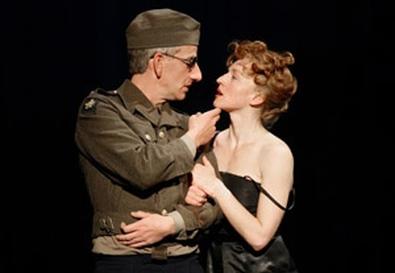
Director Thomas Ostermeier's curious but potent staging of "The Marriage of Maria Braun," based on Rainer Werner Fassbinder's 1979 film, catches all the glib aloofness with which the film's title character (played by Hanna Schygulla) faced the economic desperation of post–World War II Germany. As played here by Brigitte Hobmeier, Maria is less starry-eyed than Schygulla's version, coming off more tenacious in her efforts to wring a better life out of an unforgiving era.
Fassbinder's briskly edited film is perhaps most infamous among cinephiles for its literally explosive opening and conclusion. The film starts cold, as Maria and her soon-to-be husband, Herman, wed hastily during a violent bombing raid. Ostermeier subdues the staging of the peculiar nuptial event; while the couple exchanges vows, the low rumbles of bombs are nowhere near as ominous as the tinkle of the crystals on a nearby chandelier.
Such details pepper Ostermeier's mostly classy production, which is presented in German with English supertitles and employs a thoroughly faithful script by Peter Märthesheimer and Pea Fröhlich. Nina Wetzle's retro stage design, which includes wooden panel arches and more than two dozen waiting-room chairs, somehow recalls the eras of both the story and the film. Only a few shameless choices spoil the ambiance, such as the brazen use of blackface masks for some African-American soldiers. Jean-Pierre Cornu, Hans Kremer, Bernd Moss, and Steven Scharf all play multiples roles with ease.
Maria, whose soldier husband returns to the frontline immediately after their marriage, traverses Germany's full social strata throughout the film. She is first a poor widow, then an expectant mother, and ultimately the moneyed mistress of a French textile baron. But in a journey of defied expectations, Hobmeier's unsentimental Maria seems to take each hardship in stride. "I think it is a bad time for feelings," she says at one point. In the film, when the presumed-dead Herman returns to find his wife in carnal embrace with an American G.I., Schygulla gushes in adoring disbelief, "Look, Bill; it's Herman." Hobmeier's deadpan reading of the same line is humorous, simply a dry assessment of yet another problematic situation.
Presented by Brooklyn Academy of Music and Münchner Kammerspiele as part of 2010 Next Wave Festival at BAM Harvey Theater, 651 Fulton St., Brooklyn, N.Y. Nov. 17–20. Wed.–Fri., 7:30 p.m.; Sat., 2 and 7:30 p.m.; Sun., 3 p.m. (718) 636-4100 or www.bam.org.