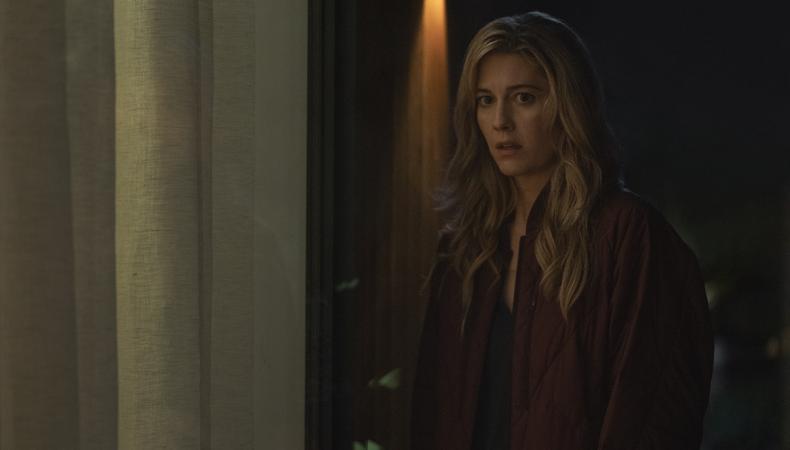
Mary Elizabeth Winstead brings emotional nuance and a sense of verisimilitude to every role—even when she’s portraying a parallel-universe-traversing ninja delivery girl or a kidnapping victim whose risky escape from her human captor turns into a fight for her life against alien invaders.
In her latest project, Michelle Garza Cervera’s remake of the 1992 psychological thriller “The Hand That Rocks the Cradle,” Winstead once again proves her range as she delves into maternal anxiety, complex human connection, and a thrilling battle against a vengeful nanny. Here, she discusses her process for building characters, the power of collaboration, and why letting go of perfection changed everything.
Winstead starts with emotional connection.
For Winstead, choosing a role begins with a visceral pull toward the material that signifies a deeper connection. She felt that instantly upon receiving the script for “The Hand That Rocks the Cradle.”
“I read the script when [it] came to me, and I loved it immediately,” Winstead says. After researching the original film, directed by Curtis Hanson, she realized the backstories were substantially different and deliberately chose not to watch it. “I was like, oh, this is quite different just in terms of the backstories of the characters and what gets the ball rolling in terms of the story,” she explains. “And so I thought, I don’t really know that this is going to be helpful for me in terms of creating this character, because her backstory is so different than the story in the original. So I decided to stay away from it and just do my own thing.”
Her process consistently starts by finding what resonates emotionally. “When I read something and love it, I know that’s because there’s a connection there,” she says. “Sometimes I know what that is right away. And sometimes I go, OK, I love this, but why? Like, what is it about me that is so drawn to this?”
That connection often comes from identifying the character’s core wound. “I fall in love with the character that I’m playing, and I figure out what it is about them that is wounded, and what it is about them that I see, that I love,” Winstead continues. “I kind of go towards that and try and hold on to that throughout the kind of crafting of the work…. It’s always kind of starting from the same place of connection to the character and the story.”
She used that approach to great effect for James Ponsoldt’s “Smashed” (2012), in which she portrays a recovering alcoholic. “That was really pivotal for me in terms of cementing my process as an actor,” Winstead says. “It just taught me a lot about myself and the way that I like to approach roles and the way that I like to work. I go back to that when I’m approaching a role or a character and trying to get into it. I think about that process and what that was like, and what an amazing experience it was. And that’s something that I definitely carry with me all the time.”
Collaboration fuels her best work.
Working alongside fellow scream queen Maika Monroe in “The Hand That Rocks the Cradle” was “just amazing,” says Winstead. “I do think the characters are so connected to each other,” she explains. “Even though there is so much animosity from at least one direction, there is this undeniable something deeper, this connection with them. It was lovely to feel that with Maika, even though we were kind of keeping our own separate processes as well.”
Before filming began, Winstead, Monroe, and Cervera met to discuss the major scenes together. “We were all so much on the same page about what it needed to be,” Winstead recalls. “We had a really good time, kind of going, ‘Oh, if we change this line, we change that line, and we hint [at] this backstory here and there.’ I felt like we were in the collaboration together, which was really great.”
Shooting the film’s climax proved to be simultaneously daunting and exhilarating. “It’s the kind of thing where this is on the schedule, and we’re working towards that, and it’s looming over us that we’re going to have to do this kind of monster of a scene,” Winstead says. “So that’s always difficult—when you know in the back of your mind that you’ve got something to do that’s going to require a lot of you. And even though when those moments come, I always love it, it’s the time leading up to it that is difficult.” But when the moment did arrive, working with the stunt team to make it “scrappy and real” became one of her favorite experiences on the production.
She trusts her instincts when choosing roles.
As Winstead’s career has evolved, so has her confidence in turning down roles that don’t feel right. “It’s much easier for me to say no based on not feeling that connection,” she says. “Even if there’s great people involved, and on paper, everything looks great, if it doesn’t feel like something I’m pulled to do, then I’m not the right person for it.”
This represents a significant shift from earlier in her career. “I probably would have been like, well, this is a good director, and it’s a good writer, and even though I don’t really understand it, I should do it,” she says. Now, she waits for projects that feel just right, with the understanding that even great films can be right for someone else but wrong for her.
She advises actors to let go of being perfect.
If Winstead could offer her younger self advice, it would be: “Don’t try to get anything right. Don’t try to be perfect. Don’t try to think about nailing it when you’re in an audition or on set.”
“I think in my early days, that’s what I was really concerned about,” she says. “And I always wanted to get it right, and I was always practicing and practicing. It’s not to say you shouldn’t be rehearsing and going over the scene or working on it and breaking it down, but I always sort of felt like there was a right and a wrong.”
Today, Winstead starts with a more expansive mindset. “I have no ego around being told I got the scene totally wrong,” she says. “You just try it and you play, and you bring yourself to it, and don’t worry so much about whether or not you hit every moment correctly. It’s about playing, and it’s about finding truthful moments and being as free as you could possibly be.”
For actors still working toward that sense of freedom, Winstead recommends “giving yourself grace.” “Just practice being free—even if you only find a few moments where you feel that way, that’s great,” she advises. “Don’t worry if you feel nervous, intense, and all that stuff. Just practice trying to let go, and one day you’ll be able to do it.”