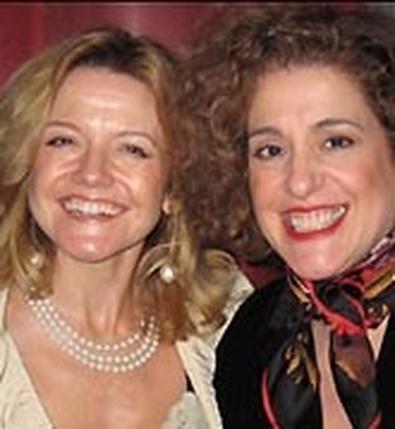
Something I already knew was that Rusty Magee was good. I didn't realize the songwriter-performer — who died five years ago at 47 — was that good, though, until Mary Testa and Alison Fraser brought Together Again to the Laurie Beechman Theatre at the West Bank Café. The show, deserving better than a two-night booking, is a Magee retrospective, and I challenge anyone to rack his or her brain for a better pair to demonstrate how vital the late tunesmith's work remains. Let's say a better trio, because for the final two songs (that's before beg-off encores), Testa and Fraser are joined by the always breathtaking Annie Golden.
Yes, three voices of the highest performing caliber in Manhattan are raised in song for that exhilarating 10-minute stretch. And when only two of them are dueting or soloing, there's enough excitement to fuel a Boeing 777. Testa is one of those fresh and direct singers who can do anything — saucy, serious, strong, or sensuous. Fraser's tones are equally solid, and she's got her evergreen soubrette insouciance going. The properly named Golden can race from whisper to train whistle in seconds flat, which leaves audiences cheering.
Smiling as they hold hands, Fraser and Testa open the set with Magee's "Perfect," which is about friendship. The ditty lives up to its title as a description of what obviously underlies their bond — Fraser being Magee's widow and Testa clearly a close buddy. Early in the set, there's a medley of children's songs for which the two morph into youngsters having romper-room fun, but most of the contents are what Testa amusingly dubs "the adult songs." Though the Magee-Fraser marriage must have been built on a firm foundation, the late writer had profound insights about troubled relationships, which he expressed in ballads that Fraser and Testa infuse with depth. Fraser's "Wrong for Me" triggers sustained applause for the simmering anger seeping off the stage like molten lava, and so does Testa's "Song Because I'm Leaving" for the same impassioned reason.
Magee wasn't a guy to go to for the easy power-ballad hook, and his work is more interesting for that. He was also able to drop into different genres with finesse. The ultrapolitical "Balance of Power" (written with Lewis Black for The Czar of Rock and Roll) is something Randy Newman might covet. The hot rock anthem "Don't You Go and Get Famous" — with Allison Leyton-Brown driving the beat at the piano — is Golden's opportunity to rattle the rafters. At closing, Testa sings an art song called "High Light," which is James McGee's poem set to Magee's music. If she's ever sung anything more beautifully, I'll eat this review. Fraser does McGee's setting of Walt Whitman's "Thanks in Old Age," here called "Sweet Appreciation," and it's icing on the cake.
In closing, I'll point out that of all the songs about New York City that aren't sung enough and may rarely be sung at all, the best is arguably McGee's "New York Romance," which Fraser does as if she's lived every word, which perhaps she has. Here are only some of those words:
It's a subway door that closes,
And you only see the pain.
It's a bagel at Grand Central,
While you're waiting for her train.
It's a crosstown connection.
It's a taxi in the rain.
It's a New York romance.
The show is sweet appreciation indeed.
Presented by and at the Laurie Beechman Theatre at the West Bank Café,
407 W. 42nd St., NYC.
Mon., Sept. 29, and Mon., Oct. 20, 7 p.m.
(212) 695-6909.