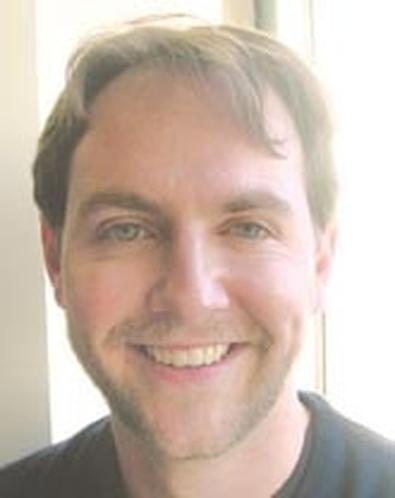
We often hear about child actors who ultimately find themselves at career dead-ends, leading to disappointing or even tragic lives. Yet for some prodigious talents, such as highly regarded director-producer Matt Shakman, success as a young thespian was a precursor to greater career heights. An energetic, multitasking professional, Shakman has found creative success as the founder and artistic director of the award-winning Black Dahlia Theatre in Los Angeles while simultaneously enjoying a flourishing career in directing for television. Under Shakman's helm, the Dahlia opened its latest production last week: the world premiere of Jonathan Tolins' Secrets of the Trade, a seriocomic showbiz saga, starring John Glover, Amy Aquino, and Bill Brochtrup.
Born and raised in Ventura, Calif., Shakman began acting on camera at age 4 and attended boarding school in nearby Ojai for high school. He then received his theatre training at Yale University while performing during summers at the New Jersey Shakespeare Festival. He subsequently launched his career by "pounding the pavement" in New York, which he continued for two and a half years, landing gigs as assistant director and acting Off-Broadway. After running a new Shakespeare company in Vail, Colo., with a colleague for a year or so, Shakman returned to California in the late 1990s to pursue new career avenues.
Yale and Hearty
The roots of the Dahlia trace back to Shakman's years at Yale. "During my college studies," he says, "I met Steven Klein. He ran the Yale Undergraduate Shakespeare Company. I directed the Scottish play, which Steven was in and produced." During their college years Shakman and Klein, the Dahlia's staff producer, didn't discuss the possibility of running a theatre together, though Shakman always had interests in this area. When their paths crossed again in Los Angeles, the two launched a theatre collective, the Firefly, collaborating on experimental projects that meant a lot to them. In 2001, Shakman and a small group of colleagues formed a company and began preparing to open the 30-seat Black Dahlia Theatre on Pico Boulevard, converting it from a tiny storefront. Klein joined this effort not long thereafter.
The collaboration among Shakman, Stein, and their handful of associates has generated lavish critical praise for the theatre's world and local premieres, beginning with Austin Pendleton's Orson's Shadow in 2001. The company's eclectic fare — ranging from Theater District, Richard Kramer's riveting drama about gay parenting, to powerful solo dramas like Adam Rapp's Nocturne and Geraldine Hughes' Belfast Blues — has been regularly showered with awards and nominations from the Los Angeles Drama Critics Circle, Back Stage West, LA Weekly, and the Ovations. American Theatre magazine called the Dahlia "one of a dozen young American companies you need to know," and Los Angeles magazine named it "Best Small Theatre."
Is it difficult to juggle the responsibilities of television gigs with the duties of running a small theatre and directing most of its offerings? "It's challenging," Shakman replies. "But I sustain the same commitment to the Dahlia regardless of what else is going on. During the [writers] strike, I had more time, so I've been able to focus more on the theatre, including capital gain improvements. Our core group of seven is always pitching in, seeing to it that the ongoing tasks get done: getting up the productions, developing new plays, casting, fundraising, advertising." Managing Director Brian Siegel has been with the company from the start. Current producing director Jennifer Welsh and Klein joined soon thereafter; others came later.
Shakman says the team works well. Some pick up the slack when others are heavily occupied with other career projects. Says Shakman, "For each show, we usually depend on the talents of one or two of us who oversee the production, more or less turning over their life for the period. Then they might take the next play off, but everyone is always willing to help paint sets and do things like that."
Rite for the Role
Dahlia isn't a membership company. "I didn't want to have that kind of a structure," explains the gracious and articulate Shakman. "I wanted a company that was free to make all decisions that we felt were best for our key artistic mission — developing new works — rather than trying to satisfy the needs of each member in a large group. I wanted to find the best plays to produce and then find people to be a part of them." Yet simpatico artists return to work with the theatre. "That's especially true with designers," says Shakman.
"We have resident designers who do a lot of work here. There are solid actors whose work I really respect, and if there's a part that's right for them, I call them right away, but we are always open to who is out there." Though actors are auditioned, it is not in open calls. Agent submissions, referrals, and recommendations often lead to reading appointments for specific roles. "We ask anyone interested in working here to send us a picture and résumé," Shakman notes. "We keep them on hand, and if something seems right for someone, we call that actor in. We call some in to read for every show."
Well-known film or television actors sometimes appear at the Dahlia. Shakman says this is bound to happen, as he and his associates work in the different mediums and meet a lot of people, but he emphasizes that the Dahlia doesn't operate as a celebrity-driven organization. "When we work with well-known actors, it's usually because we have gotten to know them. They are brought in for their talent and their suitability to specific roles," he asserts. "People who love theatre and come from theatre yet work in TV or film will find their way back to it. John Glover is in our current play. He loves theatre and is game to doing plays that he responds to, whether here or in New York or elsewhere. Same with Eric Stoltz, who did a play with us before."
Shakman says his acting years are behind him and that he has happily found his niche as a director. By the time he went to boarding school, he was vested in his Screen Actors Guild pension, but he was already yearning to do something different. He says, "I wanted to have a more typical educational experience, rather than being just a kid with a tutor on a set. I still acted there, but I started to direct a lot at that time, doing several plays in high school. When I got to college, I started acting again as a way to introduce myself to that community. In my sophomore year, I started directing, and then I was doing a mix of both until I graduated."
He enjoys the diversity of directing in the theatre and in television. He remarks, "Even as a child, I was always interested in how things worked on the other side of the camera. I had many great mentor figures who were willing to entertain my questions. Nowadays I consider my acting background to be very valuable for what I'm doing. Directing has been a great journey for me."
What about the future? Shakman feels if he can continue working on a diversity of fine projects in different mediums with talented people, as his career has provided so far, that's plenty to satisfy him. He concludes, "I would also love to know that if I stepped away from Black Dahlia at some point, the company would continue."
Bio Briefs
As a child actor, appeared in such television series as The Facts of Life, Highway to Heaven, and Diff'rent Strokes
Directed West Coast premieres, at Los Angeles' Black Dahlia Theatre, of two Stephen Adly Guirgis plays: Den of Thieves (2002) and The Last Days of Judas Iscariot (2007)
Directed the 2006 New York premiere of Jamie Pachino's Splitting Infinity, starring Tony winner Michael Rupert
Television directing credits include Ugly Betty, Six Feet Under, Brothers & Sisters, House, Boston Legal, and Once and Again
Secrets of the Trade runs through April 20 at the Black Dahlia Theatre, 5453 W. Pico Blvd., L.A. Wed.-Sat. 8 p.m., Sun. 7 p.m. (Dark Sun. March 23.) (800) 838-3006. www.thedahlia.com.