It's not that playwright Michael Frayn wants to go all lofty in talking about "Noises Off," a sex farce--a parody of a sex farce to be precise--but given the play's international appeal (and from his point of view, its success is totally unexpected), he can't help engaging in a little analysis. With a small chuckle and a dismissive wave of the hand, he apologizes ahead of time for his elevated spin.
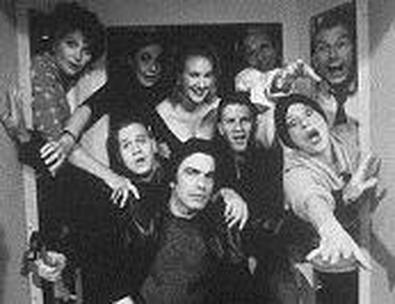
The current revival of "Noises Off," slated to bow on Broadway at the Brooks Atkinson on Nov. 1, details the high-jinks shenanigans of a troupe of inept actors--mind-bogglingly inept--rehearsing and then performing a third-rate farce, "Nothing On," where everything that can go wrong does. It is broad--very broad--comedy that at moments brings to mind vaudeville, burlesque, and even silent black-and-white movies. "Noises Off" debuted on Broadway and the West End in 1983 and has since enjoyed an audience worldwide.
"This play has caught people's fancy--more so than all of my other plays--and I've wondered why," notes the 68-year-old London-born playwright, with whom we meet in his Central Park West hotel suite. "It can't be because the play is a sex farce, because most audiences, outside of England, have never seen a sex farce. And it can't be because the characters are actors, because most people don't care about actors.
"I believe the play's appeal lies in the fact that all people [not only actors] are afraid that they won't be able to go on with their performance, metaphorically speaking," he continues. "Their laughter [in response to the onstage chaos] is a release from their own anxiety and fear. What causes one of the greatest fears, even among the most successful, articulate people? Making a speech," he answers his own question. "Suddenly you're conscious of your own performance, with everyone's eyes on you."
He adds, "Some people might think [on basis of this play] that I hate actors. I don't. The more I know them and see them work, the more I admire them."
Frayn has written many plays; his best known, of course, is "Copenhagen," which earned the Tony, Drama Desk, Olivier, and Evening Standard awards. His other plays include "The Two of Us," "Alphabetical Order" (Evening Standard Award), "Donkey's Years" (Olivier Award), "Clouds," "Balmoral," and "Make and Break" (Evening Standard Award). He has translated four of Chekhov's full-length plays, and published nine novels?most recently, his well-received "Headlong," a comic yet scholarly story about, among other things, a long-lost Breughel painting.
Asked what, if anything, thematically ties his eclectic body of work together, he quips: "That's for others to decide." Still, the easygoing Frayn, who resembles a professor in a rural-based based Ivy League university, reluctantly concedes that all of his novels and plays have a "cerebral" element.
That includes farce, a genre he finds especially daunting. He paraphrases the old adage about comedy, noting, "Dying is hard, but not as hard as farce. And 'Noises Off' poses even greater problems because two interlocking farces are occurring--on stage and backstage, respectively. It verges on the impossible because if you change one thing, everything else is affected by it. It's like a statue made of Jell-O.
" 'Noises Off' is physical comedy and that's the challenge for the actors. They have to be great mimes, especially in the second act. I believe both American and British actors come out of a tradition of physical comedy. Russian actors do not. It was very interesting to see a production of the play in Moscow in the late '80s. They knew it was a comedy, but approached it as a serious enterprise. They were doing a play about actors doing a play. Although they were not doing a farce, it was wonderfully funny. Yet, the audience sat there in silence for 40 minutes before starting to laugh."
There is surely no shortage of laughter at the Brooks Atkinson, at least the night we were there (the first preview to boot). And that's particularly gratifying to Frayn, who was not certain that either the actors or audiences would find this material appropriate in the wake of the Sept. 11 catastrophe.
"The rehearsals had just started around Sept. 11 and as I watched the TV in horror in London, I was convinced it was the end of the production. It took me over a week to get through to [director] Jeremy Sams. And he assured me the actors wanted to do it. And it looks like the audience is there. Americans want to get on with things."
A Theatrical Johnny-Come-Lately
Frayn grew up comfortably--his father worked as a salesman--but mixed messages were always present. As Frayn tells it (smiling wryly), "My father was skeptical about my ability to earn a living. I kept it to myself that I wanted to be a writer, yet he was the one who put it in my mind that I might consider writing."
Frayn went on to Cambridge University, where he majored in "moral sciences"--today we call it philosophy--and he launched his career as a journalist, reporting for the Manchester Guardian and, later, the Observer.
He wrote a fair number of novels and even some teleplays before he turned his attention to playwriting. He admits frankly, "It took me a long time to even consider theatre. I hated it. When I was in college, I was a member of the Footlights Club. We'd write skits and often these sketches would end up on the West End for a brief run. My pieces weren't selected and so I was down on theatre."
Frayn was further alienated from theatre when he was invited to write a one-act piece about marriage and family life for a series of playlets that Alexander Cohen was producing. Frayn's work dealt with how the presence of children affects a marriage. Cohen's response was bizarre. "He said he had never read anything so dirty and he'd never put my play on stage," Frayn recalls. "I had no idea what he was talking about. It turned out he objected to the baby's diapers being changed on stage."
Frayn's early theatre endeavors were not smooth sailing; indeed, he didn't have a success until he was 37. And even his first critically acclaimed play, "Alphabetical Order," didn't make it to Broadway. "It was produced at the Long Wharf in New Haven [1970] and received a rave review from Clive Barnes who wrote for The Times, " Frayn recollects. "I was sure we were in. But nothing happened. We never transferred, although the play was produced on the West End."
Over the years, Frayn has had a number of artistic influences; his most significant have been--talk about a curious amalgam--Feydeau, Chekhov, and Peter Nichols. The latter, whose "Passion Play" was recently revived Off-Broadway, has been especially potent in helping Frayn hone his work.
"He said, 'When you think you've finished a play, read through it again to track each character's point of view. You want to make sure he has an independent existence--separate from that of the other characters.' "
One thing is certain: Within the parameters of dementia, all of the protagonists in "Noises Off" have clearly defined points of view; not that Frayn wants to belabor the point or spend too much time worrying about what audiences are thinking and feeling about it all. Yes, Frayn wants theatregoers to laugh a lot, but short of that, he says, "The play is the play. And I'm not going to say anything beyond that."