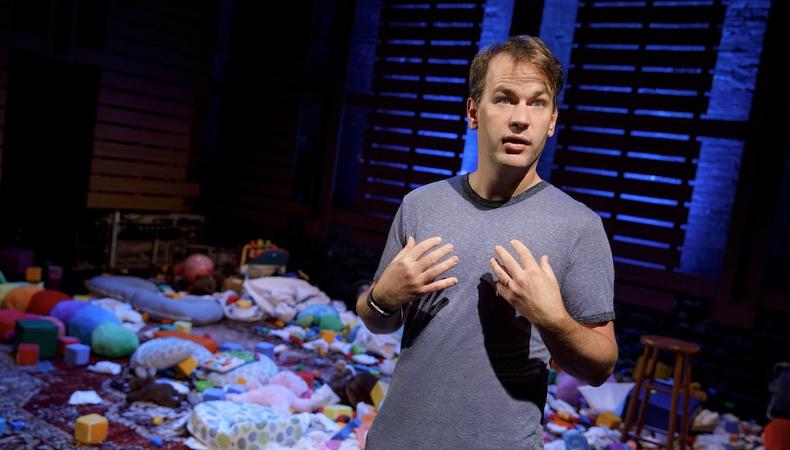
As a Tony–winning scenic designer, Beowulf Boritt’s work can be seen on stages all over New York City—currently on Broadway with “Come From Away” and four Off-Broadway productions, including cult sensation musical “Be More Chill” at the Pershing Square Signature Center and Mike Birbiglia’s one-man show “The New One” at Cherry Lane Theatre, which marks his fourth collaboration with writer and star Birbiglia and director Seth Barrish. Here, Boritt speaks with Backstage about how at the end of the day, he’s bringing a vision to life to serve the performers onstage and to offer his best advice for aspiring theater-makers of all kinds.
For those unfamiliar with what you do as a scenic designer, what does a day in the life look like?
Oh man, there is no one day in the life! This month is a busy Off-Broadway month for me. I’m opening four Off-Broadway shows in July. I try to keep busy, but this is a little busy even for me. Every day is different. I was teching two shows at the same time and running back and forth between them last week. This morning, I was on a production meeting call for Mike Birbiglia’s show, and I’m about to get in the car and drive to look at a set for Broadway, a play I’m doing in September. And then going on up to a second shop further upstate to see the set for the Mike Birbiglia show.
This is the fourth time that you’re working with Mike, correct?
Yes, it is. Designing for Mike’s shows is a little different, I think, than really anything else I do. For a one-person show in general, it’s a slightly different kind of design because you’re not storytelling in quite the same way, and the set, at least when I do them, it tends to sort of pull back a bit because you really don’t want to get in that person’s way. You don’t want to get in that actor’s way, period. But when you’ve got 20 people singing and dancing, the set can do some tricks and it’s just going to add to that. When it’s one person talking to you, the statement that the set is making has to be sort of quieter, in a way, so that you don’t get in the way of the performer or the text.
What’s interesting working with Mike, I always say it’s sort of a cross between stand-up and a play. They’re very structured and they definitely have a dramatic arc to them, and they always have some kind of a hinge in the middle of the story where suddenly you’re like, “Oh, now I get what this is all about.” And that’s what I find really exciting about working with Mike and Seth [Barrish] on these projects. An example of that is in “Sleepwalk With Me,” the first one we did together, there was a big glass wall at the back of the stage with a hole in it, and I think the audience didn’t know what that was until all of sudden you get through the story to the point where Mike jumps through a second-story window while he’s sleepwalking. And we’ve done similar things with the other projects I’ve done with him that it’s kind of a simple, slightly abstract statement that looks interesting, but you’re not quite sure what it is until suddenly this thing happens. It tends to be kind of the dramatic hinge of the story. It’s kind of the 11 o’clock number, in a way, and it’s the moment that, hopefully, the set kind of clicks and you get the visual statement that’s really the theme of the story.
When it comes to working on a one-man show like this compared to some of the musicals you do—I’m such a fan of your work in “Come From Away,” for instance—does Mike directly have more of an influence than an actor in a larger production?
Absolutely. Because Mike’s the writer and also the producer on these, he and Seth and I work really closely, and we’ve sort of worked out a pattern over the years where we’ll just get together and hang out and talk a bit. Sometimes Mike will do parts of the show. One of my favorite things is I’ll often sit in his kitchen with him and he’ll do a speed-run of the show for me and its high points. I’ve just started calling them “the kitchen run-throughs.” But it gives me a sense of the flavor of it, and it’s usually while it’s still developing, so we don’t quite know what the text is, but we know what the arc of the story is, and we know what the points that we need to hit are. So that’s very involved.
I think on something like “Come From Away” or on most shows, I probably don’t have too much contact with the actors in the design process. It’s basically all of the director, sometimes the writers a bit. But basically, especially because I do a lot of musicals, I find it works best if the director is the top of the pyramid. I work with the director and the other designers and the director feeds those ideas onto the producers and the writers and brings feedback to us if needed. And it doesn’t mean we don’t all talk, but when you get everybody in a room together, it starts to be too many cooks and it’s good to have the director as that single point of contact that everybody is going through.
What is your process like in making sure that everything is accessible to an actor onstage?
What I try to do is when I really sit down to figure out what the physical set is gonna be, I’ll build a little model of the theater and get a little model of the person and stick it in there, and I’m sort of constantly checking back to say, “The things that I’m putting here, what do they do in relation to a human body?” The most important thing for me onstage is getting the proportions kind of harmonious but also so they’re not overwhelming the actor and also not making an actor feel too big or too small—that it’s sort of a good proportion to offset the human body. Because there’s no such thing as a close-up onstage, one of the things the set has to do is kind of bring the focus in—and lighting does this, too, obviously—so that the human body becomes the most important thing onstage. That proportion and working that out is super important to me, and I’m constantly jumping back and forth saying, “If I do this idea, what does it do to the size of the human being?”
Is working in miniature something you learned in your own practice and craft or just something that you started doing for yourself?
I probably was taught it in school, to be honest, but it’s something that I definitely hang to tightly when I’m working. It’s easy to get carried away with an interesting sculptural or visual idea, but I have to keep telling myself to bring it back to the human being and to the performers. I say it all the time: I think what theater ultimately is a literary art form. It’s about the written words that are presented by a live person. And if those words are good and the person presenting them is compelling, then you’ve got a play and you don’t actually need anything else. So everything else that the rest of us are doing is kind of frosting, but if we do it well, it’s really good! You know, who wants a cake without frosting? That’s how I think of what we do, and hopefully I’m finding images that can add to and develop what is going on onstage.
For other theater creatives out there who want to get into scenic design, what advice do you have for them to either get the proper training or to—once they do have the training—get their foot in the door?
It’s so tough to say. The thing that I tell people all the time is that this business is 75 percent luck. You can be very good and very skilled at what you do, and if you don’t get the lucky breaks, you may not have a career doing it. That’s what stinks about it. But once you get that break, you’ve gotta have the goods to do it. You’ve gotta be able to do the job and do it well and do it efficiently and all those things. That’s probably true in any job, but certainly true in any job in the theater.
One of the best pieces of advice I got when I was starting out—two things. One was if you want to be a set designer, you have to design sets. And that’s an obvious thing to say, but one summer I was debating taking a job designing scenery for a little summer stock theater that paid almost nothing, or I had another offer for a summer job that was nothing related but paid a lot better, and a teacher of mine in college said, “Take the job that doesn’t pay because that’s what you want to do, and eventually, it will pay if you keep at it.” And that turned out to be really excellent advice. Especially when I was starting out, I would design anything that I was asked to do. As long as I could squeeze it into my schedule somehow, I would always say yes to it. In my earlier years doing this, I designed 30 shows a year, sometimes. And a lot of them were tiny little projects, but you never know which one is going to introduce you to someone or lead you to something or whatever. You can’t tell going into it. I famously tried to turn down “25th Annual Putnam County Spelling Bee” when it was first offered to me as a summer stock show, and thank god I didn’t because it cracked open my career for me.
Ready to get to work onstage? Check out Backstage’s theater audition listings!