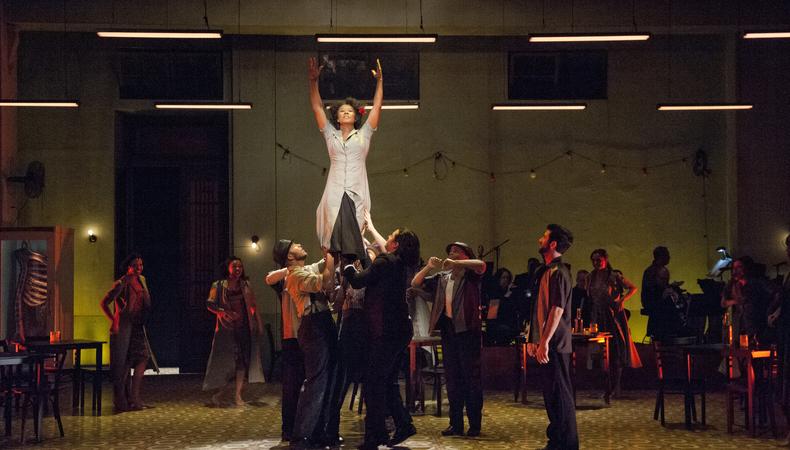
Since 1991, the Tectonic Theater Project has been known for its original works blending artistic innovation with socio-political themes onstage. Their “Laramie Project” has been performed worldwide and was made into an HBO movie. Another work, “I Am My Own Wife,” won the 2004 Tony Award for Best Play.
The collective prides itself on creating these works collaboratively, where director, actor, designers, and playwright get an equal say in how the work is made. How did they do it? Now readers can find out. Tectonic founder Moisés Kaufman and actor Barbara Pitts McAdams have co-written a book that’s currently on the shelves: “Moment Work: Tectonic Theatre Project’s Process of Devising Theater.”
Below, Kaufman and Pitts McAdams define for Backstage readers the company’s revolutionary, multidisciplinary technique.
How did the book come about?
Moisés Kaufman: We’ve been teaching Moment Work as a process for the better part of 15 years. As we’ve been teaching it, devising is becoming a real movement now in the theater. Most universities now around the country has a devising arm or a devising class.
The traditional method of a playwright writing a play and giving it to a director is one of the ways in which theater is made, but obviously it’s not the only way that theater is made. So I think there’s a hunger out there—young students see themselves more and more as theater makers, instead of just actors, just playwrights, or just directors. This very rigid classification is being blurred.
Barbara Pitts McAdams: And they always ask us, where can I read more about [Moment Work]? And we have to push them to someone’s PhD thesis because we didn’t have a book. So now we have it in our own words.
How did you discover and codify Moment Work?
Kaufman: It was very organic. The original impetus of the Tectonic Theatre Project was to create work that explores theatrical languages and theatrical performance, and to create works that address the human social and political ideas of the day. The company started out of a discontent with realism and naturalism—we were tired of seeing sofas onstage, and so we wanted to see what are the other ways that theater could communicate that was immediate.
So that led us to develop these processes to develop the work. Slowly the processes codified amongst us, and we started teaching it. And when you start teaching something you continue to codify and continue to articulate. And I think that writing the book has been the last part of that process.
Why was it important for playwrights, actors, and designers to all have a hand in creating a play?
Pitts McAdams: As an actor, you’re so rarely involved in the formal questions. Normally you show up and they say, “Here’s the rendering of what the set will look like and here’s what your costume is going to look like.” And then you rehearse for three weeks, and maybe you’re flailing your arms above your head a lot, but then you get your costume on and you can’t lift your arm over your head. There’s always this sort of “us and them” feeling when you get into the final stages of work.
For me it was such a game changer to be creating it as we go along. In “The Laramie Project,” we had our costume designer constantly bringing in pieces that we might use, because we were figuring out what was the form of the play. As we were discovering content, we were discovering the form. For someone who had very traditional actor training, to be asked to be a structural unit onstage was a real game changer and revelation to me.
READ: 6 Books Every Actor Should Have on the Shelf
What’s a misperception that people have about devised theater?
Kaufman: There is a misconception that all of the decisions are made collaboratively. In Tectonic, everybody works collaboratively, but depending on who originated the project, you have one leader, one person who makes the final decision. So there’s many forms of collaboration and many ways to collaborate, and I think the book addresses that as well.
Pitts McAdams: Our aesthetic is very interested in a well-told story, and making sure the narrative is clear. [In this book], because we track what our aesthetic is, so it doesn’t seem to the reader like it’s a potpourri free for all. I get annoyed when I see devised theater that seems like, “Oh, it’s devised so it’s sloppy.” That’s certainly not our aesthetic.
What advice would you give to actors beginning to devise work?
Kaufman: Buy the book. [Chuckles] I think if people are interested in devising, they should pick up the book and go into a rehearsal room and start making moments. I think that’s the only way you learn, is by doing.
Pitts McAdams: If you’re going to devise a piece, it’s helpful if it’s a subject or an idea that you just can’t stop thinking about, that you feel really drawn to. Because you’re going to spend a lot of time on it, there’s going to be a lot of frustrations as you go along, a lot of false starts. If you keep returning to something you’re passionate about, you’re forced to move forward.
And the other advice I would give is there’s nothing like a deadline. If you have scheduled deadlines for yourself, you’ll force yourself to move it along further and faster. There’s something to be said for the idea of exquisite pressure, when you’ve got enough pressure that it forces you to make creative decisions.
Kaufman: One of the things that the devising movement is proposing is everybody in the room think of themselves as theater artists, not classifying their work as one thing. It’s about everybody getting into the room and finding theatrical ways of telling a story.
Inspired? Check out Backstage’s theater audition listings!