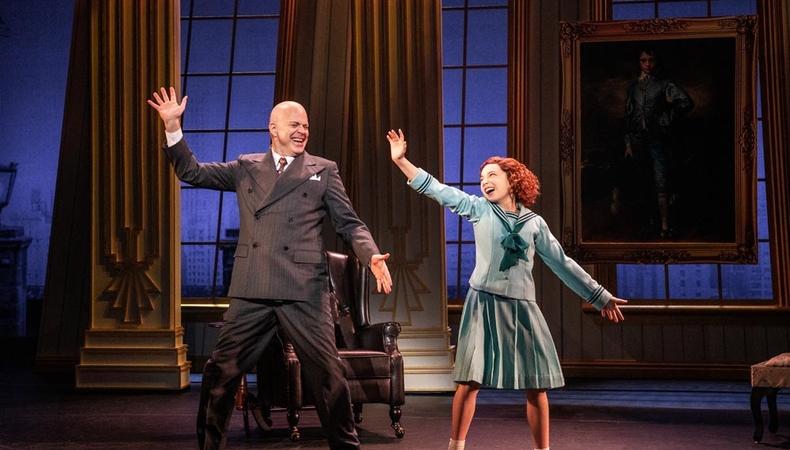
Whether it’s a searing murder confession in “Chicago” or an adoption speech leaving nary a dry eye in the house in “Annie,” some of the best monologue opportunities come from musicals. If you’re a triple threat looking to land a role that lets you act, sing, and dance, then musical theater monologues are a great choice. Here’s how to choose a monologue from a musical, what makes a good selection, and a look at some of the top options.
JUMP TO
 lev radin/Shutterstock
Monologues function differently in musicals than they do in traditional stageplays. The old adage goes: If you can’t say it, sing it; and if you can’t sing it, dance it. As such, most of the moments with the highest emotional impact in a musical are moments of song. However, there are a number of (mostly short) monologues from musicals that can be fantastic audition material, particularly when accompanied by a song, or when you find yourself auditioning for a musical.
Finding a solid monologue from a musical requires examining how the monologue functions in relation to the songs. Does it stand on its own, or does it simply set up the next musical number? You want to make sure that you’re choosing a speech that doesn’t require singing to reach its emotional conclusion—unless you also plan to perform the song.
 lev radin/Shutterstock
1. “Chicago” by John Kander, Fred Ebb, and Bob Fosse: The merry murderesses
“Chicago” tells the story of Roxie Hart and Velma Kelly, two “merry murderesses” on death row. It is jazzy and sassy, featuring a host of dynamic characters, and it is not sung through, which means there are a number of fantastic monologues to choose from.
The first example happens in the middle of the musical number “Cell Block Tango,” wherein the women tell the stories of how and why they committed murder. Velma tells her story in the following speech:
VELMA
My sister Veronica and I had this double act, and my husband, Charlie traveled around with us. Now, for the last number in our act, we did these 20 acrobatic tricks in a row—one, two, three, four, five—splits, spread-eagles, flip-flops, back-flips, one right after the other. Well this one night we were in Cicero, the three of us, sittin’ up in a hotel room, boozin’ and havin’ a few laughs and we ran out of ice, so I went out to get some. I come back, open the door and there’s Veronica and Charlie doing Number 17—the spread-eagle. Well, I was in such a state of shock, I completely blacked out. I can’t remember a thing. It wasn’t until later, when I was washing the blood off my hands I even knew they were dead.
The next example from “Chicago” is a speech that Roxie gives right before she sings. It is an excellent piece to pair with a performance of the song “Roxie.”
ROXIE
You wanna know something? I always wanted my name in the paper. Before Amos, I used to date this well-to-do, ugly bootlegger. He used to like to dress me up, take me out and show me off. Ugly guys like to do that. Once it said in the paper, “Gangland’s Al Capelli seen at Chez Vito with cute redheaded chorine.” That was me. I clipped it out and saved it.
Now look, “ROXIE ROCKS CHICAGO.” Look, I’m gonna tell you the truth. Not that the truth really matters, but I’m gonna tell you anyway. The thing is, see I’m older than I ever intended to be. All my life I wanted to be a dancer in vaudeville. Oh, yeah. Have my own act. But, no. No. No. No. No. No. It was one big world full of “No.” Life. Then Amos came along. Sweet, safe Amos, who never says no. You know some guys are like mirrors, and when I catch myself in Amos’ face I’m always a kid. Ya could love a guy like that. Look now, I gotta tell ya, and I hope this ain’t too crude. In the bed department, Amos was… zero. I mean, when we went to bed, he made love to me like he was fixin’ a carburetor or somethin’. “I love ya, honey. I love ya.” Anyway, to make a long story short, I started foolin’ around. Then I started screwin’ around, which is foolin’ around without dinner. I gave up the vaudeville idea, because after all those years… well, you sort of figure opportunity just passed you by. Oh, but it ain’t. Oh no, no, no, but it ain’t. If this Flynn guy gets me off, and with all this publicity, I could still get into vaudeville. I could still have my own act. Now, I got me a world full of “Yes.”
2. “You’re a Good Man, Charlie Brown” by Clark Gesner: Sally’s “C,” and Snoopy and the Red Baron
“You’re a Good Man, Charlie Brown” is a musical based on the beloved Charles Schulz “Peanuts” cartoons about Charlie Brown, Sally, Lucy, Linus, and, of course, Snoopy. It’s full of fun songs and monologues, and much of the material can stand on its own.
In this monologue, Sally expresses her distaste at having received a C on an art project. It’s a perfect comedic monologue for a young performer.
SALLY
A “C”? A “C”? I got a “C” on my coat hanger sculpture? How could anyone get a “C” in coat hanger sculpture? May I ask a question? Was I judged on the piece of sculpture itself? If so, is it not true that time alone can judge a work of art? Or was I judged on my talent? If so, is it right that I be judged on a part of my life over which I have no control? If I was judged on my effort, then I was judged unfairly, for I tried as hard as I could! Was I judged on what I had learned about this project? If so, then were not you, my teacher, also being judged on your ability to transmit your knowledge to me? Are you willing to share my “C”? Perhaps I was being judged on the quality of the coat hanger itself out of which my creation was made… Now is this not also unfair? Am I to be judged by the quality of coat hangers that are used by the dry-cleaning establishment that returns our garments? Is that not the responsibility of my parents? Should they not share my “C”? Thank you, Miss Othmar. The squeaky wheel gets the grease!
In another fantastic standalone monologue, Snoopy talks about his pursuit of the Red Baron.
SNOOPY
Here’s the World War I flying ace high over France in his Sopwith Camel, searching for the infamous Red Baron! I must bring him down! Suddenly, anti-aircraft fire, “archie” we used to call it, begins to burst beneath my plane. The Red Baron has spotted me. Nyahh, Nyahh, Nyahh! You can't hit me! Actually, tough flying aces never say “Nyahh, Nyahh.” I just, ah… Drat this fog! It’s bad enough to have to fight the Red Baron without having to fly in weather like this. All right, Red Baron! Where are you? You can’t hide forever! Ah, the sun has broken through… I can see the woods of Montsec below… and what’s that? It’s a Fokker triplane! Ha! I’ve got you this time, Red Baron! Aaugh! He’s diving down out of the sun! He’s tricked me again! I’ve got to run! Come on, Sopwith Camel, let’s go! Go, Camel, go! I can’t shake him! He’s riddling my plane with bullets! Curse you, Red Baron! Curse you and your kind! Curse the evil that causes all this unhappiness! Here’s the World War I flying ace back at the aerodrome in France, he is exhausted and yet he does not sleep, for one thought continues to burn in his mind… Someday, someday I’ll get you, Red Baron!
3. “Annie” by Thomas Meehan, Martin Charnin, and Charles Strouse: Daddy Warbucks’ adoption speech
“Annie” tells the story of a beloved orphan and the billionaire who adopts her. This heartwarming classic has a number of monologues to choose from and, because it also isn’t sung-through, there are plenty of important emotional moments that happen in speech.
In this monologue, Oliver Warbucks tries to express to Annie that he loves her and wants to adopt her. It’s sweet and stilted, and offers an actor ample opportunity to play opposing emotions: a stoic man who has softened completely where this child is concerned.
OLIVER WARBUCKS
I was born into a very poor family in what they call Hell’s Kitchen, right here in New York. Both of my parents died before I was ten. And I made a promise to myself—some day, one way or another, I was going to be rich. Very rich.
By the time I was twenty-three I’d made my first million. Then, in ten years, I turned that into a hundred million. (Nostalgically.) Boy, in those days that was a lot of money. (Back to business.) Anyway, making money is all I’ve ever given a damn about. And I might as well tell you, Annie, I was ruthless to those I had to climb over to get to the top.
Because I’ve always believed one thing: You don’t have to be nice to the people you meet on the way up if you’re not coming back down again. (Softening just a bit.) But, I’ve lately realized something. No matter how many Rembrandts or Duessenbergs you’ve got, if you have no one to share your life with, if you’re alone, then you might as well be broke and back in Hell’s Kitchen. You understand what I’m trying to say?
4. “Fiddler on the Roof” by Jerry Bock, Sheldon Harnick, and Joseph Stein: The matchmaker monologue
Adapted from the tale “Tevye and His Daughters” by Sholem Aleichem, “Fiddler on the Roof” tells the story of Tevye, a milkman who is doing his best to maintain his Jewish traditions as the outside world encroaches on him and his family.
In this monologue, the village matchmaker comes to tell Golde, Tevye’s wife, that she has a match for one of their daughters.
YENTE
Golde, darling, I had to see you because I have such news for you. And not just every-day-of-the-week news, once-in-a-lifetime news. And where are your daughters? Outside, no? Good, such diamonds, such jewels. You’ll see, Golde, I’ll find every one of them a husband. But you shouldn’t be so picky… Even the worst husband, God forbid, is better than no husband, God forbid… And who should know better than me? Ever since my husband died, I’ve been a poor widow, alone, nobody to talk to, nothing to say to anyone. It’s no life. All I do at night is think of him, and even thinking of him gives me no pleasure because, you know as well as I, he was not much of a person…
Never made a living, everything he touched turned to mud, but better than nothing.
Ah, children, children! They are your blessing in your old age. But my Aaron couldn’t give me children. Believe me, he was good as gold, never raised his voice to me, but otherwise he was not much of a man, so what good is it if he never raised his voice? But what’s the use complaining, other women enjoy complaining, but not Yente. Not every woman in the world is a Yente. Well, I must prepare my poor Sabbath table, so goodbye, Golde, and it was a pleasure talking our hearts out to each other.
 How to Choose a One-Minute Monologue for Your Next Audition
 5. “Fun Home” by Lisa Kron and Jeanine Tesori: Alison reads her father’s letter
Adapted from the graphic memoir of the same name, “Fun Home” depicts Alison Bechdel’s childhood growing up in a funeral home, contending with her father’s homosexuality and suicide, and reckoning with her own coming out. This gorgeous musical won the Tony Award for Best Musical.
In this speech, Alison reacts to a letter from her father, which is a delayed reaction to her own coming out letter.
ALISON
“Dear Al, big week at Fun Home. Couple of kids from Lock Haven wrapped their car around a tree and I ended up working two eighteen-hour shifts. Bad for my blood pressure. Anyway, that’s why I’ve been out of touch for a bit. Oh, by the way, we got your letter. Well, kid, talk about a flair for the dramatic. As far as I see it, the good news is you’re human.”
What does that mean? What else would I be?
“Your mother’s pretty upset—not surprising, I guess. But I’m of the opinion that everyone should experiment.”
Ew.
“I can’t say, though, that I see the point of putting a label on yourself. There have been a few times in my life when I thought about taking a stand, but I’m not a hero. Is that a cop-out? Maybe so. It’s hard sometimes to tell what is really worth it.”
The tone is what I can’t stand. It’s so typical. So all-knowing. He has to be the expert. Lots of wisdom and advice about things he doesn’t know anything about. I’m gay. Which means I’m not like him, and I’ve never been like him, and he can’t deal with that. He still wants to be the intellectual, broad-minded, liberal, bohemian but he can’t pull it off, because he can’t deal with me and you know what? He never could. He never could.
6. “The Fantasticks” by Tom Jones and Harvey Schmidt: What Luisa wants
This 1960 musical tells the allegorical tale of two neighboring fathers who want their children to fall in love. But they know better than to encourage them directly, so they trick them into falling for one another by pretending to be in a long-standing feud.
In this monologue, Luisa talks about what she wants out of her life. The monologue leads directly into the lovely song “Much More,” and would be fantastic to pair with it.
LUISA
This morning a bird woke me up.
It was a lark, or a peacock,
Or something like that.
Some strange sort of bird that I’d never heard.
And I said “hello”
And it vanished: flew away.
The very moment I said “hello.”
It was quite mysterious.
So do you know what I did?
I went over to my mirror
And brushed my hair two hundred times without stopping.
And as I was brushing it,
My hair turned gold!
No, honestly! Gold!
And then red.
And then sort of a deep blue when the sun hit it.
I’m sixteen years old,
And every day something happens to me.
I don’t know what to make of it.
When I get up in the morning to get dressed,
I can tell:
Something’s different.
I like to touch my eyelids
Because they’re never quite the same.
Oh! Oh! Oh!
I hug myself till my arms turn blue,
Then I close my eyes and I cry and cry
Till the tears come down
And I can taste them. Ah!
I love to taste my tears!
I am special.
I am special.
Please, God, please—
Don’t let me be normal!
7. “A Chorus Line” by James Kirkwood Jr., Nicholas Dante, Marvin Hamlisch, and Edward Kleban: Dancer-life stories
This classic Broadway musical takes place during a cattle call dance audition where hundreds of hopeful dancers gather to land a role in the chorus. Some of them share their life stories, as in the following monologues.
“A Chorus Line” offers some of the best musical monologues around because each of the characters are so different. Drama and comedy is covered in this show.
The first example is a wonderful comedic monologue given by Val that leads into the song “Dance 10, Looks 3.”
VAL
So, the day after I turned 18, I kissed the folks goodbye—got on a Trailways bus—and headed for the big bad apple. ’Cause I wanted to be a Rockette. Oh, yeah, let’s get one thing straight. See, I never heard about “The Red Shoes,” I never saw “The Red Shoes,” I didn’t give a fuck about “The Red Shoes.” I decided to be a Rockette because this girl in my hometown—Louella Heiner—had actually gotten out and made it to New York. And she was a Rockette. Well, she came home one Christmas to visit, and they gave her a parade. A goddamn parade. I twirled a friggin’ baton for two hours in the rain. Unfortunately though, she got knocked up over Christmas—Merry Christmas—and never made it back to Radio City.
That was my plan. New York, New York, here I come. Except I had one minor problem. See, I was ugly as sin! I was ugly, skinny, homely, unattractive and flat as a pancake. Get the picture? Anyway, I got off this bus in my little white shoes, my little white tights, my little white dress, my little ugly face, and my long blonde hair—which was natural then. I looked like a fuckin’ nurse! I had eighty-seven dollars in my pocket and seven years of tap and acrobatics. I could do a hundred and eighty degree split and come up tapping the Morse Code. Well, with that kind of talent I figured the mayor would be waiting for me at Port Authority. Wrong! I had to wait six months for an audition. Well, finally the big day came. I showed up at the Music Hall with my red patent leather tap shoes. And I did my little tap routine.
And this man said to me: “Can you do fankicks?” Well, sure I could do terrific fankicks. But they weren’t good enough. Of course, what he was trying to tell me was… it was the way I looked, not the fankicks. So I said: “Fuck you, Radio City and the Rockettes, I’m gonna dance on Broadway.”
Well, Broadway—same story. Every audition. I mean I’d dance rings around girls and find myself in the alley with the other rejects. But, after a while I caught on. I mean, I had eyes… I saw what they were hiring. I also swiped my dance card once—after an audition. And on a scale of ten… They gave me: For dance: ten. For looks: three.
The next example from “A Chorus Line” is a dramatic monologue from Paul, a young gay man who talks about his parents coming to see him dance.
PAUL
One day I looked at myself in the mirror and said, “You’re fourteen years old and you’re gay. What are you going to do with your life?” By that time I was in Cardinal Hayes High School. There were three thousand boys there. I had no protection any more. No homeroom where I could be charming and funny with the tough guys so they’d fight my battles for me. Like when I went to small schools. I liked school. But my grades got so bad. Even if I knew the answers to questions, I wouldn’t raise my hand because I would be afraid they would laugh at me. They’d even whistle at me in the halls. It was awful… just awful. Finally, I went down to the Principal’s office and said : “I’m a homosexual.”
Well, it was a Catholic high school at around nineteen sixty-two and at the age of fifteen you just didn’t say that. He said: “Would you like to see a psychologist?” And I did. And he said: “I think you’re very well-adjusted for your age and I think you should quit school.” So, I did. But I didn’t really want to. I couldn’t take it anymore.
See, when I quit school, what I was doing was trying to find out who I was and how to be a man. You know, there are a lot of people in this world who don’t know how to be men. And since then, I found out that I am one. I was looking for the wrong thing. I was trying to learn how to be butch.
[...]
We were working the Apollo Theater on a Hundred and Twenty-Fifth Street. Doing four shows a day with a movie. It was really tacky. The show was going to go to Chicago. My parents wanted to say goodbye and they were going to bring my luggage to the theater after the show. Well, we were doing this oriental number and I looked like Anna May Wong. I had these two great big chrysanthemums on either side my head and a huge headdress with gold balls hanging all over it. I was going on for the finale and going down the stairs and who should I see standing by the stage door… my parents. They got there too early. I freaked. I didn’t know what to do. I thought to myself : I know, I’ll just walk quickly past them like all the others and they’ll never recognize me. So I took a deep breath and started down the stairs and just as I passed my mother I heard her say: Oh, my God. Well… I died. But what could I do? I had to go on for the finale so I just kept going. After the show I went back to my dressing room and after I’d finished dressing and taking my makeup off, I went back down stairs. And there they were standing in the middle of all these… And all they said to me was please write, make sure you eat and take care of yourself. And just before my parents left, my father turned to the producer and said: Take care of my son… That was the first time he ever called me that.
 aerogondo2/Shutterstock
- Pair your monologue appropriately with the role you want. This means, if you’re auditioning for a comedy, choose a comedic monologue; for a tragedy, choose a tragic monologue.
- Consider the composer. If you’re auditioning for a Stephen Sondheim musical, for example, take a look at the rest of his oeuvre for other possible audition material.
- Tell a story. Because so much of what is spoken in musicals acts as connective tissue between songs, make sure that you’re choosing a piece that goes somewhere narratively.
- Pair your monologue with your audition song. Chances are that if you’re choosing a monologue from a musical, you’re auditioning for a musical and, thus, will need to sing as well. Choose material that goes together. You may even want to perform a monologue that leads directly into one of your songs.