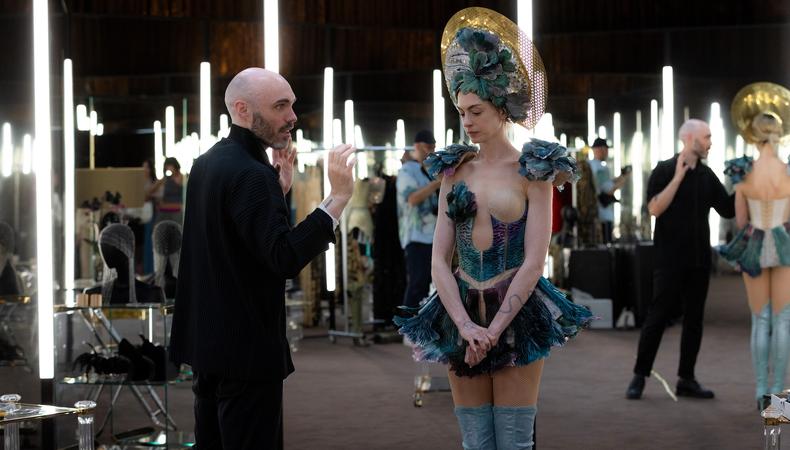
David Lowery is always thinking about his next film, even when he’s still shooting his current one.
During production on 2021’s “The Green Knight,” Lowery already had plenty on his plate with the Dev Patel–led dark fantasy adventure. But his creative gears never stopped turning, and he was suddenly captivated by the idea of “Mother Mary.”
“I really wanted to make a movie with two actors in a room, about a pop star, and focused on performance above all other aspects of filmmaking,” the 45-year-old filmmaker explains. “I started writing this on the set of ‘The Green Knight,’ and I was in a reflective period about where I was as a filmmaker and where I was headed.”
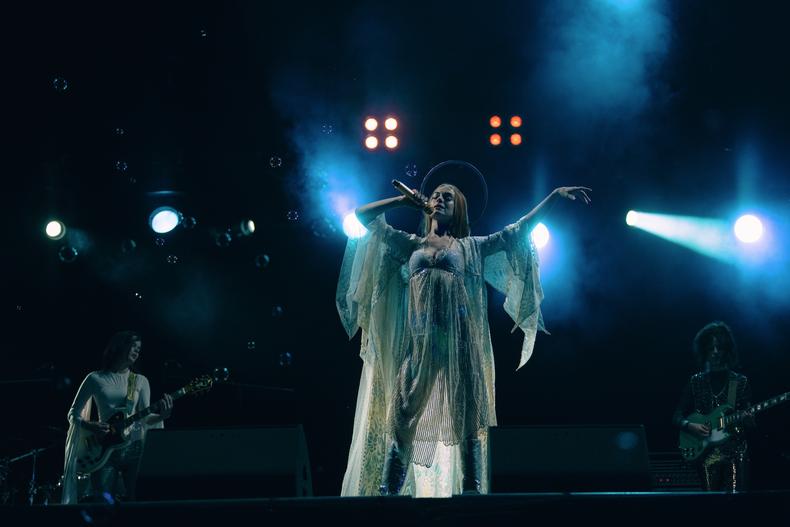
Inspired by Taylor Swift’s Reputation Tour and the 2018 Alexander McQueen documentary, “McQueen,” Lowery created “Mother Mary,” a psychological drama that acts as both a love and ghost story. Anne Hathaway stars as Mother Mary, a pop icon who desperately seeks the help of her former friend and costume designer, Sam (Michaela Coel).
With the new A24 film now in theaters, we spoke to Lowery about needing Hathaway’s star power and wanting advice from younger creatives.
You’re consistently unpredictable in terms of what type of movie you are doing next. How do you decide what you want to dedicate your time to?
There’s never any calculation. I’m an impatient multitasker, so I usually have a lot of things simmering in the background when I’m making any given movie. These things are all kind of overlapping, so I never have a moment to just stop and think, What am I gonna do next? There’s always something. But every movie I make is autobiographical to a large degree, regardless of its scale, and it has to feel like it’s the right thing for me, at the right time.
One of the benefits of having multiple things in the works is that I can have a script that I might think is ready to go, but then I decide that it could use more time in the oven, and I can turn to something else. Years later, I usually realize why I made that decision. And that leads me down paths that feel very unpredictable. From the inside, it feels like every movie leads directly from one to the next, and I can look at “Peter Pan & Wendy” and very clearly chart the connection to “Mother Mary.” But that’s for me, and I know audiences will be like, “How did this come out of that? That makes zero sense.” [Laughs.]
What was your approach to casting “Mother Mary”?
I never want to put star power first, but, in this case, we were making a movie about celebrity, and it felt necessary to acknowledge that in the casting process. I was thinking about people who have been in the public eye for the better part of my life, and I saw my first Anne Hathaway movie in high school, and she’s been a star ever since. When making “The Old Man & the Gun,” I realized that we could either run away from who Robert Redford was or lean into it. Sometimes it’s appropriate to go the other direction, but it is equally valid to lean into who they are and to take the impression that the public already has of them and use it to the movie’s benefit.
How crucial were festivals for you at the beginning of your career?
Film festivals are why I’m here now. My first feature, “St. Nick,” premiered at South by Southwest, thanks to [Director Emeritus] Janet Pierson, who plucked it out of the pile. I made that movie for $12,000, and it’s a far cry from the “Star Wars” movies that I imagined myself making when I was 7, but I felt, if I can make movies like this, and go to film festivals and show them, I will be content as a filmmaker. And that gave me confidence in the experience of making things that were personal to me and sharing that part of me with an audience.
And then going to festivals and meeting filmmakers who I admired and became my peers, like Ti West. We got our start at the same time and have been able to grow as filmmakers together. You can build a network of like-minded filmmakers, whether it’s batting ideas around or collaborating on each other’s movies. I was just talking to someone who I met at the Sidewalk Film Festival in Birmingham, Alabama, in 2007, and we both think about that weekend as one of the formative experiences in our filmmaking lives. It was so special to go to this little corner of America that we’d never been to before and find an audience that wanted to connect with our movies.
Did it feel like your festival relationship came full circle when you got to direct Sundance founder Robert Redford in “The Old Man & the Gun”?
At 13 years old, when my mom told me about the Sundance Film Festival and Robert Redford, I made a very conscious choice that I wanted to make independent films. His mission with the Sundance Institute sounded pretty good to me. So I religiously submitted films to the festival, I applied to the labs, and eventually made it through. And to actually get to meet and sit with him, but to then direct him, it really felt like there was some sort of magic in the universe.
What advice would you share with young filmmakers?
For years, my piece of advice was simply don’t quit—and that still holds true. But the world is changing in such crazy and drastic ways, and I sometimes feel left behind by the way in which the language of film is evolving. I’ll watch things on YouTube that feel like movies that I can’t make because this is a voice of a generation that I’m not a part of. And so I’m sitting here in awe, watching a future generation develop a language that is separate from mine. And so I want to ask them for advice. What am I missing out on? What have I not seen that could help me broaden my perspectives as a filmmaker? And maybe that’s the piece of advice, that the conversations always need to be considered a two-way street.
This interview has been edited for clarity and length.