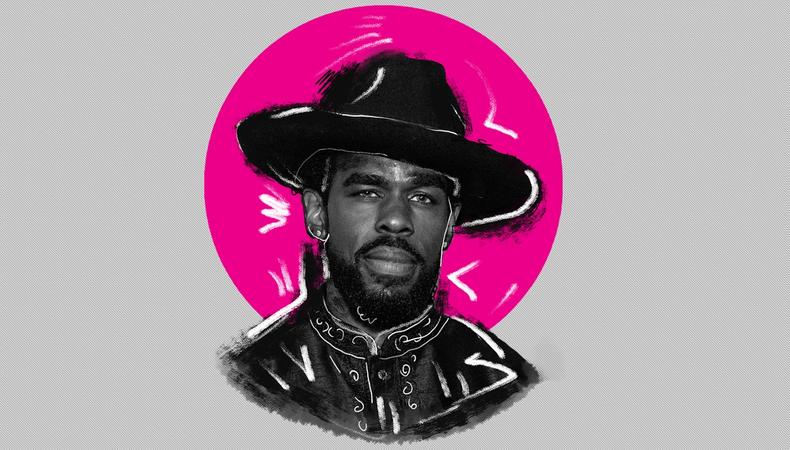
Mustafa Shakir’s summer is bookended by roles on Netflix’s “Luke Cage” and HBO’s “The Deuce.” On the former, Shakir plays the season’s villain, crime boss John “Bushmaster” McIver, his first role in a comics-inspired series after auditioning for Season 1, the CW’s “Black Lightning,” and “Black Panther.” Ahead of reprising his role as Big Mike on Season 2 of “The Deuce,” Shakir discusses how he needed to “chill” early in his career.
How do you typically prepare for an audition?
You want to be as tall as possible. It’s a strange situation to go into a small room with someone you may or may not know and pour your heart out. Take a few minutes to meditate. You have to know what your character is saying. Scour the text and really digest that. I don’t like to over-rehearse or practice. Once I get the lines down, it’s about speed—how fast I can do it, how accurately I can do it—so when I’m in the space, no matter what energy is thrown at me, I can adjust how I do my thing. It’s about knowing what you’re going to say and getting in the room and allowing the moment to dictate how you say it.
I know you were a barber. What were some of your other most memorable survival jobs?
Most notably, I was a private trainer for many years. I also bartended [and] I did catering. I worked marketing [and]advertising for Converse, Timberland, Eastpak. I did clerical work a bit. I sold Coach bags, [and] I sold women’s shoes. That gives you a wealth of experience to pull from. In retrospect, I’m really grateful that I’ve had as many experiences as I’ve had. It gives me an ability to improvise with a wide range of situations and circumstances. In barbering, I was dealing with up to 18 people a day, with 18 different personalities…so you learn how to adjust your energy to different circumstances.
Have you used Backstage in the past?
In the very beginning, Backstage was my homie. [Laughs] It was all about getting the new Backstage as fast as you can so you could find those auditions, circle them off, and prepare yourself for them. That’s the dues-paying. You remember those days—or you should.
What advice would you give your younger self?
Chill. Do the work and relax. This business is very difficult because there aren’t a lot of footholds to step into, or guarantees. Everything is on you. It may be justified to be concerned about where you’re headed in your career, but ultimately, what I understand is you can relax in those situations. The building could be burning down, but you don’t have to go crazy. You can calmly walk down the steps. It’s the choice of how to react. For me, there were a lot of variables that I had to contend with as an artist. I would’ve preferred to go at it a little more relaxed. Not that I was crazy, but a little more chill.
Are there any similarities for you in how you approach roles in period pieces, like “The Deuce,” and comedic shows?
Believe in your characters and believe in what they want, and really get inside their headspace and see what their desires are. Once you do that, you pretty much tell the story. What are we if we are not the things that we want? Of course we’re more than that, but that determines the story of our lives.
Even when the desires are a little far-fetched, it’s still rooted in human emotion.
Exactly. It’s like, am I upset right now? What’s really going on right now? And paring it down to the rawest essence of what the character is feeling.
What have your latest roles on “The Deuce” and “Luke Cage” added to your acting skills?
I enjoy watching James Franco work. He’s a really smart dude. He’s always trying to find another idea, how to saturate the scene. That’s cool, because it always keeps you reaching and trying to create moments—and that’s what people watch shows for. They watch it for those moments where they can see their own humanity displayed in the subject. That’s the beauty of this art; it’s such a collaborative effort between all of the people, and it’s wonderful to celebrate when things go together really well.
How do you separate yourself from the bigger picture of the story and set?
It’s a practice of mine, what I call “dropping out.” Dropping out is essentially being in the moment. You get fever pitched with this thought and that thought and what that means. And I don’t know about you, but I catch myself sometimes and I’m like, Oh, my God, this is overwhelming. So I choose not to think about it. I do what’s in front of me. The acting is not acting, just be present for what it is. It’s wonderful when you’re able to allow yourself to be.
You had a number of auditions for comic book characters. How do those differ from other auditions?
These days, not much, because, especially in “Luke Cage,” the way they approached the characters was in a very grounded way. It was as much showing the humanity of the character as it was playing up the super ability. The super ability is icing. This is a normal person—but oh, my God, did he just jump over a building? The auditions are pretty much the same. You go in and create a character and see if they like it.
Ready to get to work? Check out Backstage’s TV audition listings!