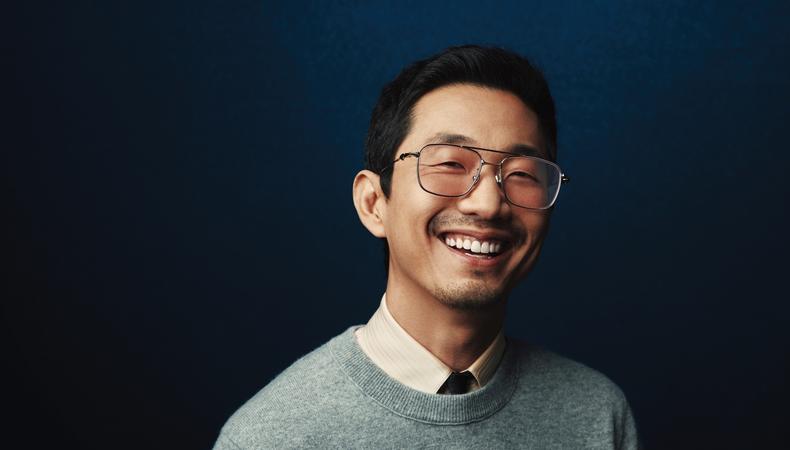
Lee Sung Jin uses lots of metaphors in conversation. Actors are trees in a garden. And seasons of “Beef,” his acclaimed Netflix anthology series—why, those are rock albums. The creator, writer, director, executive producer, and showrunner could have copy-pasted the first season’s road rage storyline for the follow-up. Bands play it safe on their sophomore records all the time. But why do that when you can be Thom Yorke?
“You see a band like Radiohead—every single album just taking huge swings. That helps me remind myself, we’re not doing this just for commercial or critical reception,” he says. “This is to challenge ourselves to do deeper, almost Jungian shadow work, and always be pushing boundaries and trying different things.”
The second season of “Beef” follows an escalating feud between two social-climbing couples. Country club manager Josh (Oscar Isaac) and interior designer Lindsay (Carey Mulligan) turn to embezzlement to maintain their privileged lives. Meanwhile, Josh’s employee Ashley (Cailee Spaeny) and her himbo partner, Austin (Charles Melton), are desperate to escape their own financial constraints. The four exploit each other to disastrous ends to try to get ahead.
This year “Beef” racked up 16 Emmy nominations, including writing and directing nods for Lee. He won both categories for the first season, along with outstanding limited or anthology series. Ahead of Emmys night, Lee chatted with Backstage about collaboration, chord progressions, and connection.
How did the characters in “Beef,” Season 2, take shape, from getting them on the page to developing them with the actors?
There’s a bigger writers’ room and a smaller room. In the bigger room, we’re just collecting people’s stories. There’s nothing better than real-life incidents that the universe provides, because they’re more ingenious than what we could come up with as writers. We spend a lot of time getting really vulnerable and sharing.
We’ll go days without writing, and then someone will share something that fits into the themes of what we’re talking about. Suddenly, an index card appears on the board. Once we whittle it down to a smaller room, that’s when we start doing what I like to call the story math—kind of the narrative chord progressions. It’s a lot like songwriting.
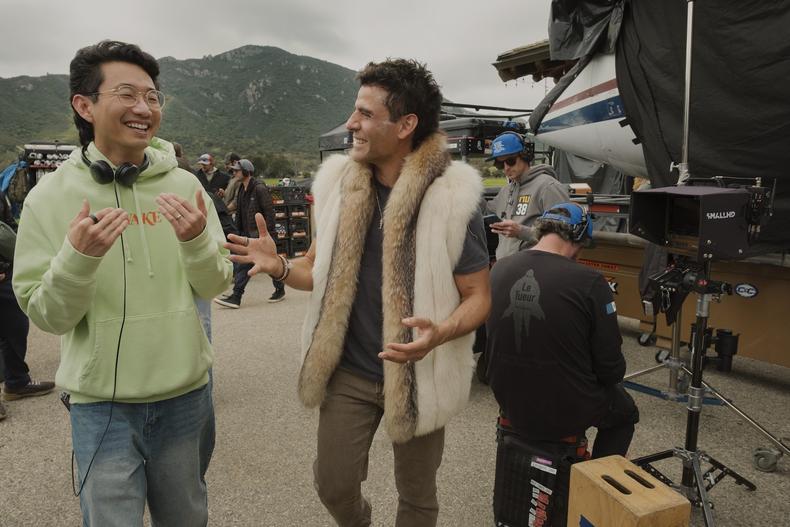
Lee Sung Jin and Oscar Isaac behind the scenes of “Beef.” Credit: Andrew Cooper/Netflix
I like to attach our leads very early in the process, because the collaboration is so important. I’ll present the narrative chord progressions, and then the actors will have their own ideas and personal experiences. We start riffing, and what felt like a Top 40 chord progression suddenly has these interesting suspended chords and dissonant chords, because of all the hours of conversation the actors and I have.
It’s this ebbing and flowing between the rigidity of the technical writing and the openness and fluidity of trusting your actors and their instincts. They embody these characters in a much more three-dimensional way than my mind could. It’s a really great way to produce this alchemy that you wouldn’t have been able to think of on your own.
RELATED: How to Get Cast on Netflix's 'Beef'
Congratulations on your Emmy nomination for directing the season’s fourth episode, “Oh, the Comfort, the Inexpressible Comfort.” That episode feels so suffocating, with Austin and Ashley stuck in a hospital waiting room. How did you work with the actors on the tone?
We were on location at this abandoned hospital [in downtown Los Angeles] for the whole way, which we very rarely get to do. It allowed us to really go for things. Whenever you’re in one location, it just suddenly buys you a little bit more time. Classic example: Charles [as Austin] when he’s on the phone with Eunice [played by Seoyeon Jang].
When he is talking about Ashley and says, “I don’t think I even know her anymore,” that wasn’t scripted as an emotional moment. It was just supposed to be him skeptical and starting to wonder whether his fiancé is the boy who cried wolf. Charles, surprisingly, maybe three or four takes in, started to cry as he said that line.
After the take, he came to the monitor and was like, “I don’t know what’s going on. I’m so emotional right now, and I’m sorry. Should I stop this?” I was like, “Dude, no, just stay in it. I don’t know why that’s happening, but that’s great.”
We went again, and I think that the take after his big cry was the one that you saw. What I love about it is, even though it wasn’t scripted that way, it really goes to show what an avoidant people pleaser his character is—the fact that this is the first time he’s ever admitted out loud that he’s questioning his relationship. Just that small act of defiance, his body can’t handle it, and he starts to get teary.
That’s not something I could have thought of on my own. I would never have expected someone’s body to react that way, but it makes so much sense.
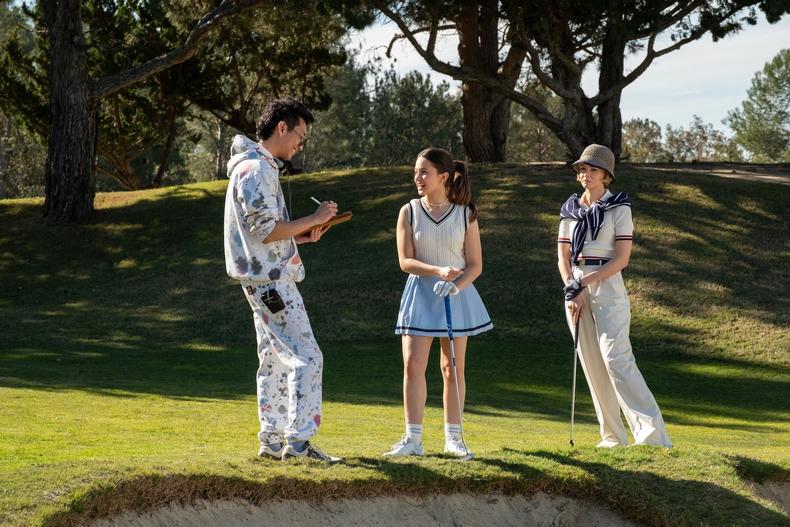
Lee Sung Jin, Cailee Spaeny and Carey Mulligan behind the scenes on “Beef.” Credit: Andrew Cooper/Netflix
What’s the best thing an actor can bring to set?
Something I find so valuable in our cast is everyone’s uncanny ability to be themselves at all times, even in roles that are so far from who they really are. Oscar, Carey, Charles, Cailee—they’re not like those characters, but they’re able to bring a sense of truth to every moment just by being themselves.
That’s that X factor, that gold that you can’t just find. Oftentimes, when things aren’t working, it’s usually either because the writing is trying to reach too hard or the acting is trying to reach too hard, or it’s both.
You cast actors of all career stages in the Season 2 ensemble, from newer faces to mid-career stars to veterans. How did that affect your experience filming?
It’s almost what the show’s about, in a weird way. Different generations are going through what seems very unique to them at the time. But, ultimately, all the seasons are going to come for everybody.
Because really, it’s all the same root, just with different branches. For myself, as the person curating and gardening this landscape, I can’t treat one tree the same way I would a delicate flower that’s just sprouting. You need to have a seasoned green thumb as the landscaper to be like, OK, this tree needs this amount of water, and the sun’s over there. That comes from loving your cast and crew and the show.
I can’t imagine a landscaper or gardener being upset at, why does this tree grow this way, or why can’t everything just be this one flower? No, it all makes this beautiful tapestry, and you love it, so you want to see everything grow and thrive.
This story originally appeared in the Aug. 17 issue of Backstage Magazine.