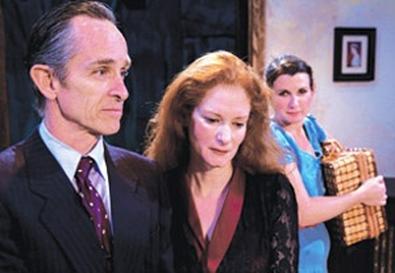
Tellingly, the strung-out characters talk more than they listen. As the play begins, 30-something Elisabeth Joubert (Katherine Tozer) bathes in a portable tub in the family home in France, fervently reciting a stream-of-consciousness diatribe; then she shamelessly stands to reveal her nude body, in the presence of her wimpy father, Henri (Bradley Fisher).
He’s a discontented factory worker, yearning for a more prestigious job in England, believing his French ancestry is looked down upon by British society. Henri’s strident alcoholic wife, Anne (Lisa Pelikan), enters and launches into a circuitous monologue, something to do with an erotic nightmare involving a strawberry-blond man. Among episodes that follow are a heated exchange between Elisabeth and her abusive black fiancé, Michael (William Christopher Stephens); the Jouberts’ peculiar social interactions with their bourgeois British companions, the Caton-Smiths (Christopher Shaw and Shannon Holt); Henri’s amusing philosophical discussions with his jovial employer (William Dennis Hunt); and an edgy climactic scene between Henri and Anne, leading to a startling resolution.
The actors keep the often-cryptic text interesting, suggesting the despair beneath the surface. Pelikan’s haunting portrayal brings to mind the suppressed anguish of morphine-addicted Mary Tyrone in Eugene O’Neill’s “Long Day’s Journey Into Night.” Tozer does a fine job of illuminating the emotional fragility behind Elisabeth’s obstinate demeanor. Hunt offers welcome comic relief as Henri’s sympathetic confidante. Holt and Shaw excel as the befuddled upper-crust guests. As the eccentric and somewhat ludicrous Henri, Fisher has his best moments in the powerful final scene. Stephens is formidable as an embittered laborer confronting racial profiling. Though the script needs trimming and clarification of its enigmatic indulgences, it’s a bold and thought-provoking piece that’s well-served by the ever-adventurous Rogue Machine.
Presented by Rogue Machine at Theatre/Theater, 5041 Pico Blvd., L.A. Oct. 8–Nov. 15. Thu.–Sat., 8 p.m.; Sun., 2 p.m. (323) 960-7774. www.roguemachinetheatre.com.