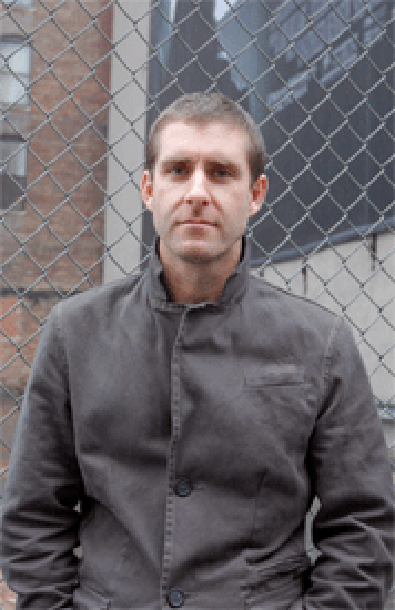
The Sundance Film Festival is a week and a half of exhilarating highs and dispiriting lows, dreams come true coupled with crippling exhaustion. Paul Fitzgerald is currently experiencing one of the highs, having just come from an early morning screening of Forgiven, the dramatic competition film he wrote, directed, and stars in. The Q&A session after the film morphed into something of a lively town-hall meeting, audience members engaging in spirited discussion about the movie's themes and story line. Taking a quick breather on the patio of Park City's Marriott Hotel, Fitzgerald can barely contain his excitement, words spilling out at a rapid pace. "It's cool," he says of the audience response. "It's exactly what I was hoping would happen with the movie."
Tall and movie-star handsome, Fitzgerald exudes the confidence and passion of someone who knows how to get things done-fitting, considering that his determination to make the film got the process rolling in the first place. His first step was simply articulating out loud the notion that he was going to direct and star in a movie he wrote. "As soon as I got the idea, I'd just tell people with this utter confidence, as if it was a given," he says. "So you say it, and then you look like an ass if you don't end up doing it. Once you start putting it out there, you kind of Catch-22 self-commit yourself."
Until now, Fitzgerald has been known primarily as an actor, performing on and off Broadway and appearing on such television shows as Will & Grace, The West Wing, and Law & Order: Special Victims Unit. He started writing screenplays several years ago, developing Forgiven beginning in 2002. The film focuses on Peter Miles (Fitzgerald), a small-town district attorney campaigning for the U.S. Senate. Death-row inmate Ronald Bradler (Russell Hornsby), whom Peter prosecuted for murder, is exonerated by the governor just as Peter launches his campaign. Things start to unravel for both men when Ronald uncovers evidence of impropriety on Peter's part, leading to a shocking, devastating chain of events.
Fitzgerald was initially inspired by a series of death-row exonerations that took place in Illinois in 2000. The cases led to scrutiny of the death penalty on a national level and got Fitzgerald thinking about the themes that would ultimately play a part in Forgiven: guilt, forgiveness, responsibility. "On a pedestrian level, it was inspired by learning about these stories and following [them] in the news," he says, noting that no one involved in these cases seemed interested in taking responsibility for what these former inmates had been through. "I was thinking, 'It sucks enough that this all happened, but the fact that you're out on your ass and no one's even saying [they're sorry]?' It helps the healing process when someone says they're sorry-it just does," Fitzgerald asserts. "That ultimately [raised] the parallel: How do you forgive-can you forgive-if someone doesn't even apologize? ... It just seemed very difficult to me. So that's kind of what got me revved up."
That said, Fitzgerald fleshed out each character's point of view-one of Forgiven's most compelling strengths is that it ultimately raises more questions than it answers. "I started the story writing more from Ronald's perspective, and in the early, early drafts, [there's] just page after page of Ronald monologues, and Peter just says 'What?' and 'No.' And you could literally see on the page, 'Oh, one of these characters is very articulate on his point of view, and the other one has no point of view,'" he says. "And then in the subsequent drafts, I was, like, 'Particularly if I'm going to play this character, he has to be real, he has to have a point of view that you understand that has some logic to it.' It started to even out-Ronald's stuff got cut down and Peter started to have an argument, he found his voice. That was difficult for me, because he's not a sympathetic character to me, but he became [one] by the end of it."
Viewers may not ultimately be clear on where the characters' allegiances lie--and that's a good thing. "If the audience watches it and feels like they keep getting shifted around and they don't know who to root for, that's great," says Fitzgerald.
On the Line
Around 1999, Fitzgerald dabbled with the idea of making one of his other screenplays into a film, but the timing wasn't right. "I just wasn't ready," he says. "Things were really good with me acting-wise, [and] I knew you had to kind of stop your life, so I just didn't [pursue it]. But it definitely instilled me with some confidence. I was, like, 'Oh, I can do this. People seem to believe it's real; it's a real script.'"
Several years later, Forgiven script in hand, he was ready to put everything else aside, lay all his chips on the table, and make a movie. "[I started] to realize, I just wanted more creative involvement than just being an actor," he says. "It's something I intuitively knew a long time ago; it was going to happen eventually, I just didn't know when it was going to take shape. You basically get bored with doing the same scope of roles‌. That sort of intersected with an emerging political consciousness in the very tumultuous time in the last five or six years in the world. And then things going on with me personally sort of coincided [with that] to force the issue: Now's the time to do it. Also, I had started to feel like I was lazy and not really taking any risks in life. You go through the routine of, I do a play, a pilot, a guest role-repeat. Just do it again. It was, like, '[Time to] take a chance and put a little something on the line.'"
Fitzgerald took the script to Sally Ware, his agent at the Gersh Agency in New York, who read and loved it. The agency is, he says, "so supportive of this sort of thing." Additionally, Gersh had just had a successful experience with an actor crossing over into writing and directing: Tom McCarthy, who helmed The Station Agent. "They knew the channels [to go through] to help me and sort of sent me down the same road in terms of hooking me up with producers and stuff," says Fitzgerald.
He knew he wanted to shoot in North Carolina or his home state of Virginia, so, yellow legal pad in hand, he scoured the states' film commission websites and cold-called every producer listed. Additionally, his reps at Gersh called all over town, looking for "established producers who had an assistant or a line producer or someone who was ready to take that next step up," remembers Fitzgerald. "They were just soliciting all those sorts of names, and I was scribbling down names as quick as I could and then calling those people."
Producer Kelly Miller, a veteran of the New York indie film scene, was recommended through producers Fitzgerald's agents had worked with. "We just hit it off," he says. "She really liked the script, and she jokes now, after the fact, 'I took this on because I believed in you, but I also didn't want you to fuck up a great script.'"
Miller and Fitzgerald decided to shoot in Wilmington, N.C., and christened their production company Pulled Pictures, after a barbecue joint they visited during a scouting trip to North Carolina. They raised Forgiven's budget via their own bank accounts and donations from family and friends. Fitzgerald is not at liberty to name the final figure but says, "It was ultimately a very modest budget, so a lot of little investments amounted to what we needed."
Miller's husband, Stephen H. Carter-whose set design credits include Far From Heaven, Spider-Man, and The Sopranos--came on as production designer, and Vanja Cernjul, who is also repped by Gersh, signed on as director of photography. Fitzgerald already had two major cast members in mind when he wrote the script: He wanted actor pal Susan Floyd (Without a Trace, Law & Order) to play his onscreen wife, and Kate Jennings Grant (Commander in Chief, Kinsey), with whom he'd worked in the past, to play Ronald's conflicted defense attorney. The two actors signed on (Grant chose Forgiven over a Broadway musical offer); then it was just a matter of casting the crucial role of Ronald. "That was a bit of a nailbiter, because we looked around a lot, and we saw a lot of guys audition. We had a couple people on the hook that we liked, but we hadn't sort of seen 'it,'" says Fitzgerald. "One of my other agents at Gersh had seen [Hornsby] in a show in Broadway a year before and had said, 'This is your guy.' So we were on to him but had a hard time tracking him down. We finally got him on tape--we were, like, 10 days out from shooting, and we were getting really nervous. We saw him on tape, and we were, like, 'That's the guy.'"
Throughout the casting process, Fitzgerald worked with casting directors Laura Rosenthal in New York and Tracy Kilpatrick in Wilmington. Kilpatrick ended up playing such a key role that the filmmakers decided to give her a co-producer credit. "She's a Wilmington casting director who knows the entire region and was in a position to pull favors and get her actors who she knows to work for such minimal scale," says Fitzgerald. "She just took on a lot more and became a real force behind the project, as well."
The film was shot in 18 days on an Arriflex camera rented at a discount from Joe Dutton Camera in Wilmington. "They were really helpful, because that's an enormous expense, the camera," says Fitzgerald. "They believed in the project; they wanted to support independent film in Wilmington. Wilmington had been going through kind of a dry spell, and it behooves them to create relationships with filmmakers, knowing next time we'll come back and we'll have a little more money and won't have to ask for as big a break."
As for the medium, Fitzgerald explored video options but decided to go with Super 16. "35mm would have just been impossibly prohibitive expense-wise, but Super 16 has become real popular because it's cheaper and it's gorgeous," he says. Additionally, the grainy quality of the medium meshed well with Forgiven's gritty feel, adding texture and roughness to the film's visuals. The project was edited by Shelby Siegel on Avid at Post Works in New York City.
Self-Direction
Fitzgerald always intended on playing Peter but concedes that taking on such a central role in one's directorial debut involves "a certain amount of insanity."
"[It's] kind of irrational behavior," he says, chuckling. "The only advantage you have on your side is, you don't know how much that is true going into it, because you haven't done it yet...I think when it works, it works great, in the sense that there is a unified vision and there is a synergy of it all working together, and I hope that's reflected in the performance."
But, he adds, there are definitely downsides. "There are times when--particularly when you're such a small operation, like [Kelly and I]--you're hearing about minefields going off [that have] nothing to do with the scene. You're just hearing about it in between takes. I understood for the first time why actors are so coddled with kid gloves--[to keep] them insulated from distraction."
It was challenging, says Fitzgerald, because even as he was trying to engage in intense dramatic scenes as an actor, part of his brain was always dealing with technical problems. "It was hard to drop in sometimes emotionally, because it's a very dramatic movie," he says. "So that was a liability, and I think it's something I had to cut around in the edit room... The main advantage you have as a director is to be able to watch playback--it's great, you've got it captured on film, you can stop in between breaks, take a look at it. But that's time-consuming, and when you're doing a movie at this budget, at this pace, you just don't have time to keep checking playback."
Ironically, Fitzgerald felt most comfortable with his acting while filming a harrowing, lengthy scene between Peter and Ronald that takes place at a construction site and serves as the dramatic centerpiece of the film. "It was sort of home turf-ish, because it's a bit of a mini play," he says. "We rehearsed it, breaking it down into beats and rehearsing the arc of this whole minipiece within the piece... It was complex in terms of breaking down the shots and breaking apart the scene so we could cut. It was a technical challenge, but a lot of that was sorted out ahead of time. I was pleased with the preparation we did that paid off, because we knew exactly how we were going to do it, and so I think if there was a time when I was able to just relax and be in the moment, it was that."
Even with the many challenges presented by his dual roles, Fitzgerald feels he brought unique insights to his directorial duties. "Every actor knows this: You can immediately pick out a director who's an actor's director, who has been an actor, and it's a great thing," he says. "I appreciate, as an actor, working with a director who knows how to talk to you, who's talking from a sort of process-oriented point as opposed to a result-oriented point. I definitely felt very comfortable talking with the other actors. To offset the fact that I was a first-time director and directing them in scenes that we were acting in together--which is awkward--[I felt that] I was able to communicate with them, which is helpful."
With one film under his belt, Fitzgerald is working on several other screenplays, some of which he wants to act in. He and Miller plan on doing other projects together, and he describes their next venture as "a musical feature about sodomy." And while he took away a number of lessons from his Forgiven experience, there is one that is key, that will resonate above all others for fellow aspiring auteurs out there. It is, after all, the thing that brought him here, to this heady day at Sundance: If you want to pursue a dream, you've got to take the lead. "I had originally conceived [the film] in this sort of private insanity of self-greenlighting: 'This is not contingent on getting money. I'm going to finance this with all the money I have left in the world, [with] credit cards,'" he says. "The main empowering thing for me, just psychologically, was [saying], 'I'm not doing it if we can get a name or we can get money. I'm doing it, period.'"
Forgiven has not yet been picked up for distribution.
------------------------------------
This article was first published in Spring 2006 ACTion, Back Stage's quarterly magazine on performers creating their own film and video projects. ACTion is a free supplement to Back Stage.