
Oscar Isaac doesn’t believe in coincidences. “I think there’s some determination in this thing,” the actor tells us, grinning beneath a grizzly salt-and-pepper beard.
This thing being life in general, but also the connection—the “spiritual link,” as Isaac puts it—between his last three projects: voicing Jesus Christ and Satan in Seong-ho Jang’s animated “The King of Kings”; bridging present and past as journalist Nick Tosches and “Divine Comedy” scribe Dante Alighieri in Julian Schnabel’s “In the Hand of Dante”; and taking on horror’s most famous mad scientist, Victor Frankenstein, in Guillermo del Toro’s long-awaited “Frankenstein” adaptation.
Within those roles, you’ll find men seeking answers from their creator through the act of creation itself. Isaac recognizes what draws him to these parts: “It coincides with a deeper yearning for understanding—a yearning for spirituality, one could say,” Isaac says. And it’s certainly no coincidence, he notes with a laugh, that he feels this newfound need for illumination now, at 46, two decades into a career that has taken him everywhere from his sleepy-eyed breakthrough in the Coen brothers’ 2013 drama “Inside Llewyn Davis” to the “Star Wars” universe and beyond.
To better explain, he cites Dante’s opening to his “Inferno”: “Midway upon the journey of our life I found myself within a forest dark, for the straightforward pathway had been lost.”
Of the most recent stops along that pathway, it was “Frankenstein” that made Isaac reflect on where his work has taken him. Del Toro, a lifelong devotee of Mary Shelley’s seminal 1818 novel, reimagines the material on an epic scale: The film is part creation myth filled with Christ-like imagery, part “big Mexican melodrama,” Isaac says.
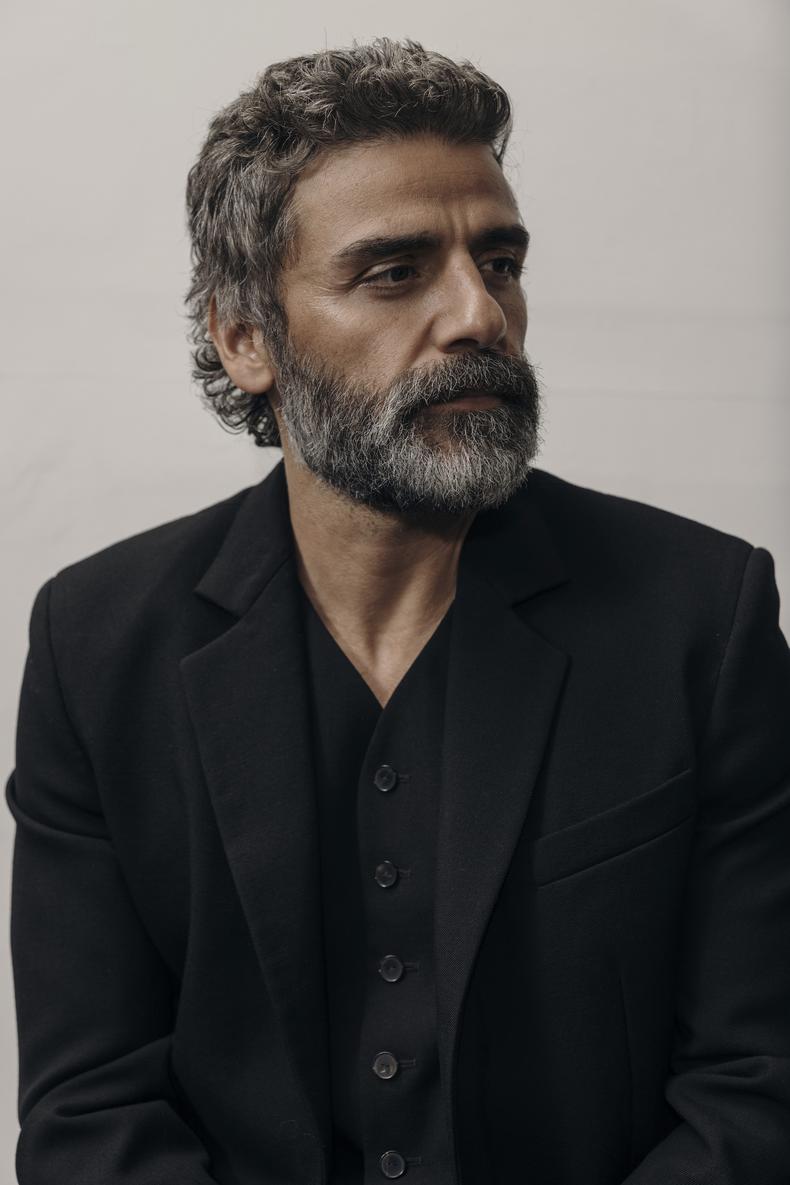
The actor’s interpretation of Victor is less the feverish man of science portrayed by Colin Clive in James Whale’s 1931 classic, or Kenneth Branagh’s psychosexual maniac in the actor-director’s own 1994 adaptation, and more an artist, who treats sewing together body parts like composing a symphony.
“I didn’t want to do the guy that is absorbed by science,” del Toro tells us in a separate conversation. “I needed a guy that is absorbed by passion.”
Victor’s desire to cheat death, to birth from reanimated body parts a son of his own (played with shocking gentleness by Jacob Elordi), stems from a cruel, overbearing physician father (Charles Dance) who failed to save Victor’s mother during childbirth.
“Early on, we talked so much about our fathers, and the way that pain gets passed down,” says Isaac, whose own father, Óscar Gonzalo Hernández-Cano, is a pulmonologist. “[The conversation] was always emotionally connected to everything being a reaction and an investigation of the world that one is born into.”
“I always thought: I don’t know about relationships. I don’t know about the world. I don’t know how to be a citizen. I don’t know how to be. The one thing is, if I have a part, I know how to do that.”
The response Isaac clung to in his character was defiance. “[Del Toro and I] talked a lot about wanting to defy our fathers, and nature, and the future, and death. The defiance of death is a big one,” he says. “The ‘fuck it’ attitude, the willingness to destroy because one can’t sit in the pain or the fear of being seen, of actually being seen. You’d rather self-immolate.”
The portrait of Victor as a young, hardheaded artist consumed by the work is one Isaac recognized well—it was him. In an origin story he’s told before, he explains how he applied to Juilliard—one of the most prestigious performing arts schools in the world—almost on a whim, in town from Miami to play Fidel Castro in the Off-Broadway play “When It’s Cocktail Time in Cuba.” He got accepted, bolstered himself with the “brutally efficient technique” he admired in the New Hollywood stars who preceded him, and emerged as one of the most magnetic stage and screen performers of the past 20 years—a dark-eyed heir apparent to Al Pacino who could project charm (“Star Wars: Episode VII—The Force Awakens,” “Dune: Part One”) and menace (“Drive,” “Ex Machina”) in equal measure.
But throughout his success, “I always thought: I don’t know about relationships. I don’t know about the world. I don’t know how to be a citizen. I don’t know how to be,” he tells us. “The one thing is, if I have a part, I know how to do that, and if I can figure that out, then everything else doesn’t matter. I felt that way for the longest time.”
That single-minded devotion calls to mind an illuminating anecdote he hasn’t told often, one he looks back on now with an almost paternal smile. During one of his final Juilliard auditions, he was performing a monologue as Hotspur from William Shakespeare’s “Henry IV, Part 1” when the head of the drama division at the time, Michael Kahn, offered a note: He wanted more intensity.
Isaac, all of 22 at the time, disagreed. “I said, ‘Well, I just don’t know if he would talk that way to the king.’ ” Kahn countered, “ ‘Yeah, but what you did was boring,’ ” Isaac recalls with a laugh. “He goes, ‘Look, you came all the way from Miami; you might as well let it rip.’ ”
So he did, and the rest is history. But even then, Isaac says, “In my mind, I was like, Yeah, but I’m still not totally convinced that, realistically, that’s what [Hotspur] would do.”
It’s that same burning conviction—that tunnel-vision trust in your muse—that Isaac and del Toro saw in this updated Victor Frankenstein. “Life is like fishing: You gotta pull, and you gotta release. Victor as a character—or me [when I was] a young director—it’s all pull; it’s all defiance,” del Toro says. “Victor has certainty, which is the most dangerous type of person you will encounter in your life. When somebody has no doubt, you should truly just brace yourself.”
Even as the lavish laboratory set fills up with buckets of blood and piles of severed limbs, Isaac keeps playing the character like he’s waltzing lightly across a stage, bathed in cinematographer Dan Laustsen’s golden light. “As opposed to being this moment of horror, it’s actually the one place where he feels at peace,” Isaac says. “He knows what to do.”
Slowly but surely, Isaac started to see too much of himself in this artist isolating himself from the world of the living. “At a certain point, you get to that dark forest, and [the mindset] has gotten you that far, but to look back, that all just looks like wild animals to me,” he says. “An adaptive, survival thing can become maladaptive.
“The narrowness of which I viewed my existence through [acting], I think it’s a beautiful way to close that chapter by playing a character whose entire being is through this narrow lens of defying his father,” he continues. “And because of that, he could not see in his periphery the cruelty that he was unleashing on others, and definitely on himself as well.”
But there’s another thread that runs through the past few characters Isaac has played—one, he says, that even stretches back to his role in the 2023 Broadway revival of Lorraine Hansberry’s “The Sign in Sidney Brustein’s Window,” and his 2022 foray into the Marvel Cinematic Universe, on the Disney+ limited series “Moon Knight.” They all allowed him to, as Juilliard’s Kahn once suggested, let it rip.
“They’re highly expressive parts. They deal with the marvelous, or wanting to touch the marvelous.… It’s almost Greek, the size of these parts,” Isaac says. On “Frankenstein,” he says, “Guillermo was very clear that this is not naturalistic. He doesn’t want this character to speak in a naturalistic way. He wants it heightened, he wants speed, and he doesn’t want pauses.”
Non-naturalistic delivery called for non-naturalistic technique. There’s an early scene in “Frankenstein” that sees Victor deliver an impassioned speech to the medical university board that’s trying to suppress his unorthodox experiments. Just to get his head around the rhythms, Isaac tried to fit the dialogue into iambic pentameter. “It wasn’t written that way,” he says. “But it felt like handlebars to help me walk up it.”
Isaac and del Toro spoke exclusively in Spanish, a first for the actor. “It felt incredibly intimate,” he says. “He would give me directions with telenovela stuff. He’d say, ‘Give me the María Cristina,’ which is like, walk up, turn around, look past the camera. Stuff that was the architecture of telenovelas.”
Other times, del Toro delivered direction in the form of dirty jokes. “They’re untranslatable,” Isaac says, chuckling. In one instance, to explain Victor’s mindset during his early experimentations, del Toro told a joke involving a mouse and a lion. Isaac trails off laughing before he can finish it. “I can’t even say the actual punchline; it’s so stupid.”
Essentially, del Toro was saying: “You’re the mouse that’s really excited about fucking the lion for the first time.”
“I can play that,” Isaac recalls thinking. “I understand. I’m really excited. I’m scared, but I’m excited.”
A bit more straightforward was del Toro’s idea that Victor is, in his own mind, a rock star. “He has to own his stage like Mick Jagger,” Isaac explains. Both he and costume designer Kate Hawley took inspiration from 1960s rock aesthetics, and guitar gods like Jimi Hendrix. When Hawley showed Isaac the platform footwear she had planned for Victor, he started watching videos of Prince performances. “I had to see—how does a man move in high heels so well?” Isaac says.
But restrictive shoes were nothing compared to the all-night sessions in a makeup chair that were required to turn Elordi into Victor’s sewn-together creation. It’s a process Isaac can empathize with, thanks to his prosthetic-heavy experience playing the title villain of “X-Men: Apocalypse” in 2016. “He got lucky that he got to do it in a great movie,” Isaac says, laughing, “so it felt worth it.
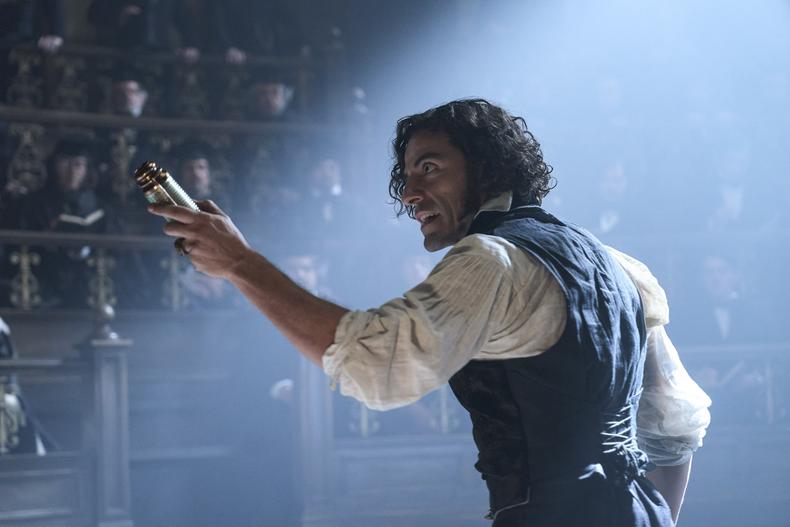
“Frankenstein” Credit: Ken Woroner/Netflix
“It’s really intense. It’s very isolating. I felt for him and was incredibly impressed with how I never heard him complain once,” he adds. Isaac remembers one particularly surreal moment in between setups, when he looked over to see Elordi in full creature makeup capturing memories in 35 mm. “If you can imagine: the creature of Frankenstein, just over in the corner taking some cool shots on his cool analog film camera,” he says. “So within all those [physical] constraints, he was also very loose and available. I certainly was not that put together as a human being when I was his age.”
Isaac and Elordi’s first scene together was actually the final scene of the film, an emotionally fraught plea for forgiveness from Victor to his creation. “I spent the whole day letting myself zero in, focus, and be in a bit of a meditative place. I listened to music. I looked at pictures of family members who had passed. I let myself evoke all these images and feelings. We did the scene, it went really well, people were moved, and Guillermo was very happy.”
But Isaac wasn’t. That obsessive voice was speaking up again, arguing that something wasn’t quite right. “The next day, [Guillermo] showed me it cut together, and I didn’t totally buy it. There was just something about it that didn’t come through to me,” he says.
That something, del Toro tells us, was Isaac’s past calling to him. “He gave me a reason,” the director remembers. “I said, ‘We got it; I saw you accepting the creature.’ And he said, ‘Yeah, but I want to do it as my father.’ He said, ‘I want to be my dad, saying I see you and I accept you and I ask your forgiveness.’ I thought that was very powerful, very profound. When somebody promises you a horizon, you pack your bags and get in the wagon.”
Isaac returned from a 30-minute break to find the scene reset. They were going again. “I had no time to prepare. I had already forgotten the words, because I had just moved on mentally,” Isaac says. “I didn’t have time to evoke anything. I didn’t have time to put the sad music on. I didn’t have time for any of that. We did four takes, and afterwards, Guillermo was like, ‘We didn’t have that, so I’m glad we did it again.’ ”
 That version of the scene is what you’ll see in the finished film. “It was a much more sober reading. It was more present,” Isaac says. “I was less trying. There was just less reaching.”
And that might have been the moment when the past and present really clicked together for Isaac, when he realized how much he has matured, and how much he still appreciates the young man who spoke his mind inside a Juilliard audition room. “Guillermo was like, ‘We could have gone home at 2 a.m. and not gotten it, or now we’re going home at 3 a.m. and we got something.’ That’s a big testament to him,” Isaac says. “And it is a little bit like that conversation with Michael Kahn, where you’re like, ‘I just have this feeling.’ It’s a conversation. You see what else is there, and you never fucking know.”
Isaac left “Frankenstein” feeling changed. In January, he started production on the second season of Netflix’s “Beef,” a role that required him to return to the micro level. “I was having a lot of trouble while I was shooting it,” Isaac says. He couldn’t understand why he was having difficulty tapping into the restrained feelings this new character called for. That’s when his current acting teacher gave him a suggestion. “She said, ‘OK, let Victor Frankenstein come back for a moment.’
“Suddenly, I had such a release,” Isaac recalls. “It was just so pleasurable. Victor got to speak and say how angry he was to be trapped inside this little, tiny man’s body that’s being squeezed by all these boring things.” And like he always has, Isaac listened to that voice. But he didn’t let it consume him. “It allowed me,” he says, “to find pleasure in the mundane.”
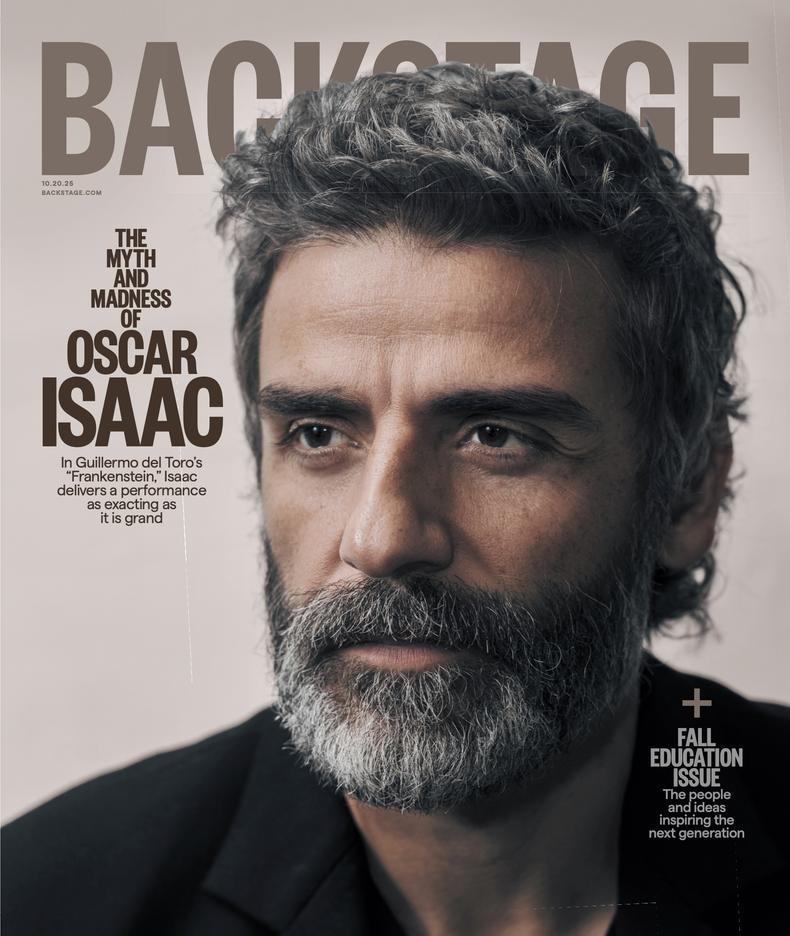
This story originally appeared in the October 20 issue of Backstage Magazine.
Photographed by Victoria Will on 9/23 in NYC. Styling by Matthew Henson and Hannah Atira with assistance from George Karamanoukian