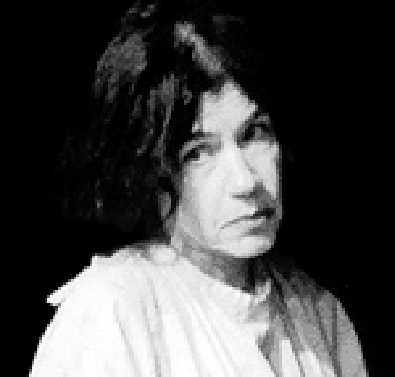
In the search for truth onstage or on-screen, Pamela Gordon isn't afraid to bare her soul, her breasts, or even play it "mysterioso." Her latest venture is The Dogwalker, an indie film written and directed by Jacques Thelemaque, founder of L.A.'s Filmmakers Alliance, in which she plays the psychologically damaged and antisocial Betsy, who prefers the company of canines to that of humans.
L.A. critics have described Gordon as "gravel-voiced," "waiflike," "diminutive," and possessed of "expressive eyes." All true. Those in the know, including a pack of edgy playwrights and directors--many of them working in the surrealist vein--are well aware that Gordon brings to her roles a distinctive, well-wrought sense of intelligence, humor, and pathos. That includes a willingness to toy with sexual ambiguity--as in Maria Irene Fornes' play Oscar and Bertha, staged a few years back at the Padua Hills Playwrights Festival. There, Gordon portrayed the boastful Oscar, who behaves like a man but later blurs her character's gender in a revealing moment. "I dressed like a man," said Gordon. "And I also showed my breasts, so it was a very mysterioso scene."
Gordon was involved for the six years, from inception to fundraising, with The Dogwalker, which screened twice at the IFP/West: Los Angeles Film Festival in June. The film was a finalist for the Gordon Parks Independent Film Award at the 2001 IFP Market, and it will hit other festivals as the director and producers try to secure a theatrical release. The character-driven film is no shaggy-dog story; it is infused with realism and pathos. Co-starring is the director's wife, Diane Gaidry, as Ellie, a woman on the run from an abusive boyfriend. Ellie and Gordon's character, Betsy, cultivate a difficult friendship. "We rehearsed a lot before shooting started, and even while we went along. By the time we actually started filming, we already knew the people. I could feel [Betsy] moving through me," Gordon said.
"Betsy is kind of a grumpy and cantankerous person who's lonely. The central journey is that of the young woman who is a runaway, and she meets up with me. I'm ill and in denial about it. I respond to her, but not in a direct, obvious way. As with so many parts, the requirement is to reveal oneself through a very unattractive, thoroughly beleaguered person." Added Gordon with self-aware amusement, "I do beleaguered pretty well."
In Theatre of NOTE's Destronelli, for example, Gordon's character finds love with someone unattainable while she is struggling with an illness. "The challenge was to kind of know that she deludes herself but still needs and wants the object of her delusion. It took a big chunk out of me. I felt I exposed myself as much as I ever have."
The Pittsburgh-born actor made her debut as a child performer there. "I wanted to be an actor from age 5, and my parents cooperated." She moved to Los Angeles as an adult and continued her career, working pretty regularly, winning awards from Drama-Logue and L.A. Weekly for best performance.
Although she'd deny it's a specialty, Gordon has portrayed a number of extreme characters. Fans of science fiction and fantasy may recall her as an extraterrestrial's victim in the campy The Borrower, or as a vampire's ghoulish mother in Bloodstone: Sub-Species parts 2 and 3.
With the Evidence Room, she slipped into the part of a gang leader in the period play No Orchids for Miss Blandish, conveying a kind of sexual deviance we'd be hard-pressed to find in classic film noir. She also performed as a lascivious mother in the Evidence Room's Saved, which she described as strong, scary, and offensive: "The character is quite embattled and ferocious, with a yen for the boyfriend of her daughter. So there's a nice little seduction scene there, in which she comes on to him without seeming to."
Gordon can also be a perfectly nice, uptight mom (as in the feature Weird Science) or even a stalwart sitcom trooper, as with her semi-regular role as Velma Fleckner in TV's Buddy Faro. "I loved that character of Dennis Farina's secretary," said Gordon, with her unique cigarette laugh. "She was a real dresser and took very good care of him."
Moving easily from TV to stage (including some directing gigs) and film, Gordon is involved in another indie, The Technical Writer, taking the part of an ill character who spends a lot of time in bed. Surprising perhaps, because, as Gordon said, "I like to move." She has had extensive dance training.
Gordon isn't shy about assessing her own work. But she also gets validation through the usual avenues: peer approval, paychecks, and meetings with extraordinary people. She struck up a friendship with casting director, teacher, and playwright Michael Shurtleff (author of Audition) after he came to see Destronelli and then, at Gordon's invitation, attended a screening of The Dogwalker. Said Gordon, "He was very complimentary. I was so flattered that I decided to believe him."