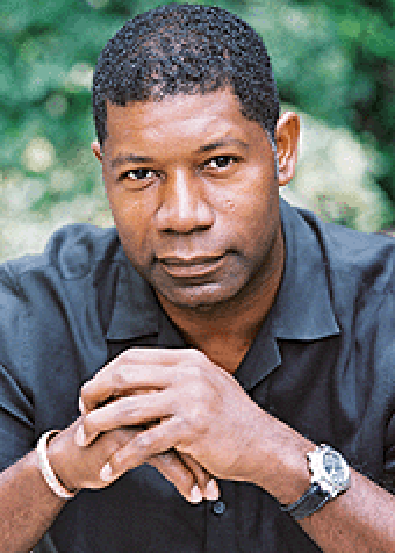
"Hey, Mr. President," the limo driver calls out his window before waving and driving off. Dennis Haysbert, standing in front of the Four Seasons Hotel in Beverly Hills, smiles and waves, looking something between bemused and flattered. A minute later, a woman standing yards away shouts, "I love you," before going on to say how jealous her publicist is going to be that she got to meet him. He is calm and gracious to all his admirers. He shakes their hands, hears their compliments, and generally handles the situations as smoothly as--well, a politician.
Martin Sheen may have shown up first in The West Wing, but television audiences are currently embracing Haysbert as their favorite leader. After spending his first season on the hit show 24 as Sen. David Palmer, Haysbert received a promotion in the show's second season to president of the United States. With the help of Kiefer Sutherland's federal agent Jack Bauer, Palmer spent the last year trying to track a nuclear bomb in Los Angeles and prevent a major world war. Along the way he had his presidency stripped away by a back-stabbing cabinet, was forced to work alongside his devious ex-wife, and--in the jarring season finale--was the victim of a biological assassination attempt. It is unknown whether Palmer survived the attack, and even Haysbert doesn't know yet if he'll be returning to the show in the fall.
Even if the show's creators are foolish enough to kill off Palmer, Dennis Haysbert will survive just fine. After years of solid and steady work in film and television roles, Haysbert is riding high on the success of 24 and his commanding work in last year's Far From Heaven. In addition to finally being recognized for his work, he is becoming equally well known for that voice. A low bass that would make James Earl Jones tremble, Haysbert's distinctive velvet vocals will be on full display in Dreamworks' upcoming animated feature Sinbad: Legend of the Seven Seas. Haysbert plays Kale, the 7-foot-tall first mate to Brad Pitt's Sinbad. The father of two young children, Haysbert quickly cleared up any misconceptions that he did this movie for the kids.
"I did it for myself," he said, laughing. "Jeffrey Katzenberg called and said, 'We have this role we want you to do.' I was very happy and very proud and very excited that they chose this particular script because it's a great story." Haysbert has other fans in high places. "I think my voice was best described in Oprah's June magazine. I made her O Man section, and they said: 'The voice is deep and smoky.'" Haysbert allowed himself a small smile. "I liked that."
Haysbert attended the Academy of Dramatic Arts in Pasadena and after graduation began landing work fairly quickly in television. Recalling how he landed his first agent, Haysbert said, "I sent out 100 pictures and resumes and took the first person who called. Which is probably not the best way to do it." Asked if he is still with that agent and Haysbert quickly shook his head. "No, but it was worth having for the time I had him. Then I was with another agent for a while who was one of my classmates at the Academy."
Today, Haysbert has an agent (Lorrie Bartless at the Gersh Agency), a voiceover agent, a manager, a publicist, and an attorney--the attorney, he joked, is a "requisite."
In the Majors
During the 1980s, Haysbert appeared regularly on television in everything from Buck Rogers to The A-Team, but his first film came as the voodoo-practicing baseball player Pedro Cerrano in the 1989 comedy Major League. Haysbert credited writer/director David S. Ward for giving him his first big break in what remains one of his best experiences to this day.
"It's the most fun I've had on a movie," Haysbert raved. "I was playing baseball and getting paid for it." Perhaps his biggest opportunity came in 1992, when Denzel Washington dropped out of the lead opposite Michelle Pfeiffer in Love Field. "[Director] Jonathan Kaplan gave me an enormous break. I was in the mix, but they went with Eriq LaSalle. For some reason, he didn't work out, so they brought me back in. That was a really arduous audition process. It was a very stressful time because it was such a huge break."
Haysbert then appeared in other high-profile films (Heat, Absolute Power). When asked if he feels like he's just broken into the mainstream consciousness with his recent hits, he mused: "I've always thought I was in the mainstream. I just think people knew me but didn't know my name. I was a little obscure. These last two projects have definitely opened up a lot of doors and let a lot of people know who I am."
When 24 premiered in fall 2001, it won critical raves for its innovative real-time storytelling format and plotlines ripped from tomorrow's headlines. The main storyline revolved around a plot to assassinate the first viable African-American presidential candidate, David Palmer. As originally portrayed, Palmer was a man without any visible faults.
"He had to be squeaky clean," Haysbert insisted. "Had to be. They would have found any kind of chink in his armor to exploit. He had to be damn near perfect."
In Season Two, the show had gone from cult favorite to bona fide hit, and Haysbert was now playing the first African-American president, a responsibility he doesn't take lightly. "I think it has, first and foremost, seriously put it in people's minds that it is possible," he said. "Especially in light of the last couple of years, with things that have happened in this country and around the world, the last thing we should be thinking about is the color of our president's skin."
Haysbert's portrayal has been so well-received that he is asked to run for office, he estimated, at least "three times a day." Recently he went to Washington, D.C., to participate in a panel discussion on how Hollywood portrays D.C. With some time to kill, Haysbert paid a visit to the Senate floor. "I was already dressed for the panel, in my suit," recalled Haysbert. "And every Secret Service agent, every page, every guard we passed, would say, 'Hello, Mr. President.' At one point we were in the president's waiting room, and even senators came up to me and said, 'Mr. President, may I have your autograph?' And the strangest part was, I felt comfortable."
Truth of the Moment
Because of the nature of the program and the need for secrecy, actors on 24 often don't know where their characters are headed. Some actors might find it difficult playing a character whose destiny is constantly open-ended, but Haysbert compares it to real life.
"You don't know what's going to happen today. So you play the truth of the moment. I think it's a shame when people rely too much on the last page of a script." Haysbert reads only two scripts at a time, and even he didn't see certain plot twists coming. "I was stabbed in the back too much this year. I was like a pincushion. And if I knew that was coming, there is no way you would see the surprise. Because if you know what's coming, it will somehow subconsciously color your performance."
Haysbert admitted to being "picky" about the roles he's chosen, having turned down projects over the years for various reasons.
"There are a lot of things that draw me to a project," he said. "Story. Writing. Other actors that are in it. Generally, it's whatever the character is doing. If he's doing something that I find really objectionable, I'll kind of shy away from it. If the audience is not going to learn something from it and I'm not going to enjoy what the character goes through, I can't do it."
One of Haysbert's favorite films is the little-seen Suture, a stylish noir thriller shot in black-and-white that plays with people's perceptions of color. "I played a twin who everyone in the movie saw as looking exactly the same as my other twin, who was white. So the audience was looking at the movie and seeing this," said Haysbert gesturing to his arm. "But everyone within the movie saw me as looking the same as my twin. It's one of my favorite movies, just for what it said."
Haysbert also loved his work on Far From Heaven, in which he played Raymond Deagan, a remarkably overqualified gardener who befriends Julianne Moore's 1950s housewife. In a film designed to ape the style of Douglas Sirk's melodramas, the stars had to walk a fine line to steer clear of parody.
"It could have easily teetered in to cheese very quickly," Haysbert noted. "But with all the wardrobe and the music and the language, what stood out for all of us is the truth--the truth of the words. And I always contended that my character didn't fit in that world. He made his own world. Most black people didn't fit into that '50s Tupperware Leave it to Beaver/Father Knows Best/ Donna Reed world because we weren't invited. What I like to think of with Raymond is that he invited himself. He was kind of making up his own world as he went along, and if you wanted to be in that world you were welcome. But he was definitely going to dabble in any world he wanted to."
Haysbert singled out the scene in which he takes Moore's character to an all-black club and restaurant as the reason he fell in love with writer/director Todd Haynes. "No one has ever written that scene before. Black, white, nobody has written it. I would work with Todd on anything. If he wanted to shoot the phone book, I'd be there."
The other key to Heaven, according to Haysbert, was the friendship between the two characters. "That relationship didn't start off as, 'Hey, you look good in that taffeta, baby.' It wasn't like that. He was a genuine gentleman who saw people, not color. But he recognized that other people saw color; he just wasn't going to comment on it."
Back to those fans. Haysbert is signing a headshot for an admirer, explaining with some embarrassment that he doesn't normally carry photos of himself around. Employees at the Four Seasons, who undoubtedly see an endless parade of celebrities, thank him for coming in and try not to stare. Does this level of attention ever get to him?
"Most of the people who come up to me are from all walks of life, but they get the show," Haysbert said. "They get who this character is. And they can differentiate between me and David Palmer. Then they'll go on to say they like the show, and it's heartfelt. And that's what I got into the business for. If I couldn't be in a show or a movie that taught somebody something, at least I wanted to entertain the hell out of them." BSW