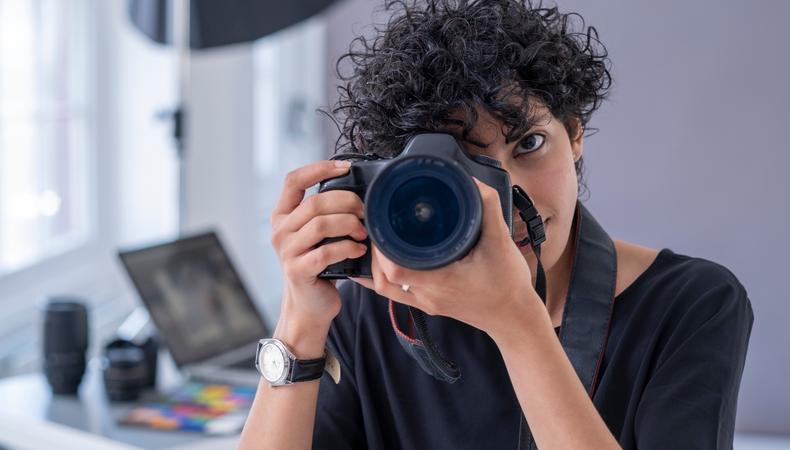
From Ansel Adams capturing images of Yosemite’s grandeur to Jessica Kobeissi framing the world through cinematic street photography, every now-famous photographer started by learning the basics. Getting behind the lens can be intimidating—whether you’re looking to pursue an artistic career or elevate your Instagram game—but understanding your camera and continuously developing your eye will set you apart from the endless scroll of mediocre content. Let’s dive into eight photography tips for beginners.
1. Understand the exposure triangle.
The camera’s settings are one of the most intimidating factors when learning how to shoot photography. Improving as a photographer means having full control over your camera’s capabilities, which in turn means understanding the three elements of the exposure triangle: ISO, shutter speed, and aperture. Essentially, the exposure triangle is a camera’s three core settings that determine how light enters a camera and is captured by the sensor.
- Aperture is the size of the opening in a camera’s lens, measured in f-stops, such as f/1.4, f/2.8, f/5.6, and f/11. The higher the f-stop number, the smaller the aperture and, thus, less light is let into the camera. The lower the f-stop, the larger the aperture and the more light is let in. Higher apertures like f/16 have a deeper depth of field, meaning more in the frame will be in focus. Lower apertures like f/1.4 have a shallow depth of field, meaning that the background and foreground of a subject will be blurrier and out of focus.
- Shutter speed is how long a camera’s shutter stays open to allow light to enter the camera and expose the camera’s sensor or the film stock. Quicker shutter speeds capture motion with less blur but allow less light. Slower shutter speeds allow more light but can result in motion blur from movement.
- ISO differs between film and digital. On the digital side, ISO simply means a camera sensor’s sensitivity to light. Lower ISO is less sensitive, thus requiring more light but producing a cleaner image with less noise. Higher ISO is more sensitive and can shoot in lower light, but it produces digital noise in an image. With film, ISO indicates the sensitivity of a roll of film to light. Unlike digital, film ISO is fixed.
Understanding the exposure triangle is crucial for photographers because it gives you creative control over how your images look and feel, allowing you to intentionally craft the mood and style of your photos rather than leaving it to chance. When you master how aperture, shutter speed, and ISO work together, you can adapt to any lighting situation, freeze fast action, create artistic motion blur, and move beyond auto mode to create the exact image you envision.
2. Know your lens types.
Lenses are classified by zoom versus prime and by focal length.
Zoom vs. prime:
- Zoom lenses can change focal length, which simply means they can zoom in and out.
- Prime lenses, on the other hand, have fixed focal lengths and cannot zoom. While prime lenses cannot zoom, they often have a shallower depth of field, which allows them to work better in lower light.
Focal lengths:
- Ultra-wide (10–24mm) is perfect for dramatic landscapes and architectural shots.
- Wide angle (24–35mm) excels with environmental portraits and group settings.
- Standard (35–70mm) makes for the most natural-looking perspective for portraits.
- Telephoto (85–135mm) is the go-to choice for flattering portraits that isolate subjects to make them pop.
- Super telephoto (135mm+) allows you to capture detailed images of wildlife, sports, and distant subjects.
Typically, wide angle lenses are great for capturing landscapes and cityscapes, but they are also used for stylized portraiture by photographers like Platon or for environmental portraiture, as seen in the work of Annie Leibovitz. More traditional portrait photographers opt for standard lenses because they are more flattering for facial features. Telephoto lenses are used to capture subjects that are far away, making them perfect for wildlife, sports, and live events.
While these are typical uses for each lens type, there are no hard-and-fast rules. Understanding lenses, their effect, and the frames they make will allow you to use them creatively to capture your own images.
3. Use and break composition rules.
There are some common rules based on traditional composition techniques that can be used (and broken) to artistic effect.
- The rule of thirds places a subject along the intersection of lines of a 3x3 grid to balance a frame.
- Leading lines use lines within your shot to create depth and lead the eye toward a subject.
- Framing and balance prioritize a sense of harmony and visual weight within a composition so that there is a feeling of even formality.
Of course, breaking these rules can also be a creative decision, but it must be done with intent, either narratively or to create a specific visual effect. For example, disrupting balance can lead to interesting asymmetrical photos that incorporate negative space in new and fascinating ways.
4. Learn lighting types and techniques.
When first starting photography, there are two basic types of lighting: natural and artificial.
- Natural light simply means shooting with the available natural light you’re given, whether it is directly from the sun or ambient sunlight.
- Artificial light is any light that comes from a man-made source such as street lights, camera flash, or studio LED lights.
Whether you’re shooting with natural or artificial light, light quality also matters.
- Hard light, where light hits a subject straight on, will create hard shadows and strong highlights, resulting in deeper contrast and more dramatic lighting styles.
- Soft light, where light is diffused by either diffusion material or by bouncing light onto a subject, will create softer shadows and highlights, making it more flattering.
Lighting has a direct impact on the emotional tone and visual style of your photos, so use it with intention. The best thing you can do is observe light in your everyday life, and when something catches your eye, seek to understand what the light is doing.
5. Manipulate color in-camera and in editing.
An all-too-often overlooked component of a photograph’s story is color and its emotional impact.
- In-camera use of color includes styling a subject’s wardrobe, production design, and props to have a specific color story, whether this is using complementary colors or monochromatic schemes.
- Postproduction color grading allows you to adjust an image’s aesthetic to make an otherwise dull photo full of story and emotion. Be sure to shoot in RAW, as RAW files retain the most visual information, which will help you when taking on our next tip.
6. Edit your photos.
Beyond coloring in post, editing in post allows you to refine and continuously develop a photograph. This means finding new compositions by cropping an image. An uninspiring wide shot can suddenly become a dramatic medium shot with the right crop. A slightly off-center horizon can become better composed if slightly rotated.
Tweak the shadows and highlights of your image to find new areas of detail, especially when shooting in RAW. If an image is not as sharp as you would like, slightly increase your contrast to create a bit more sharpness. These are only a few small editing tips, and you can discover more through trial and error as you experiment in photo editing.
7. Spend time around cameras and photographers.
Learning from others can be a huge jump-start to learning photography. Whether you decide to take photography classes, take on photography jobs, or connect with other photographers through meet-ups or simply at the local camera shop, you’ll be surprised at how much you can absorb by being around others who are passionate about the craft.
“I can’t just become a pro photographer because I decided it,” explained Peter McKinnon in an interview with Forbes. “But, if I get a job at a camera shop it gets me that much closer. I can learn about cameras more, and then maybe get an internship, and I can intern with people who do it professionally and learn more.”
Not only will being surrounded with projects and peers elevate your abilities and knowledge, it can also help you land jobs as a photographer.
8. Shoot, shoot, shoot.
If you want to get better at shooting photographs, our final tip is the most important: Shoot more photographs! This is especially true in today’s day and age, where most people have a camera sitting in their pocket constantly. Whether you’re shooting with a 35mm film camera, a mirrorless digital camera, or your iPhone, constantly shooting will be the best way to develop your eye, get better at composing images, and refine your perspective—ultimately, the thing that you as an artist are bringing to the medium. Go out and shoot, and don’t be afraid to make mistakes, experiment, and refine.
Many aspiring photographers spend plenty of time online to gain inspiration, engage with audiences, and build their social media followings—all important, of course. But to go out in the world, shoot, and understand what it is you want to capture is what separates the good photographers from the great. When developing your photographic sensibility, remember the advice of photographer Rinko Kawauchi: “Take a break, turn off the computer, turn off the phone, don’t look at a screen, go to a library, touch something.”