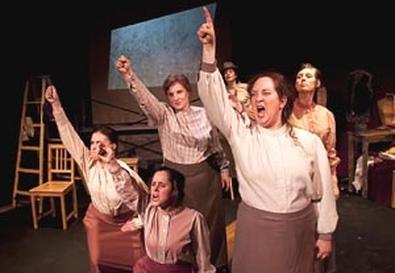
Photo Source: Michael Taggart Photography
The tragedy inspired historic changes in labor law—from improved factory safety standards to better working conditions. This week, a new production by the all-female theater company Looking for Lilith will commemorate both the disaster and the labor revolt it inspired.
"Fabric, Flames and Fervor: Girls of the Triangle," directed by Kathi E.B. Ellis, makes its New York debut on March 24 for four performances at Manhattan Theatre Source—a short walk from where the tragic fire took place in the old Asch Building (now called the Brown Building).
Louisville-based Looking for Lilith typically focuses on the female perspective in historical events. Their work has brought to the stage stories on everything from college life in the 1960's to the Iraq conflict.
Ellis, born in England and now living in Louisville, has directed a slew of Shakespeare, musicals and classical theater pieces throughout the country. This is her first original play for the troupe. Back Stage sat down with the director to discuss this project.
Back Stage: Why did you choose to stage a production based on the Triangle Shirtwaist Fire?
Kathi E.B. Ellis: Several years ago I read the book, "Triangle: the Fire that Changed America" by David Von Drehle. Reading the book I knew there was a theatrical way to tell the story, with all of the human cost and lives that were imbedded in that tragedy.
I knew... Looking for Lilith. I had seen the way they create original work. I thought this would be a really good company to fulfill that vision. I met with Shannon Woolley, the artistic director, and Trina Fischer, one of the founders. At that point [I] discovered that Shannon and another co-founder had actually attended New York University and were very familiar with the story; the Asch Building is part of the NYU campus.
When we finally decided to do [the show], our trajectory was to do the research, to do the devising process, and do the stage reading. We premiered the show on the 98th anniversary of the fire in Louisville, Kentucky, where the company is based. Part of our vision was to perform it in New York City on the centennial.
Back Stage: How were you able to balance the historical aspects of the event with creating a narrative?
KE: The process of Lilith is to reexamine women's experiences throughout history. The process that is used to create our original works is through a huge amount of research. We had access to the trial transcripts. We have the work of William Shepherd, a reporter who was on the scene that was very important to us.
The trial scenes are absolutely verbatim from the transcripts. We abridged but we haven't changed any of the language. The choice that we made was that in this six-woman story, we would create constant characters for three girls who would become our survivors.
We could say, girls from this country who are about this age would likely have worked at the factory. Then we were able to create fictional scenes about the experiences that these girls might have had. We were aware that we were creating fiction but based on typical experiences from that time.
Back Stage: How were you able to create a compelling story without being weighted down by name and dates?
KE: This was one of the reasons why I knew Lilith was the company to go to. They are a very movement-based and improvisational. We wanted to market it to audiences who were not familiar with of the events, but who could track where we were in the story. We put in a little bit of contextual information as well as the fire, which is the emotional center of the piece. The trial is the [play's] architecture.
Back Stage: It seems like the players are portraying these characters and teaching at the same time. What attributes were you looking for choosing each role?
KE: We showed everyone the research that we had done so everyone had the same baseline of information. The company members are always involved in the production. Six women play about 30 different characters in a 90-minute show. They play men and women of different ages. The founders of the company are women; all of the players are women. We [also] reached out to artists who are not women; the stage manager is a man, and the sound design was also created by a guy.
Back Stage: How did the players maintain this female perspective throughout the production?
I think to tell the women's story is to embrace the way the men in the story acted. We worked really hard to make sure that we didn't just choose characters in the play that just made bad decisions. There were some amazing men, the men who ran the elevators saved some many people.
We allowed the characters to speak from where their reality is. If we tell the story authentically, audiences will be able to catch the resonance of the piece.
"Fabric, Flames and Fervor: Girls of the Triangle" is presented by Looking for Lilith Theatre Company at Manhattan Theatre Source, 177 Macdougal St., #1, NYC. March 24-27. 2 p.m. $15 and $10. (866) 811-4111. For more information, visit theatresource.org.