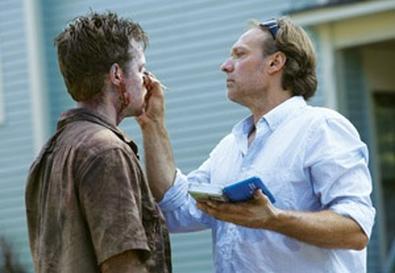
Darabont and Hurd selected multiple-award-winning effects artist Greg Nicotero not only to transform Atlanta locals into terrifying zombies, but to sit behind the casting table and to lead a three-day zombie school to prepare the background actors.
"The whole point was to keep a specific visual style for the show in terms of the look of the walkers," says Nicotero. "The graphic novel depicts them pretty specifically. These things have starved, so they're really thin and gaunt and there are a lot of teeth showing and bone structure and big eyes. We were really looking for people that fit that physical type." Nicotero's company, KNB EFX Group, has supervised makeup and effects for the films "Piranha," "Inglourious Basterds," "Drag Me to Hell," "The Mist," and "The Chronicles of Narnia: The Lion, the Witch and the Wardrobe." Recently it won an Emmy for HBO's "The Pacific."
Background casting director "Patrick Ingram and I would get together and go through a little zombie headshot book," Nicotero says. "We handpicked 150 locals in Atlanta, and we would line up 16 people at a time and do exercises with them. I said, 'Let me see your zombie walk, and action!' One girl would walk out of the room in zombie mode, and another guy just wouldn't move. It was really fun. There was a scene in the pilot where a bunch of zombies get out of a car, so we set up a bunch of chairs and said, 'Okay, let's see how you guys, in character, get out of a car.' Some people grow up singing in the mirror with a hairbrush and other people grow up practicing their zombie walk. It's not something you can teach."
Some of the extras boasted about their experience working as "scare actors" at a haunted-house attraction called Netherworld, but Nicotero found that sort of background can create bad habits. "I had to break some of them of that habit of being over-the-top, because if you're in a theme park and they have it lit with scary lighting, there's a different kind of atmosphere," he says. "But when you're dealing with a TV show, then you don't want people to look like they're performing. They need to look organic and natural. A lot of people would get tense and nervous, and I would walk up to them and put their shoulders down: 'Rest your shoulders.' It changes your arm placement. In the graphic novel, when you look at the drawings of all the zombies, they draw them with their shoulders really slump, lulling and swaying."
Zombie Authority
Nicotero is definitely what you'd call a zombie expert. He grew up in Pittsburgh and decided to put medical school on hold when director George A. Romero and makeup magician Tom Savini hired him for his first movie gig, on "Day of the Dead" in 1984. He never went back to med school, but he did call on his knowledge of anatomy while supervising the effects for "Land of the Dead," "Diary of the Dead," and "Survival of the Dead."
"I directed second unit on 'Land of the Dead,' and one of the first things George ever taught me was if you try to direct 50 zombies, all 50 people will do the same thing," Nicotero says. "That's why we did the zombie school this time. I learned every gag from Tom. He designed his effects so that the audience, much like with a magic trick, is distracted when something else happens. You would be misdirected by the way that he choreographed the effect."
But the tone of "The Walking Dead" is very different from that of Romero's more satirical fare. "One of the things that Frank and Gale were specific about is there's not, like, a zombie football player or a zombie cheerleader or a zombie police officer," explains Nicotero, who adds that there will be no zombie stars. "It's a day-player scenario, or maybe two days where we feature somebody, but there are no recurring zombie characters. The notion is, this group of undead is a collective threat." Since television is shot more quickly than film, the actors spent no more than two hours in the makeup chair having elaborate makeup and appliances pasted on.
"The Walking Dead" centers on Sheriff Rick Grimes, who is traveling with his family and a small group of survivors as they search for a safe home after a zombie apocalypse. According to Nicotero, what sets the series apart from other zombie projects is the company it keeps. "This show will have its own blueprint and fingerprints based on Frank and what he brings to the table as a writer, because he's one of the greatest writers of film in the past 20 years," says Nicotero, who has known Darabont for 18 years. "I'd worked with Gale a few times, but on set I still say, 'Dude, she produced "Aliens," "Terminator 2," "The Abyss" '—I worship Gale every day."
So what was Nicotero's favorite advice for his undead pupils? "Study people walking out of a bar at 2 o'clock in the morning. They think they're walking a straight line, but there is something that's impairing the ability of their brain and their muscles to react the same way. If you really think about it, that's the exact same scenario if you're a zombie. Your brain is either not working to capacity or it's sending information to muscles that are atrophying so they don't work right. I said that in the class, and one of the girls went, 'Hey, if I'm still drunk from last night, does that count?' And I went, 'Mmm, no.' "
"The Walking Dead" wrapped filming in Georgia on Aug. 16, but if the show does well enough for a second season, Nicotero and his team will be on the lookout for fresh zombie talent. Interested actors should start perfecting their zombie walk now and hope that vampire mania has to make way for zombie mania.