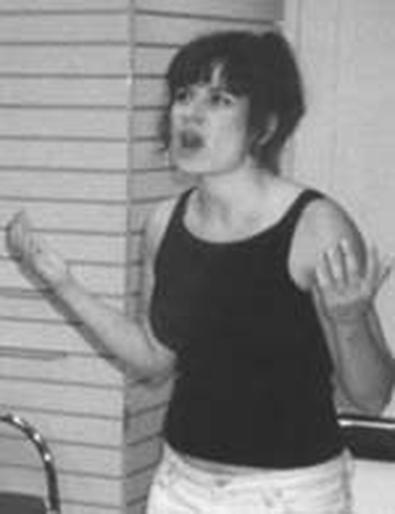
For Lynn A. Freedman, her first gig with Plays for Living was not what she expected.
"We did a show at Wingate High School [in Brooklyn]," says Freedman, an ebullient smile beaming out from her pretty, shyly side-turned face. "A young lady approached me after the show. This particular play was about domestic violence. And she expressed that she'd had experiences like that in her home. [She was] very thankful, and really wanted to talk to me and get me to validate her in a way."
For the young actress, the experience was satisfying. "It's really rewarding to have that kind of feedback after a show, instead of [thinking], 'Oh my God, did they like me? Did I get enough applause?'"
In its 60th year and boasting a list of past performers that includes Katharine Hepburn, Alan Alda and Ellen Burstyn, the New York-based Plays for Living (www.playsforliving.org) stages interactive 30-minute dramas that attempt to engage the audience on issues that directly affect their lives.
Splitting their time evenly between workplace issues (like diversity), community wellness issues (like the aftermath of 9/11), and youth issues (like date rape), PFL performs in schools, community center auditoriums and even corporate boardrooms, attempting each time to "facilitate positive social change" with one-act plays that are coupled with lively interactive discussions. What that change entails varies as widely as their clientele.
One recent performance, done at a community center near Lincoln Center, focused on Linda, a "thirtysomething wife and working mother" who has a father with worsening Alzheimer's, a boss pressuring her to travel more, children to care for, and a well-meaning husband who seems unable to grasp why she's not more receptive to his affections.
Though it sounds melodramatic, the drama lays out her conflicts efficiently and realistically, and all sides of the issue are given equal measure. After the show, the actors sit onstage while a facilitator asks the audience pointed questions well-designed to elicit debate.
Within minutes, folks are up, asking questions and offering advice to the actors as if they were the characters they just portrayed. Surprisingly, the actors--staying in character--answer and contribute to the discussion.
"Our goal is to get people to talk about [an] issue, and get an audience to start thinking it through and come up with their own solutions," says Emma Palzere-Rae, PFL's artistic director. "We try very hard not to present the answers. We look at how do we facilitate, in the broader sense of that word, having a community approach this issue and move forward on it through a play."
With more than a dozen plays in its repertoire, PFL does 250-300 performances a year, mostly in the New York City area but sometimes traveling upstate or as far south as Maryland. Wherever they are, the group often performs these well-written plays on a bare stage (save a few chairs) using a minimum amount of props, focusing attention on the characters and not on theatrics. In fact, in some cases, performers are called on to interact with people one-to-one, working almost solely through structured improvisation.
Recalls Freedman: "[With certain corporations, we are asked to] come in as our characters and sit down at a table with four or five employees and upper management, and conduct it as if... they have acquired our company, which is in distress, and they are now interviewing us to determine if they want to keep us on."
Challenge is a key word for PFL, since many of the subjects they address are very complex. But that's fine with them.
"When [we're] producing a new play... when I'm watching rehearsals or reading the first draft, I'm looking at, 'Where are the gray areas in here?' We want it to be gray, because that's what real life is. It's not all clear-cut in many respects.
"I mean, it depends on the issue. In domestic violence, it's clear -- there are good guys and bad guys. But then there's most of us who would obviously have the best intentions in wanting to help somebody that we might suspect is a victim of abuse, but would honestly not know how to go about that, or might be fearful that we would cause more harm than good. Those are [the issues] where we really like to get our hands dirty, [so to speak]."
In cases like that, PFL will often have information available for people who want to find out more--whether it's support groups or agencies designed to help. But for some performers, becoming informed on the play's subject matter even spills over into their downtime.
"A lot of actors get involved in doing research on the issues [on their own time]," says Palzere-Rae. "Just like with any role you do, you start to see the world from that perspective... You're suddenly aware of all these things that are pertinent to that role that you probably walked by every day and didn't notice."
That could mean a lot of research, since PFL often uses talented actors they trust for more than one play at a time (Freedman claims she's in "a gazillion" right now).
Says Palzere-Rae: "As an artistic company, [we've] been really working to build not just a group of actors who all happen to know certain plays, but a company of actors who care about what we do and bring themselves to that work."
In fact, though the issues are thoroughly vetted by a group of experts during a play's writing and development, in the early stages actors also contribute greatly to the process. "When a new piece is being developed, the actors play a very important role," adds Palzere-Rae. "Some pieces may be developed through improv as much as they are researched and the issue talked about."
Further, actors who work regularly with the company sometimes take on greater responsibilities, including facilitating after-play discussions. "We've been able to cultivate more work for, in some ways, a smaller company, and provide other opportunities beyond acting," says Palzere-Rae.
Though PFL does pay its actors (modestly, one told us), for younger actors like Freedman, the experience itself is invaluable. "[The interactivity in these plays] is the best practice you can get. Not only are you having to have conversations with [people], they're challenging you. They're coming at you with, 'Oh yeah, answer this.' And you have to be able to [think] on your feet."
Even for more experienced professionals like respected actor-director Arthur French (director of the current production of "Ma Rainey's Black Bottom" at The Classical Theater of Harlem), the chance to do something for the community is itself a reward. "It's not really about the money; it's really more about dealing with social issues."
"And it's nice to be part of something [in which] you feel you're helping on another level than just looking for a job." For French, in fact, PFL has been a life-long occupation. "I've been doing this [on and off] for 36 years now," he said proudly, adding: "It's just part of what I do."