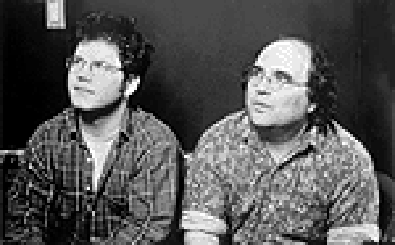
Move over, Ethan and Joel. The Kornbluth Brothers are here. The two San Francisco-based filmmakers, Josh and Jacob, made their first feature comedy, Haiku Tunnel, starring Josh and based on his solo stage show of the same name, exactly the way they wanted to make it. A key factor was the support they got from the local theatre community and others.
Josh, a writer/performer raised in New York City, first staged Haiku Tunnel--about his "vida loca" as an office temp--in 1990, the year his half-brother, Jacob, graduated from high school in rural Michigan. In 1992, Michael Peyser from Miramax saw the show when Josh toured it to Los Angeles and arranged a command performance for the heads of Miramax. Miramax optioned it in 1993, with Josh as writer and lead actor, but at the end of two years decided not to make it; Miramax had just been sold to Disney and told Josh it was no longer making small films. At about the same time, Universal optioned another of Josh's monologues, Red Diaper Baby; that, too, eventually was put in turnaround. Meanwhile, Josh had brought both scripts to the Sundance Institute's Writers' Lab, at the behest of Sundance's Michelle Satter. Although Josh and his friend John Belluci worked hard to adapt Haiku Tunnel into a screenplay, they never quite accomplished that goal.
Jacob, who was pursuing a filmmaking career in Los Angeles, had worked as a production assistant and producer, as well as directing plays, and eventually followed his big brother to San Francisco. "I had just written a script I thought was going to get an option," he recalled, "and I had just broken up with my girlfriend. I sort of knew if I didn't make a film right now, I would quit the business." The two agreed to collaborate and chose as their first joint project Haiku Tunnel largely for logistical reasons: It starred Josh and was set in San Francisco. Josh, who lives in Berkeley, has a wife and son there.
Despite the many setbacks in turning Haiku Tunnel into a feature film, Josh has no regrets.
"I'm grateful Miramax initially had some faith in me to be the center of the film. I'm also glad they put it in turnaround, because I think the film [we made] is so much better, " confided Josh, who with Jacob--as humorous, affable, and unpretentious a pair of producers as you'd ever imagine--met with Back Stage West in the conference room of the production company Pandemonium (which donated office space, just one of many freebies offered by colleagues). They were exhausted but triumphant.
The making of Haiku Tunnel was an all-day, seven-days-a-week, two-year-long project for the brothers. "One of the many challenges was to take a stage piece, specifically a monologue, and free it from the stage and from that form," said Josh.
The script eventually expanded from its original structure to become a comedy with multiple characters, locations, and--as in the monologue--elements of fantasy. Josh, as a hapless writer wannabe also named Josh Kornbluth, struggles to maintain his equilibrium as he agrees to "go perm" on his new temp job. When he forgets to mail out some all-important letters for his boss, events escalate out of control.
The film script was workshopped through extensive staged readings at the Z Space Studio. Both the Z Space and another small San Francisco theatre, the Marsh, have been instrumental over the years in helping Josh develop his solo work. Stephanie Weisman, the Marsh's artistic director, is one of the film's associate producers.
Some of the actors were Josh's friends; others the Kornbluths auditioned, often quite informally, at Josh's neighborhood hangout, Saul's Deli. Almost all the actors involved in the staged reading were cast in the film; Nancy Carlin became a co-producer, instead. Principals, stars of the Bay Area theatre scene, include Helen Shumaker, Warren Keith, Amy Resnick, Brian Thorstenson, June Lomena, and Sarah Overman. Even the smaller roles are filled by high-profile local actors like Margo Hall and Joe Bellan. By the time the cast members--hired on a SAG Limited Exhibition Contract--arrived on the set, they knew who their characters were, a huge advantage in a 20-day shoot.
The Kornbluths were advised to get Hollywood people, because that's supposedly how one raises money for a film. "Our thing was, I'm not a Hollywood person, I'm not famous, and we have all these people we've workshopped with, and they're all really talented," said Josh. "To have all local actors that we chose--it's so rare in film."
There is one Hollywood actor in a cameo: Harry Shearer, who plays the orientation leader. Shearer had seen Josh perform the monologue years earlier in Los Angeles and said he would be happy to be in any film Josh made. "So we sent him an e-mail: 'Harry, it's time!'" said Josh.
Money Matters
Raising money was indeed a huge challenge, something the Kornbluths, being sons of communists, felt ill-equipped to do. They had pizza parties at which the actors performed little scenes. "We never had anyone say immediately, 'I'm going to invest.' You follow up with phone calls. And you wait and wait," explained Josh.
They thought they'd come to the end of the line and knew they hadn't raised enough money when Weisman arranged for them to meet David Fuchs, a potential investor who was on her board and who had seen Josh perform.
"By this time," said Jacob, "we'd spent a year fulltime, Josh hadn't made a new monologue, I hadn't made a living [a friend let him live in his apartment rent-free for a year as an investment in the film], Josh had some heartburn thing, we were falling apart physically and worn down mentally." Along the way, Josh had been doing some performing gigs and also acted in two films: Lynn Hershman-Leeson's Teknolust starring Tilda Swinton, and Bartleby. But he was largely relying on his schoolteacher wife, Sara, to bring in the bread. And Jacob was coasting, grateful for friends who picked up restaurant tabs. There were no savings or Kornbluth family wealth.
But a few weeks after the meeting at the Marsh, Fuchs called back. He was in, for way more than they'd thought. Fuchs became executive producer; he and producer Brian Benson formed a four-person team with the brothers. When the film was accepted at this year's Sundance Film Festival, the four of them carefully hand-carried the precious canisters to the festival.
Would they find a distributor at Sundance? As it turned out, they were told theirs was one of three films that arrived at the festival that year without a distribution deal in place and got one--with their first-choice distributor, Sony Pictures Classics. The filmmakers met with two reps from Sony at 11:45 p.m. at Sundance and left with an offer from Sony that they knew not to count on until it was signed--which it was, shortly thereafter. They also signed with a foreign-film distributor, the French company ARP. Haiku Tunnel, abroad, is called I'm Just a Secretary--a title, say the Kornbluths, that made them realize the foreign distributors really "got" the film, understanding the central character's deep desire for escape from his office-bound life.
By then they had secured both a Los Angeles producer's rep and a publicity firm, thanks to referrals from Satter of Sundance, who'd been a source of support all along.
Ultimately, the brothers figure, the film cost between $200,000 and $500,000. Local vendors donated their wares, friends offered up their homes and businesses as locations (the film was shot in San Francisco and Oakland), crew members donated their time, and Skywalker Ranch ponied up with post-production sound.
FUBU
How have the two been getting along during the intense process? Fine--they're too tired to quarrel, joked Josh. Elaborating on their partnership, Jacob said, "Having known Josh's voice for so long, watching his plays, respecting him 'til the end of the moon, I wanted to find a way to take his voice and not lose it in the process." In a certain way, by collaborating with his brother, he lost his own voice, but both agree that a new voice emerged, a collaborative voice. Said Josh, who remembers diapering Jacob as a baby, "I think the aesthetic is this combination of what Jacob and I put into it. I love that about the film more than anything else."
The beat goes on. "It's been our running joke that it's never over," said Josh. The day they met with BSW, they would also rewrite the synopsis for the press materials and work on the website. A publicity tour was planned. They'd recently delivered the dubbing script to ARP, gone to L.A. for the transfer to video.
They also brought the script for their next film, a drama titled The Best Thief in the World, to the Sundance Writers' Lab in June. Said Jacob, "If we're lucky and Haiku Tunnel does really well, we'll get to keep on making films and go through this whole process again."
"There's an African-American clothing store called FUBU," said Josh, "[meaning] 'for us, by us.' That phrase is one that Jake and I always felt should apply to this film. It was all a matter of faith and friends." BSW
"Haiku Tunnel" opens Sept. 13 at the Embarcadero in San Francisco and Laemmle's Sunset 5 in Los Angeles.