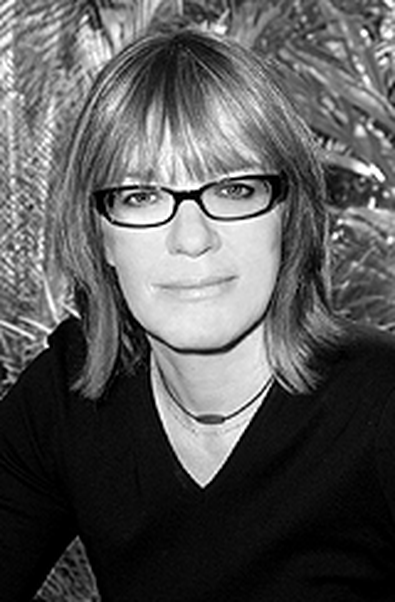
You could say that Elaine Pope was born into the business. Co-producer and co-screenwriter of Alfie (the remake starring Jude Law, to be released on Oct. 22), Pope grew up in Canada, the daughter of two "actors who didn't make it." Between her mother's trunk of old headshots and her father's sense of humor about television writing, she recognized as a child that there were jobs in making TV and movies.
"My father had this insane habit," says Pope. "Whenever we'd be watching something on TV, he'd always say how it was going to end, and then he'd say, 'I wrote the script.' I don't know why he said that, but at a very early age I realized that everything I was watching was written by somebody. I loved to write, and I got obsessed early on with 'I want to do that.' I understood what it was."
As a teenager, Pope started hanging around standup comedy. She got a waitressing job at The Second City in Toronto, where she crossed paths with Gilda Radner, Dan Aykroyd, and Bill Murray. Pope started out writing material for people whom she met through the company, then worked in television and radio in Canada--a good training ground, she says, because the shows had so little money that she had to learn to do every job. While working in Canada, Pope was aggressively trying to get her work seen in L.A. She even flew out once, drove up to the guard at the Paramount lot, and asked him to take one of her scripts around to producers. "It was a different time," she says. The guard did it.
Pope moved to L.A. for good 20 years ago when Lily Tomlin hired her on the first of several Tomlin specials she would write. Since then Pope has written and produced for the series Seinfeld, for which she won an Emmy. She was a writer and co-executive producer on Murphy Brown and Love and War. She worked on HBO's political satire Not Necessarily the News for its entire run, and she has written TV sketch and stage comedy for such performers as George Carlin, Andy Kaufman, and Larry David. With Carrie Fisher, Pope recently co-wrote and co-executive produced the TV movie These Old Broads, starring Elizabeth Taylor, Shirley MacLaine, Debbie Reynolds, and Joan Collins. Alfie, which she wrote with the film's director, Charles Shyer, is her first feature film.
Alfie today: Pope was 13 years old when her mother, who was English, showed her the original Alfie (1966) starring Michael Caine. Pope became obsessed with the film and watched it over and over.
"I really wanted to do a remake of it for years, but nobody would listen to me," she says. Then she met Shyer, who shared her enthusiasm for the project--a darker and more stylized remake than those he had done in the past--and things moved very quickly.
"It was almost surreal because it was so quick," says Pope. "We could only take it to Paramount because they owned it. We took it in. They called us within two hours and said OK. We spent a long time on the script, probably a year, and did many, many drafts, but as soon as we turned it in we got a green light. They offered it to Jude, and we were shooting. And everybody who I saw in my head writing it wound up playing the roles. Susan Sarandon and Jude and Marisa [Tomei]--that's who I saw in my head, and there they were."
Though the serial womanizer, Alfie, may be as recognizable today as he was in the 1960s, the job of updating the film was more daunting than Pope and Shyer expected, in part because major story points needed to be translated to contemporary life. The writers also had to bring the female characters up to speed.
Says Pope, "Alfie is kind of a timeless character: the person who doesn't really place a value on love, doesn't understand it, is afraid of commitment. I think it's really interesting that you can take that guy from almost 50 years ago and drop him into today, and he's still relevant. But the women in the original--it was before feminism--they were kind of a downtrodden bunch. Making contemporary women out of them was a big part of what we had to do."
In fleshing out the women, as well as Alfie, Pope and Shyer brought a psychological approach that was absent in the original. "People didn't really analyze themselves in those days, and look at behavior, and wonder what it was," says Pope. "Alfie, in the original, has no friends, no family, and never references anything like that. We tried to lay in a little bit about why he would be this way, make sort of a loop to a childhood that was without love and understand why he didn't place a value on it."
Shared experience: During their collaboration, Pope and Shyer have marveled at how many people assume that she would write the female characters and he would write Alfie, "When in fact it wasn't that way at all," she says. "Charles was very tuned in to what happened with the women, and I was very connected with writing Alfie. It's sort of sexist," she adds. "But I guess that's just the way people think."
Such assumptions surprised Pope less when she was first looking for jobs; she was told more than once by potential employers that they liked her but they had "already hired their woman."
If there's a benefit to a writer in being a woman in a male-dominated business, it's what one learns about behavior. Says Pope, "I would wind up a lot of times in a scenario where it was me and, like, 20 guys, and I actually used to like it. On Seinfeld and every show where I was the only woman, I'd always say, 'Please don't censor yourself. I really want to hear how you talk when there are no women around.' And that was an eye-opener because eventually they would. I learned so much about men."
Being observant about what makes people different is as important for writers as it is for actors, of course, and Pope admits to being a committed eavesdropper. For projecting herself honestly into others' points-of-view, however, the heart of her approach is in the common and recognizable, particularly for comedy.
"All of the stuff that I've done where I've been successful has been about things that have really happened or could really happen to somebody," she says. "I'm not good with joke writing where there's a preposterous scenario presented. Seinfeld, and writing with Larry [David], and Alfie, even, had so much of things that had happened to me and [on Alfie] to Charles, our own life experiences. That's the only kind of writing I can do. Hopefully the tone is something that people can relate to, and the laughter comes from the shared experience."
The same applies to acting, she continues: "Especially for television, I would always say to actors, 'Don't try to be funny. Just say the words,' because when people try to be funny, it's not funny. If you try to amp it up, it's not real. I've said that to so many people, and when they hear it, it can be really effective. I really believe that if you're in a situation that's funny, you don't have to try to make it be funnier; you just have to be in it."
In casting: When Pope is writing major roles, she allows the faces of recognizable talent to drift into her thought process, even before casting has begun. For smaller roles, however, she says there's plenty of leeway for actors to come in and offer something totally different than what she was imagining in terms of type or approach.
On Alfie, she remembers trying to cast a woman to play a doctor who examines Alfie's penis in a mortifying/comedic scene. "We started to think it was a bad scene because we just couldn't find anybody," she says. "And then one day somebody said, 'Why don't we start seeing men?'
"This guy came in, Jefferson Mays, who has a show on Broadway called I Am My Own Wife. He came in and played the character as this kind of sexually ambiguous German man. And it was a scream. There was an example of an actor doing something that was so outside the realm of what we were thinking--it was so much better, and we were so appreciative. He made it work. So I think you just have to see everybody and be open to everything....You're really lucky when somebody makes it their own and gives you something that's beyond your expectations."
If anyone can relate to wanting a role badly, it's Pope, who set her sights on her writing career as a young girl and more than got herself there. But in the casting room, she says, "wanting it" too badly, can ruin an audition.
"I love to run lines with my actor friends when they have auditions," she says. "And I always say to them, 'Don't want it when you go in; don't think about wanting it. Just think about enjoying the moment.' When you're casting and people come in wanting the part too badly, you feel it. It permeates the room, and then you just feel bad for the actor."
She offers: "I think a really good discipline when you're auditioning is to go in and be that person that you're supposed to be, and remove yourself from who you are, and your desire to have that part, and your fear of rejection, and the hunger that you have. It's very difficult, but the more you can break away from that and just embrace the moment that you're in, in that performance, the more effective it's going to be." BSW