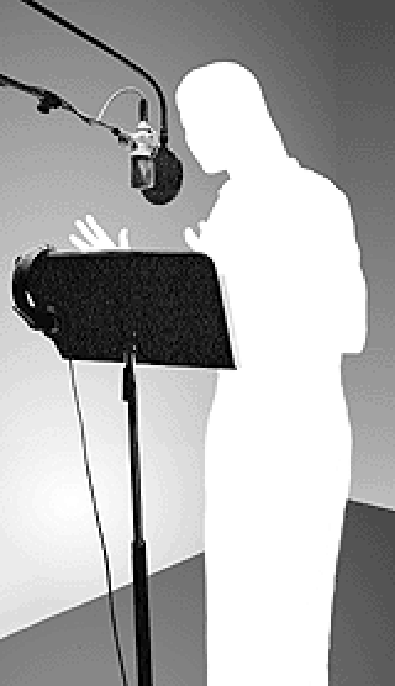
So you've decided you want to join the close-knit group of voiceover artists you hear working constantly on your radio, TV, and movie screens, but you don't know where to start? Insights shared here by a few actors belonging to that well-regarded bunch, as well as voiceover casters, directors, and coaches, can help steer you in the right direction.
Many of Hollywood's leading voiceover insiders interviewed quickly deny that the business of voiceover is a harder nut to crack than any other form of acting. Indeed voiceover veteran Charlie Adler dismissed that myth entirely.
"It has become my mission to discourage people from thinking of voiceover as a separate career," said Adler. "It's just as hard to get a career started in voiceover as it is for on-camera or stage. It's all performance. Voiceover is just another avenue. I have done commercials, television, theatre, and it has all helped in my long voiceover career, because acting is acting."
Adler has voiced more than 100 regular characters in more than 80 animated series, including the Emmy nominated series Cow and Chicken and Nickelodeon's juggernaut Rugrats, numerous features and specials, plus voice direction for television and feature films.
Said Adler, if you have an interest in voiceover, first work on your craft. "It's not about making voices," explained Adler. "It should be approached like any character you play, no matter if it's a talking chicken or whatever. I recommend people approach the work not by the sound of their voice but from creating the character."
Voice Breaks
Actors break into voiceover in various ways. Some aggressively pursue the genre, while others just happen to slip into it. For young voiceover artists Kyla Pratt and Spencer Breslin, it was just another audition that came their way, which led them to their first roles, respectively, Penny Proud on The Disney Channel's The Proud Family and Crandall/Captain Crandall on Toon Disney's Teamo Supremo.
"I auditioned with a whole bunch of other girls, and I remember it like it was yesterday," said Pratt, who also stars in UPN's One on One. "I was really nervous because they were just going to record my voice. They weren't going to do any glamor shots or anything that I was used to. I never thought I had a distinctive voice. But they called me in and I got it."
Like Pratt, Breslin was making the audition rounds when he went in for his first voiceover role in Supremo. "I auditioned for Crandall and I got the job and went into other cartoon stuff, like Peter Pan Returns to Neverland and Dumbo 2," said Breslin. "I love cartoons. I enjoy doing the voices. I like putting my voice into other characters' bodies. I think that's really cool."
Part of Pratt's attraction to voiceover work is that it allows her to make herself "look crazy without it showing up on film." She also enjoys the creative challenge of bringing a character out through the voice only. She admits to finding it difficult to conserve her voice for sessions: "I am a very loud person when I am in public or when I am at home, and I have to preserve my voice. I had to learn how to be quiet."
Joni Robbins' voiceover career started when a friend told her about a startup agency that was seeking clients.
"My friend set up an interview with Richard Lawrence, who later started Abrams, Rubaloff, and Lawrence. They were the first to sign me," recalled Robbins. "I went out, booked a few jobs here and there, but then I got a show called New Zoo Revue. I was Freddy the Frog. That show is still on the air in reruns. That actually started my career. I was very, very lucky."
Since then, Robbins has accumulated an impressive list of voiceover and voice directing credits. Robbins recalled a time when voiceover work wasn't quite as popular as it has become today.
"I got the New Zoo Revue right out of high school," she recalled. "I didn't know what I was doing, and there were no classes at that time. It was really not as competitive as it is now. There were times when only a few agencies were voiceover only, but now so many are voiceover it's grown a great deal. And though I never discourage anybody who's interested in this, I'm honest with them and let them know that it is very competitive and you really have to be the best you can be."
Numbers Game
One way to stand out from the crowd is uniqueness--sometimes with a trait that others might consider a liability. Niecy Nash had only one other voice credit to her name when she auditioned for the lead in the upcoming Comedy Central animated series The Robert Evans Show. "I didn't like my voice; it didn't sound like everybody else," said Nash. "You know how most women have a very dainty voice? Well, my voice is not that. And I thought that would limit me. So I just worked on perfecting my craft. What ended up happening was The Robert Evans Show put out a call for funny African-American females. I had nothing to compare this type of work to because I had never done it, so I just went in and did what I know how to do and I booked it." The key was her craft--and her unique vocal quality. "What I thought was probably going to be a handicap actually worked out being positive, because I didn't sound like anybody else," said Nash
For Keith David--a Broadway, feature film, and television actor--the path to voiceover work was not easy.
"When I got with my first agent and told him I wanted to do voiceover, basically he told me that it was the white boys' club and even that was made up of only a few cats who did everything," said David. "Well, of course, I'm never interested in that type of conversation. Don't tell me what I can't do. I can tell you what hasn't been done; let's talk about possibilities. So he began to send me out, and then it was sort of a numbers game. If you go out for enough, hopefully bringing something to the table, eventually somebody's going to say, 'Oh, let's get that guy.' Slowly, that began to happen for me. It took about three years of being sent out before suddenly I began to get requests."
Added David, "I had an extraordinary teacher as well. Norman Rose was my poetry teacher in New York. He was the voice of Juan Valdez for years. He did the CBS promos for years. He was greatly inspiring, and the way he taught was for us to find the voice of the poet and let that inform our characterizations."
Character creation is something Dionne Quan is quite familiar with. Quan, who currently voices Kimi Finster on TV's Rugrats, in addition to the recently released animated feature Rugrats Go Wild, unknowingly used a childhood pastime to prep herself for a career in voiceover.
"I guess it began when I first started reading books in Braille," recalled Quan, who is blind. "I would read them out loud and just have fun with them. It was something I just did for fun. At that point I didn't realize that it would develop into a career. My parents tell me that after school I would go to the store we owned and read books. The customers used to congregate around me because they liked the way I told the story."
Quan's parents immediately recognized her penchant for performance and encouraged her to seek out performance opportunities. "My parents have always been receptive--really attentive to things that interest me. I have Asian parents, but they're not traditionally Asian--most Asian parents want you to become a doctor or a lawyer. To have them encourage me to act was, like, outrageously weird."
Quan enrolled in a San Francisco conservatory. "I was acting onstage, but that didn't go too well because people were limiting me--limiting the parts they gave me," she recalled. "Finally I started taking voiceover lessons in the Bay Area and eventually landed my first job at 14." Since then, voiceover has offered the unlimited freedom of characterization she had always longed for. "I love it," said Quan. "There aren't any barriers that I've encountered." And her agent, Jeff Danis of ICM, told her she is the first blind person to successfully pursue voiceover. "I do know another guy who does it [voiceover]," said Quan, "but it's just something he does part-time, whereas this is how I make my living."
Scratch Tracks
Nash's unique, distinctive tone and David's deep, reverberating pitch are the kind of things that attract voiceover agents like Steve Tisherman of the Tisherman Agency. He explained that the announcers of yesteryear don't work as much anymore.
"The beautiful voice is not as important," said Tisherman. "I don't think buyers are interested in it. I'm not looking for another Procter & Gamble housewife who used to work so much on- and off-camera." Tisherman also said he is not particularly interested in imitations. "Imitation is the sincerest form of flattery--and that's all it gets. I mean, people equate 'star' when they're casting things: 'We want a Charlie Sheen sound.' Well, that doesn't mean a Charlie Sheen. It supposed to give you an idea of where their heads are at. It's nice to sound like somebody, but don't go for it."
Indeed what most interests Tisherman is voice imperfection.
"I'm interested in people with scratchy voices, people who [sound like they] gargled with nails, a break in the voice--things that years ago you would laugh at and think no one would use. Now, as you can see with the MTV-type edited spots, there are a lot of 'attitude' commercials. They seek out edgy, sarcastic, attitudinal voices that work very well with the images they put in front of your face. They want something that you hear walking down the street, the type that is not predisposed to knowing the technique of voiceover. Although they may know it, they are not supposed to sound like they do. They don't want the beautiful sounds; there is no need for it anymore. People have to adapt and evolve, which is part of the equation of making a success of yourself in this area."
Warner Bros. animation voice and casting director Andrea Romano also seeks out voices with character.
"It's so good to talk to your readers about people who do character voices, as opposed to someone who has a voice with character," clarified Romano. "Someone who has a voice with character is like a Brenda Vaccaro, a Clancy Brown, a Sterling Holloway, the voice of Winnie-the-Pooh. They each have an identifiable voice because it has texture, or depth, or some quality to it that we go, 'Oh, that's so-and-so's voice. I recognize that in a second.'"
This is an excerpt. To read ths story in full, Click Here