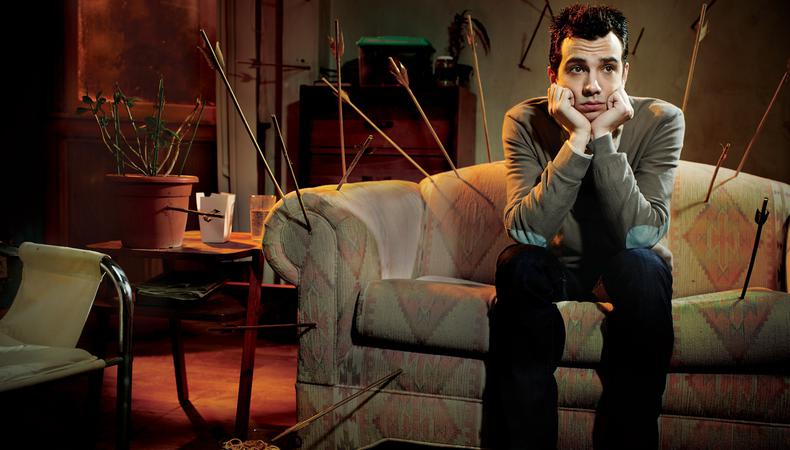
A working actor since age 12, Jay Baruchel’s résumé covers everything from R-rated comedies (“Knocked Up,” “This Is the End”) to family-friendly toons (“How to Train Your Dragon”) to award-winning dramas (“Million Dollar Baby”). Last year’s zany FXX comedy “Man Seeking Woman” finally put the funnyman front and center as lovelorn hero Josh Greenberg. Season 2 returns Jan. 6 for more laughter at his expense.
Tell us about Season 2.
We found a way to go even crazier and even harder than we did last year while also working in a bit more substance. I adore the first season, [but] I think this one does things that the first one doesn’t come close to. I think this one is going to surprise people how much more it gets to them and moves them. Don’t get me wrong, it’s still the same show. It’s still very much a live-action cartoon. It’s still very much a love letter to magical realism. All that and then some.
What have you learned about your acting on it?
I think if you cease to find something to learn from any gig, it’s time to check in on yourself. I’m constantly relearning things or finding new colors to paint with. I don’t think our show [would] mean half as much as it means if we’re not finding a way to connect it to very real, everyday stuff that people actually experience. So for me, I’m constantly learning about what makes a scene funny and why a series of words elicits this sort of reaction. Is this the best possible way? Am I as funny as I can be? It’s very proactive. I have no laurels to rest on. I’m learning as I do it, always.
Which of your performances has left a lasting mark on you?
When I got to work for Clint Eastwood on “Million Dollar Baby” and I got to play a character as distant from me as I’ve ever [played]. And while doing it, I’ve got Morgan Freeman on one side of me, Hilary Swank on the other, and then I’m being directed by Clint Eastwood. If you’re not better for that experience, you’re a fucking idiot.
On whom do you have an acting crush?
I go to the guys that I always go to. The same performances that inspired me before inspire me now. [Val] Kilmer in “Tombstone.” [Gary] Oldman in “JFK” and in “State of Grace.” And Daniel Day-Lewis in “Gangs of New York” and “There Will Be Blood.”
What do you wish you’d known before you started acting?
Most of the problems or more difficult stuff that I’ve had to deal with was shit that I was aware of, if only theoretically or in the abstract. I knew that this [was] putting myself out there, my face and my voice. If I’m already a sort of self-conscious kid, this is probably something to be mindful of. But I was aware of all these things. My parents made sure that these were all things that we had to be mindful of and take into consideration and [decide] that this is still something worth doing. I don’t know that I would’ve done it any differently.
What is your worst audition story?
[Auditioning] is one of these necessary evils that often can be a humiliating process. I’ve been doing it since I was 12. The thing that’s the hardest thing for me to deal with is when the notes on my audition would be that I had done everything right—that I had done terrific work and I was interesting or funny and I knew all my lines and I didn’t fuck anything up. It would always be something like, “Great read. Too ethnic-looking.” You know what I look like! If it was something that I have no control over, then boy, I sure wish I could have those two, three days back.
How do you typically prepare for an audition?
I take auditions very seriously. I always make sure I know my shit. There’s a reverence that I have for it and there’s a respect that I have for it. I think it’s an honor to get the chance to do it…. There’s the yeoman’s work of beating the words into my head and memorizing, getting that over with. But then the fun stuff is deciding how I’m going to do it. For me, I’ve found my little process is just, like, I turn the sides around and I write on the back of them a dozen adjectives that I feel like are the right area to lean into. The most fun came from when I could find as many contradictory ones as possible. If I could find sort of, like—this is a very broad placeholder example, but “shy” [and] “outgoing”—if I could find whatever happened in trying to combine these two antithetical ideas, the sort of energy that would come from that, I would always find that that’s when I was in love with doing it. That’s when I would be happiest.
Like this post? Check out more of our Backstage 5 interviews!