Paul Rudd says he has changed a lot. "In the beginning of my career, I did romantic leads, often in romantic comedies that I found boring," he explains. "It's hard to find romantic comedies that are good. They're often saccharine and generic. I was never a huge fan of anything generic. Now I'm a huge fan of many generic things--certain reality shows, for example. Now I'm a whole lot less precious about everything. But you got to have your 20s, when you wax rhapsodic about Egon Schiele," the early-20th-century expressionist painter beloved by brooding 20-somethings.
His days of artistic dogmatism over, Rudd says he prefers to play quirky characters now, even if they happen to be romantic leads. But a more important consideration is the project itself: "I ask myself, if I were in the audience, would I want to see this? I also use the musicians Tom Waits and Elvis Costello as my framework for making decisions. I ask myself, 'Would Tom Waits or Elvis Costello do this sitcom?' for example. I don't worry about being typecast or career repercussions as long as the project interests me--and that project can be an independent film or an Off-Broadway play."
That decision-making process has allowed the 37-year-old Passaic, N.J., native to rack up an impressive array of credits. Undoubtedly he's best known to TV viewers as the likeable Mike, Phoebe's boyfriend and later husband, on the phenomenally successful sitcom Friends. But he gained legions of new fans for his work in last year's hit film The 40-Year-Old Virgin, in which he wallows in romantic misery as Steve Carell's sidekick. Other films on his résumé include Anchorman: The Legend of Ron Burgundy, The Shape of Things, Wet Hot American Summer, The Cider House Rules, The Object of My Affection, and Clueless.
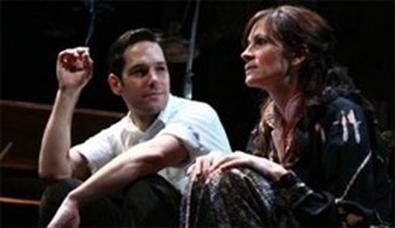
His stage credits include the 1998 Broadway production of Twelfth Night, with Helen Hunt, the comedy The Last Night of Ballyhoo (also on Broadway), and a 2000 staging of Long Day's Journey Into Night at the Lyric Theatre in London. Currently, Rudd is co-starring with Julia Roberts and Bradley Cooper in the Broadway revival of Richard Greenberg's drama Three Days of Rain, directed by Joe Mantello and running through June 18. The play-Roberts' highly publicized Broadway debut-gives each of the three actors dual roles.
Set in a downtown Manhattan loft in 1995, the first act considers the haunted lives and memories of a brother and sister and their old pal. The second act flashes back to 1960 and shows us the parents of those three characters at a defining moment in their lives. In Act I, Rudd plays Walker, a rootless soul in search of a home, literally and metaphorically; in Act II, he's Walker's father, Ned, a withdrawn man with a serious stutter.
Rudd was attracted to the play for several reasons, not least his love of Greenberg's work. "He's scathing, funny, and brilliant. There's his language and the depth of emotion beneath the language," he says. "I also wanted to work with Joe Mantello again. He directed me in [the play] Bash. He's a great director. He's succinct, not precious, and a man with a sense of humor. That's very important to me-in my friends as well as the people I work with."
His appreciation for humor also plays a part in his preparation for an earnest work such as Three Days of Rain. "The way I approach drama is through comedy," Rudd says. "To me, even if a situation is dire, I try to find the humor in it. The humor is what makes for the heartbreak. I use humor to deal with my own dramas-I don't have Sean Penn rage qualities."
Not that rage is needed in Three Days of Rain, but the play presents other acting challenges. "Walker is a man in despair; he's in a constant state of anguish," says Rudd. "The challenge is to sustain that level of mania and at the same time fill it." The character of Ned poses technical demands of its own, starting with the stutter: "You can't lean on that stutter, because it's hard for an audience to listen to and it's distracting. The scene is about his relationship with Lina [Roberts], not his stutter.
"Also, there are different levels of stuttering and different secondary characteristics that go with stuttering," Rudd adds. "I researched this subject and found that some people shut their eyes when they stutter, while others slap themselves. It's genetic and they can't control it. Something else I had to think about was Ned's sensitivity, a sensitivity that his son Walker never saw. I wanted to show Ned as the antithesis of Walker's picture of him."
Working with a megastar brings its own pressures, but "mostly for the police on West 45th Street," Rudd quips. "How many plays get mentioned on Access Hollywood? But Julia is a cool, lovely, smart person. She takes this work very seriously and is doing it because she loves the script. She doesn't have to prove anything."
And neither does Rudd, judging by the words of his colleagues. Says Mantello, "Paul's equally adept at playing one character for whom words come so easily and then another who has difficulty just getting the words out. His sensitivity serves him well as both characters: He manages to give them both real heart and find what it is they both long for."
Adds Cooper, "Besides being utterly hilarious, Paul has an ability to tackle emotionally complex characters. And being on stage with him makes you feel safe, and feeling safe is so important. I look up to him."
"He's an actor who's comfortable in any medium," says producer Marc Platt. "He can be hilariously broad and quirky in Anchorman and be easily as comfortable as a tortured character in a Richard Greenberg play. He has a quick mind, quick wit, and a real facility for language."
Fourth Billing
Of all the media he's worked in, Rudd finds theatre the most physically and emotionally demanding: "Along with the eight performances a week, once the play starts, you go right through. There are ongoing vocal requirements, and you have to memorize all the lines. In a film, you find out what you're shooting, and you'll memorize the lines for that scene."
Television, he says, is "the most restrictive and confining" medium. "There are so many cooks in the kitchen. If an actor has an idea, he can pitch it. Sometimes it's accepted, sometimes it isn't. But there is a lack of spontaneity. Television is not as creatively fulfilling as theatre, but I enjoyed it anyway." The money is an obvious benefit, he says, and so is the prospect of TV's wide exposure leading to more work. So did Friends open doors? "Not really," he says, laughing. "Maybe a little in television."
Upcoming projects include the films I Could Never Be Your Woman, helmed by Amy Heckerling (Clueless), and Wanderlust, directed by Shari Springer Berman and Robert Pulcini (American Splendor), each now in postproduction, along with Judd Apatow's new comedy Knocked Up. A character that he would love to tackle when he gets a bit older, however, is Cyrano de Bergerac, "one of the greatest roles ever written."
But Rudd says he doesn't aspire to Julia Roberts-like celebrity; his current co-star excepted, he is not especially impressed by superstars. One of his favorite actors, he notes, is "the until recently underappreciated David Strathairn. I usually find actors who show up to do the job more interesting than the celebrities. As a kid I was a die-hard Pittsburgh Steelers fan. There were superstar players like Terry Bradshaw and Lynn Swann. But my favorite was John Stallworth. I identify with the player who gets fourth billing, whether it's an actor or a wide receiver. I always thought Paulie [in Rocky, played by Burt Young] was far more interesting than Rocky."
The son of British parents, Rudd grew up mostly in Kansas, in Overland Park and Kansas City. His early ambition was to be a graphic artist, but he decided against it because "art school was so terribly expensive." At the same time, he'd developed an interest in performing, "but not theatre. I was more into standup," he says. "I had all of Steve Martin's records, Mel Brooks' 2000 Year Old Man, and the records of Bob and Ray. At the University of Kansas, where I majored in theatre, I became more interested in dramatic acting and realized that if I did standup work, it would be more along the lines of Andy Kaufman and performance art." Much later in his career, he was "peripherally involved with the TV sketch-comedy group Stella. The actors were friends of mine."
Rudd also trained at the American Academy of Dramatic Arts in Los Angeles, where his talent was duly noted. During his second year at the school, "a director there sent me to meet an agent, who sent me to audition for a play," he recalls. "The play's casting director sent me to a manager, who sent me to a commercial agent. I then booked a commercial and got into the union. My manager then sent me to audition for Sisters."
Landing the role of Swoosie Kurtz's son-in-law in the NBC series was a triumphant moment for Rudd, but it was tempered by a hard lesson in Hollywood etiquette: His manager quickly arranged for him to sign with a new agent, but Rudd failed to inform his old agent that he was moving on, leaving the rep feeling cheated and hurt. Rudd admits he feels uncomfortable about his actions even today, insisting he would never be that underhanded again.
Rudd is forthright in recounting other youthful mistakes. About one disastrous audition, he recalls, "I remember reading a story about how Danny DeVito auditioned for Taxi. He screamed and yelled and jumped up and down on the table, just the way Louie De Palma would, and he got cast in the part. So I decided to do the same kind of thing for a role I was auditioning for. But it was so inappropriate, and everyone at the audition was freaked out, especially when I lit a cigarette and then stamped it out on the carpet. All the way home I had this picture of the casting director on the floor, picking out bits of ash from the rug." The lesson? "I'm not Danny DeVito and I shouldn't try to be. It doesn't work. The best possible approach for an actor at an audition is to just be yourself."
Rudd dropped out of Sisters after its second season--to his agent's chagrin--in part because he couldn't stand watching himself on the show: "I was doing a bad Kelsey Grammer imitation--so right out of acting school. I was totally unrelaxed. And I decided I wanted to study Jacobean drama," he adds with a grin. That's precisely what he did at a three-month workshop at the British American Drama Academy, where he trained with Michael Kahn and was directed by Ben Kingsley.
Realistic Details
Aside from that experience, however, Rudd says most of his acting training was pretty worthless, with one notable exception. "The first day of my first acting class as a freshman, the teacher gave us an exercise that I still find valuable," he says. "She said, 'You need to shave, but you have only five minutes to do it because you're due at an audition.' So we all got up and went through the motions of shaving. At the end of the exercise, the teacher said, 'You all looked like you were shaving quickly. But none of you was shaving well.' If we were shaving for an audition, we would have shaved well to look good. It was that realistic detail that we lacked. I've always remembered that."
Expanding on the subject, he continues, "The problem with most acting training is that it's confusing. Acting--pretending to be someone else--is not all that tricky. We all did it as kids. The problem is that acting teachers have to justify their jobs and the fact that kids, or their parents, have spent thousands of dollars to be with these acting teachers eight hours a day. So they make it altogether more complex than it is. I'm sorry, but when I lie on the floor pretending to be the color blue, it's meaningless."
More serious, he contends, is that these acting teachers are not qualified to deal with some of the emotional issues they tap in their students: "They talk about sense memory, and 'Remember what it was like to be raped' if a student had been raped. That kind of thing has nothing to do with acting, rarely anything to do with the scene, and it's terribly abusive to the kid who is put through it. The most worthwhile thing I got out of acting school was the practical stuff: Learning how to memorize lines by writing them down. I also found the reading of plays and doing scenes useful."
Whatever Rudd's technique--he admits he has none and doesn't even know what the term means--he worked steadily in Los Angeles for a number of years before relocating to New York City, just as Friends was ending its long run. Of his most high-profile TV job in L.A., he says, "Yes, they were all friends. Yet there was something surreal about the final episode. Because I was not in on the show from the beginning, I had the sense that I was watching something I shouldn't, like watching someone taking a bath: all those tears, the trips down memory lane."
Rudd says it's a little too easy to be dismissive of sitcoms. Since the advent of the remote control, they have required a particular set of skills, he explains, with that bit of technology changing the way sitcoms were written and, by extension, performed. "Years ago, the great TV comedies--M*A*S*H, All in the Family, The Honeymooners--were structured like plays. Minutes of dialogue could go by in order to create the story. Now it's setup, setup, and punch line. It's all about the delivery of the jokes, and the performances become heightened. Actors can develop bad habits because they're not really talking to each other. But those actors who do it well, especially in scripts that are horrendous--that's talent!
"There's a hierarchy of snobbism," Rudd continues. "There's the belief that if it's television, it's less than film. Often TV's quality is far superior. I like The Sopranos, Lost, The Simpsons, and the British version of The Office--that was the greatest show ever. I also like American Idol now and again."
Performing eight shows a week in the just-opened Three Days of Rain, however, Rudd doesn't have a lot of time to catch his favorite programs, but his sense of humor remains intact. He jokes that he hopes audiences walk out of the theatre saying, " 'God, that wasn't a weather report.' ...I'm not one of those actors who says, 'I want theatregoers to relate to their parents in a new and better way as a result of having seen this play.' But I do hope they feel they've been part of an experience that makes them feel sane. Kevin Kline says, 'Great theatre makes you feel sane.' "
Asked what he wants the public to think when it hears the name Paul Rudd, he responds modestly, "A good actor with some semblance of integrity--if by chance they know who I am."