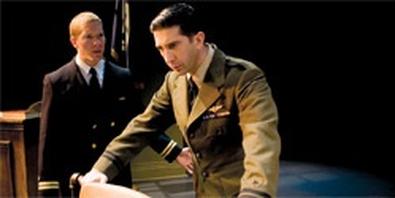
David Schwimmer always wanted to appear in a Broadway play. "But there was that little TV show I was doing for 10 years, and I didn't have the opportunity to take the time off," he says. Not that he's complaining. that "little show" he's talking about, Friends, was one of the most successful sitcoms in recent television history, and thanks to its stars' much-publicized $1 million-per-episode salaries, "I have financial freedom to choose the projects I'm passionate about," he says.
The current focus of Schwimmer's passion is the upcoming Broadway revival of Herman Wouk's The Caine Mutiny Court-Martial, slated to open at the Gerald Schoenfeld Theatre May 7. "I look for roles that are very different from the previous characters I've played," he says. And so, unlike Schwimmer's geeky, love-struck Ross Geller on Friends, his character in Caine Mutiny, Lt. Barney Greenwald, is a brilliant defense attorney who loves legal gamesmanship as much as he loves winning, though in this case it results in a profound moral conflict. The courtroom drama recounts the events aboard a World War II ship during a fierce storm, when Lt. Stephen Maryk, believing the captain to be emotionally unstable, seizes power from Lt. Cmdr. Queeg and takes over the ship. Though Greenwald is deeply grateful to Queeg for defending the country against fascism, in order to defend Maryk, the attorney must destroy Queeg's credibility, pulverizing him on the witness stand in a scarring emotional battle—thus his moral dilemma. The 1954 play is based on Wouk's best-selling novel The Caine Mutiny, which won a Pulitzer Prize in 1952 and later became a successful film, with José Ferrer as Greenwald and Humphrey Bogart as Queeg.
"I rented the movie four months ago, although it had very little to do with the play," Schwimmer says. "The court-martial is the last seven minutes of the film, and there's no mention of the fact that Greenwald is Jewish, and that's central in the novel and the play. That's one of the reasons I wanted to do this part. I felt that as a Jew, I had a special identification with this character and his connection to those who have no voice. It was also important for me to present a Jew of that era who resisted discrimination against Jews. I believe the image of Jews as passive still exists in theatre. I like playing a Jew who was in the military. I had five great-uncles who served in World War II, and that makes me feel an added responsibility."
Indeed, Schwimmer has encountered discrimination in his own career: "No one says you're too Jewish for a role. They say you're too 'dark,' 'ethnic,' or 'character.' They're all codes for 'Jewish.' In fact, even on Friends I had to fight for it to be acknowledged in one of the scripts that Ross was Jewish. Networks continue to be uncomfortable with it."
Tackling this historical drama required extensive research. "I immersed myself in books and films on World War II, the Holocaust, and the Navy," the actor reports. "I found the hot songs, the big movies of the era, and discovered that the ballpoint pen came out in 1943. I also did some research into paranoia: As a lawyer prosecuting someone like Queeg, I'd have that kind of information. And since my parents are both lawyers, they went over the script and made notes in the margins on the weaknesses and strengths of the case."
According to his colleagues, Schwimmer's efforts are paying off. The play's director, Jerry Zaks, says, "I'm a huge fan, no more so than in the last few weeks. David is giving the kind of performance that is everything I hoped it would be. He brings a credibility and authenticity to the role as an intelligent Jewish man who is in control and then loses that control. That's Barney Greenwald. And David's a mensch. He has no personal agenda. He's not there to upstage anyone else. He respects his fellow cast members and he likes being part of a team." Joe Sikora, who plays Maryk, agrees: "David is bright and intuitive and brings a very human quality to his work. He is an open and giving actor, more interested in moving the story forward than in having star moments."
In person, Schwimmer is unassuming and modest. "I have no big movie career," he admits. "I'm not 'box office.' The kind of role I'd be cast in would go to Ben Stiller. The best picture I did, Duane Hopwood, you'll have to rent." He adds that it's just fine with him if theatre audiences have never seen Friends. Indeed, he'd prefer it. Without that familiarity, they don't arrive with preconceptions about what he can do and, more important, what he can't.
"It's hard for audiences to view me in another context," he says. "When I did the TV movie Band of Brothers, I played a neurotic Army captain who berated and belittled everyone and was not unlike Queeg. Yet I still read a review referring to my performance as 'Ross in the Army.' I was stunned. The two roles had nothing in common: different context, different period, different everything. In my darkest moments, I felt that unless I'm in disguise—unless I'm wearing a beard or eye patch—every character I play would be seen as Ross." He recently wrapped Big Nothing, a dark comedy—"My favorite genre," he says—and has his fingers crossed that audiences will view his performance in it without referring to his TV past.
Born in Queens, N.Y., and raised in Los Angeles, the 40-year-old Schwimmer was the class clown; he loved performing, though initially his sights were set on a medical career. "Acting class gave me the excuse to talk with--do scenes with--the cute girls, and as much as I loved biology, I hated chemistry. The thought of eight more years of chemistry in order to be a doctor..." He shudders. "Anyway, the girls in chemistry class weren't very cute."
So Schwimmer majored in theatre at Northwestern University, where he and seven close friends launched Chicago's Lookingglass Theatre Company--and 18 years later, it's still going strong. "We were directing each other in college, so we figured we'd continue doing that in our own company," he says. "We were committed to presenting original work written by our members and adaptations of classics. We've done an adult version of Alice in Wonderland, Upton Sinclair's The Jungle, and Mary Zimmerman developed her Metamorphoses with us. We've always been about process, and we're a physical, improvisational-based theatre that's ego-free.... Every actor has an ego, and also the ability not to put it first. We all have to be passionate about our ideas and state them passionately, but in the end the group makes the decision. It's a true democracy."
But the creation of Lookingglass was not the only thing that made the late 1980s exhilarating for Schwimmer. His career was about to take off in another direction, when agents and managers saw him perform a scene at Northwestern's annual actors' showcase. "A manager approached me and said, 'Come to L.A. I can make you a big star,' " he recalls. "It was tempting, but at the same time I had just started the company with my best friends, who were also my artistic collaborators. But I honestly believed with this manager's help I could go to L.A., be a film star within a few months, make lots of money, and then come back to Chicago and act with my company. I went to L.A., giving myself six months."
That fantasy of a college acting student didn't come true, but the move had its advantages: "My manager got me an agent--Leslie Siebert at Gersh, who is still my agent. She took a leap of faith, sending me out to many auditions over the next few months. I was getting great feedback, but I wasn't getting cast. And I wasn't doing any theatre either. Finally, in the fifth month, I got the lead in a two-hour movie of the week. Yet I [still] waited tables. For seven years before I got Friends, I was waiting tables. I was getting occasional parts on television, but it was certainly not enough to live on."
A career turning point came in 1994 when Schwimmer shot 12 episodes of a series called Monty. It was an awful experience, he recalls. "I vowed I'd never do television again." But it allowed him to save $100,000 and, more crucial, led to an audition for producer Marta Kauffman, who was casting a TV pilot called Couples. Schwimmer didn't get the part, but when Kauffman and her partner, David Crane, were casting the pilot for their new series Friends, she remembered his performance and sent him a script.
Initially, Schwimmer didn't even want to look at it. "My experience with a series was creative hell, just the opposite of the kind of collaborations I like. I also hated the prospect of being owned," he says, referring to a long-term television contract. "But then Marta said the key word: ensemble." The actor was quickly flown out to meet with Kauffman, Crane, and veteran sitcom director James Burrows (Mary Tyler Moore, Taxi, Cheers). "They said all the right things to me, and the pilot was shot."
Friends, needless to say, was "a life-changing event," notes Schwimmer. "I was working with a group of people--actors and writers--who were at the top of their craft, which raises everyone's performance. The atmosphere on the set was wonderfully collaborative, and it was a real joy to go to work. The audience and fan response was terrific." But he has no intention of doing another TV series in the near future. He's enjoying his freedom too much now. And he wants to spread his wings as an actor and director.
During hiatuses from Friends, Schwimmer got a taste of what that would be like, starring in the Los Angeles premieres of the plays d girl and Turnaround, both by college friend Roger Kumble, along with Warren Leight's Glimmer Brothers at the Williamstown Theatre Festival. Last year he made his London stage debut in Neil LaBute's Some Girl(s). And Schwimmer has acted in or directed a number of projects at Lookingglass, including The Master and Margarita, West, The Jungle, The Idiot, and his adaptation of the Studs Terkel book Race.
One role he is now dying to play is the title character in the Broadway musical version of the film Young Frankenstein, currently being developed by Mel Brooks. Schwimmer says he sings and dances well enough to pull it off. He'd also love to be cast as an action hero--precisely because no one would ever think of him for that kind of part. "I'd also like to direct a film I've been trying to write. It's about a sexual predator on the Internet. It has social relevance, but it's disguised as a dramatic thriller. And I'd like to direct Neil LaBute's brutal play Fat Pig. It's a real tragedy with tremendous emotional impact. And Neil is a fun guy to work with." The same LaBute whom some have called a misogynist? "He's a great big teddy bear," Schwimmer insists.
As a director, Schwimmer thinks his acting experience has served him well: "I know how to talk with actors and how to handle acting problems. For example, if an actor is thinking too much, I might give him some business or tell him to go take a walk."
Conversely, his work as a director has broadened his perspective as an actor: "Actors can be insular. Working as a director has helped me understand that the whole story is bigger than myself acting in it. I have a greater understanding of the arc and what I can do to help another character achieve the arc. In film or TV, I have a better grasp of how the camera works for the actor and how to better use that camera to the actor's advantage. I'm aware of continuity--what an actor was wearing and where a prop was placed before we stopped shooting.
"The one difficulty I have as an actor, now that I've directed, is getting the director out of my head and surrendering control, having faith and trust that the director knows what he's doing." Jerry Zaks, he adds, is the kind of director he likes because "above and beyond anything else, he's interested in finding the play's truth." In the future, Schwimmer says, he'd love to be directed by that classic "actor's director" Mike Nichols. "I worked with him briefly--a couple of hours--15 years ago in a film called Wolf," Schwimmer recalls with a laugh. "I played a cop who handcuffs Jack Nicholson."
The Caine Mutiny Court-Martial is a far cry from that pre-Friends role as Cop #2, and Schwimmer hopes theatregoers appreciate the complexity of his character's dilemma and understand the scope of Queeg and Greenwald's tragedy: "If I'm doing my job right, the audience will be moved." But he doesn't want them leaving the theatre thinking the play is an antimilitary statement: "I hope they're able to differentiate between the military and the way an administration uses or misuses the military. World War II was very different from the one we're in now. That war needed winning."