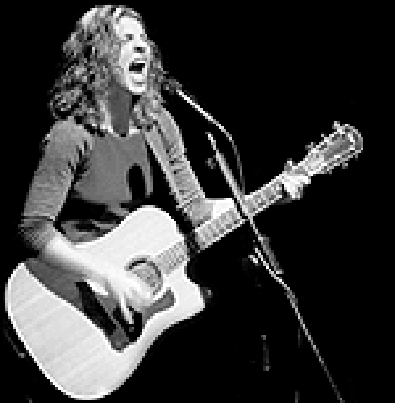
Like actors, musicians are artists who thrive in the moment of performance; they may practice their art privately but don't really do their art except in the company of others. And just as it's said that an actor only really learns to act by doing live theatre, it's also a truism that a musician doesn't really become a musician until she's logged some stage time in front of paying customers and peers.
Finding and building an audience for one's art is also as much a challenge for musicians as it is for actors. Actors can put up showcases, write solo shows, make independent films, or, most of the time, just hope to be cast in productions that will reach a larger audience. Musicians likewise can put together bands, perform showcases, make CDs, and hope for a major record label--hell, any record label--to make them a deal that will give them wider exposure.
In both cases, though, as we've learned from talking to many actors, the first steps--and usually the second, third, fourth, and so on--are up to the artists. Indeed, the interest of industry folks in either the film or the music business is typically most piqued by actors and musicians who've already got their acts together--who have an aesthetic, an audience, some product, and, in short, have made a career of their craft, if not a living. And most of these self-starters achieve a kind of success that may be all the more precious for having been earned on their own merits and savvy.
See What Develops
Much has been written about how new, more accessible digital recording technology has made it easier for artists to make their own product, and about how the Internet offers a new distribution and promotion model for artists. But while CDs and a web presence are indeed de rigueur for today's musical artists, there's still the work of getting out in front of the people with your guitar.
Singer/songwriter Eleni Mandell, a Silverlake chanteuse with two independently produced CDs, is currently on tour throughout the U.S. and U.K. with a band. She'll probably lose money on the tour, she confessed in an interview before she left, just as she's lost money making her two CDs, which have garnered retail distribution and sold under 10,000 each. What she will get out of the tour is a certain amount of performance fees, a percentage of cover charges, CD sales--and an inestimable amount of exposure, press, and attention. She has a manager to handle publicity and radio, but she booked the tour herself, which meant a lot of cold-calling, and re-calling, and a certain amount of embarrassment. But she's a living model of a proactive artist who does her art for its own sake and always finds a way to keep at it.
When she made her first CD, Wishbone, in 1999, it turned things around for her almost immediately--just not in all the ways she'd expected.
"I'd been performing in L.A. for about seven or eight years without anybody knowing who I was, and suddenly I had a press kit," she said, referring to positive reviews in Pulse and Billboard, which led to the distribution deal and a tour. At the start of the tour, Mandell admitted, "I thought, Oh, I'll get a big record deal, and next year I'm going to have money and be traveling the world." The deal and the money didn't materialize, but she did make another CD, Thrill, which has sold more copies and garnered attention from eclectic deejays and music supervisors (the driving "Pauline" recently appeared in an episode of Six Feet Under). Big-time success hasn't been in the cards yet, and that seems to be OK with Mandell, who still works a day job pulling espresso at an Echo Park coffee bar.
"There's just so much you can do on your own, and even people who do get record deals expect their record labels to do all of these things for them, and then they get someplace and they're like, 'No one knows who we are, nobody's at the shows,'" she said. She could just as easily be talking about actors who get agents when she said, "They have this sense of entitlement, that they don't have to be proactive and work for stuff."
Singer/songwriter Janet Robin could be the definition of proactive. Indeed, she's stunningly entrepreneurial, keeping her overhead low by touring alone and seeking out performing gigs anywhere they'll have her--restaurants, bars, bookstores, even San Francisco's popular laundromat/coffeehouse Brain Wash--and recording her two self-produced CDs, Open the Door and Out From Under, in large part at home with a pair of digital tape recorders. A seasoned guitar virtuoso who's toured and recorded with Lindsey Buckingham, Robin can line up great backing musicians for recording or local appearances, and she also takes session and backing work when it comes up.
"Everything basically gets funded through my shows and CD sales," she said. "I'm surviving doing this on my own." She agreed that A&R folks at record labels "aren't doing much development right now," by which she means plucking up unformed, promising talents and shaping a career for them. "If you can find a way to get out on your own and make things happen, it's a two-sided thing: It makes you more attractive to bigger labels, but it's also better for your own career. If I got a label deal, it would help me with fans, catapult me to a bigger audience, maybe get me some radio play. And in the end, if that would make them happy enough to keep me, great. But I'd also be OK if I got dropped by a label." In other words, the career she's already got going could continue, as it has for years now, with or without a label.
But doing it yourself has other, more immediate benefits, she explained: "Artistically it makes you a better artist, because you're out there on the road--I've done a lot of writing on the road--and it forces you to be in uncomfortable situations and deliver."
The decision to make her own CD, as with Mandell, came up inevitably a few years back, after playing around and making some homemade cassettes. But Robin, typically, took an especially proactive approach to her CD.
"I have friends who've made a thousand CDs, and they're just sitting there in their apartment," she said. "I still think people should think about, Are they ready to make the CD? I said, If I'm going to make a CD, I'm going to have a plan to sell it, to tour with it."
Calling Card
Cabaret singer Lee Lessack is similarly entrepreneurial: He made a self-titled CD years ago and learned the ropes of production and distribution, taking full advantage of digital recording and Internet marketing. Now he has his own cooperative "label" for cabaret artists, LML Music, which distributes a growing catalog of cabaret and Broadway singers' CDs.
"When I decided I wanted to do the CD, I was unemployed at the time--I had $37 in my checking account," he recalled. "I raised the money, sent a letter to investors, came up with a skeletal budget, and raised $12,000. I should have raised $20,000."
Indeed, between $10,000 and $20,000 is a good ballpark budget for making a CD, depending on the sparseness or lushness of your musical genre and the number of favors you can call in to complete the record. The costs include recording time, session musicians, mixing and mastering time, and CD duplication and packaging.
And while distribution through a source like LML--which has a retail deal with Koch, an international distributor--gets product out to stores, the way cabaret artists really move the units, as with Robin's solo acoustic gigging, is by performing a lot, all over the place. Some of the artists on LML Music appear in Broadway shows and on musical tours (Louise Pitre, of Mamma Mia fame, has a CD on LML), so getting those shows to add actors' CDs to their lobby merchandising cart is another valuable point of purchase. Lessack recently got the Chicago production of Joseph and Amazing Technicolor Dreamcoat to sell his CD of Brian Lane Green, who plays the lead, in the lobby of the Royal George Theatre.
But while new technology and businesses like LML make it relatively easy to turn out a product, Lessack still cautioned eager performers: "If singers don't have a career yet, who's going to buy their CD? I encourage people to wait until they have a career where they're working clubs around the country. It has to be something I can sell."
Adryan Russ is an exception to the rule. A songwriter/composer mainly for the musical theatre, Russ has just put out a CD of her pop and theatre songs, Everyone Has a Story, sung by a gallery of cabaret and Broadway stars from Jason Graae to Susan Egan, through LML Music. Her reasons are similar to those of most singer/songwriters and bands, but her business plan is necessarily different, since she's not pounding the pavement as a performer.
"I think of a CD as a very expensive calling card," said Russ, who with Doug Haverty wrote the Off-Broadway musical Inside Out, which has had a successful afterlife in regional theatre and on a cast album. "My original intention was to create something so that people would know what I do. It really got beyond that." Indeed, once she and producer Bruce Kimmel decided which of her songs they would record, they "cast" it from among performers they knew. So what are Russ' expectations for the slickly produced album?
"I imagine one can make some of the budget back," she said, but she's realistic about her chances, minus a tour of personal appearances. "If I can make it back by getting other work, I'll be happy." Her advice for cabaret artists, which could apply to anyone making a CD: "Be simple, be straightforward, be honest about representing who you are. Cabaret is about knocking that fourth wall down and presenting yourself directly. Do that as best you can with a CD, because people aren't seeing you, they're just hearing you."
Talent Pool
For a rock 'n' roll band, making a cheap recording is all too easy--for one, the musicians usually play for free. Kung Fu Hula Girl, a quirky L.A. trio who just self-produced an album called Hitz!, had an added advantage: They're skilled players who've been able to parlay their talents into currency. The drummer, Colin Chambers, who can change time signatures as easily as breathing, got dozens of hours of studio time for free by offering his drumming services to the producer for other sessions.
"We've been fortunate, 'cause we're all musicians," said Chambers, whose day job is in the drum department at West L.A. Music. "We've been playing so long, we've come across a lot of people who would just help us. We really sat down and said, 'We can put out a professional record and not spend a lot of money. What resources can we pool?' And we did it. The only thing we paid a substantial amount of money for was the pressing--about $1,800."
Kung Fu Hula Girl, which plays regularly at such L.A. venues as 14 Below and the Gig, has a big enough following that a recent CD release party sold enough copies to cover that pressing charge. Chambers said the band doesn't necessarily have a larger strategy for the CD--it's been an end in itself.
"Yeah, eventually we'll be getting into hiring somebody in terms of PR," said Chambers. "It's the beginning of a larger plan. For now, we just wanted to prove to ourselves that we could do it."
This self-starting spirit is what has driven all these artists to make their own recordings--not profit but passion. And that's what audiences (and presumably record labels) respond to, anyway: passion. Mandell may have put it best: "I always feel like I didn't have a choice with music; it chose me. Which is why I sort of forged ahead on my own and didn't wait for a major deal. You know, I wracked my brain for something else to do, and I just didn't come up with anything."
Sound like any actors you know? BSW
www.elenimandell.com, www.janetrobin.com, www.lmlmusic.com, www.kungfuhulagirl.com. Janet Robin also recommends the guidebook Musician's Atlas; we recommend reading and shopping in the publication Music Connection.