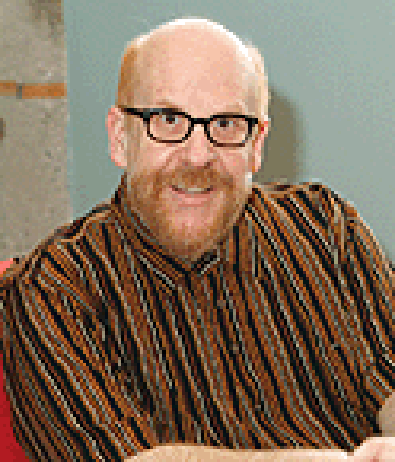
Stuart Cornfeld says he has always been fortunate to hang out with "interesting people." In this group he seems to include, with equal emphasis, the "smart, creative, different" kids he sought out as friends in school and all the cultural figures and industry mavericks with whom he has shared paths. If he leads an interesting life, it may be in part because his default attitude is one of interest: He's a guy who--faced with a rather nervous interviewer--compliments her shoes, asks her a few questions, and discovers, within in a minute, that they both lived in Berkeley in the '70s.
Hollywood was Cornfeld's territory long before he became a producer. He grew up near the movie industry, in Silverlake and then the Valley, and remembers L.A. as a great place to be a teenager, where there was a vibrant music scene and it was safe to hitchhike. He and his mother shared a love of the movies--he was always "that person who went to see everything"--and he knew "real people" who were in the business: A friend's dad was Hitchcock's storyboard artist (Harold Michelson), and the same friend's mom owned a research library based at AFI.
Cornfeld never thought about working in the movies--until he graduated from UC Berkeley with his degree in psychology. Unsure of his next move, he went on the game show Split Second and brought home a couple of days' winnings.
He says, "My girlfriend at the time said I should figure out how long I could live on that money, figure out what I'd always wanted to do with my life, and just go and do whatever that thing was, no matter how weird it was. Until that moment, I'd never thought of doing anything in the movies. I went to the American Film Institute and volunteered to be a PA on a student film, and it just all sort of clicked."
After graduating from AFI in the late '70s, Cornfeld, at 27, produced his first studio film, Fatso, written and directed by Anne Bancroft and starring Dom DeLuise. Bancroft's husband, Mel Brooks, employed the young filmmaker from '78 to '81 at Brooksfilms, where Cornfeld brought David Lynch to Brooks' attention for The Elephant Man. Cornfeld later produced David Cronenberg's The Fly in conjunction with Brooks' company.
With a history of shepherding talented writer-directors--Darren Aronofsky is among those who consider him a mentor--he seems to have found a place for his talents with partner Ben Stiller, running their production company, Red Hour Films. There he most recently produced Dodgeball: A True Underdog Story, the debut feature from writer-director Rawson Marshall Thurber. Cornfeld is an independent producer with the freedom to act on his instincts and according to his taste, a first-look deal with DreamWorks, a collaborator who's the in-guy of outsider comedy, and he has plenty to keep him interested.
A Red Hour Film: According to Cornfeld, the method by which he and Stiller choose their projects is very simple: They make the films they would want to see. "For the most part, our taste runs to comedies that are sort of off-center, character-driven stories about outsiders, stories that explore obsessive characters-engaging stories about emotionally relatable characters," he says. "It's kind of all over the place, because we do things like Dodgeball and then we have projects like [George Saunders'] CivilWarLand in Bad Decline, which is a beautiful, beautiful story that deals with the plight of American mid-management, and the concessions you sometimes have to make in the workplace so that you can provide for your family.... It has certainly got comedic elements, but overall it's kind of a transcendent, contemporary tale."
Projects in the works at Red Hour also include Tropic Thunder, a comedy about five actors who go on location to shoot a war movie and find themselves in a real war-like situation (Stiller collaborated on the script with Etan Cohen and Justin Theroux); a biography of musical genius and tortured wit Oscar Levant; a horror film from A Simple Plan writer Scott Smith; the romantic comedy Date School, to be directed by Miguel Arteta (The Good Girl); and Blades of Glory, a comedy about two rival figure skaters who are banned from the men's individual competition but exploit a loophole allowing them to compete as a pair.
Having been drawn to producing by his passion for creative collaboration rather than the challenge of engineering the perfect summer blockbuster, Cornfeld has always felt comfortable going where his enthusiasm leads him. In his early career it led him to Lynch. "When you see Eraserhead, there isn't much question; the guy is just a true artist," he says. "It's just good taste. It's never been, 'Oh, gee, this is going to turn into something important.' When I saw Eraserhead I just really wanted to do a movie with David."
When scripts make it onto his desk at Red Hour, Cornfeld insists, the names and histories of the writers are immaterial, and complete unknowns--such as brothers Craig and Jeff Cox, who wrote Blades of Glory while one worked at Starbucks and the other as a closed-caption editor--have as good a chance as anyone. "The interesting thing about spec scripts is, it's really a meritocracy," he says. "It doesn't matter if you're an Ivy League graduate, or a successful actor, or a 70-year-old hunchback; if you send in a script, people are just reading the script and evaluating that movie."
In front of the camera: Cornfeld never studied or aspired to be an actor, though he has appeared in a few films for directors he knows (he played Judge Reinhold's boss in Amy Heckerling's Fast Times at Ridgemont High). Although he views the actor's process from the outside, and with bewilderment, working with Stiller and members of his comedic circle, who develop projects together, has brought him somewhat closer to their perspective through the common ground of writing.
"There was this quote that I had read once from Orson Welles that said an actor who writes is the single-most creative force in the movie industry," says Cornfeld. "I never quite understood that until I started working on things with Ben and some of these other guys. In addition to the situations, ideas, and dialogue most writers deliver, actors have a unique ability to get into character and solve dramatic problems with pauses, gestures, and looks. Dealing with people who are so in touch with what it is for a character to move through a story rather than just focusing on the story, which is where I think most writers come from, just gives you a whole other group of things to explore.... I think that it moves more toward things that people relate to that may not be as funny on the page but are much funnier in the delivery. A lot of these guys--Ben, Jack, Will, Vince, Owen--they're actors who write, so it's a potent group."
When it comes to the casting process, Cornfeld sees himself as a collaborator but certainly not the last word. Reading actors, he says, is "the worst part of making a movie and kind of the best part. It's great when somebody comes in and you just go, 'Oh, my God, they're the one.' They bring something to it that you hadn't seen in the script; they find laughs that you didn't know existed; or they have a presence that just blows you away. The tough thing is when somebody comes in, and 18 seconds into the reading you know they're not right. They're going through the process of the reading, and you know it's not happening, and they know that you know it's not happening, and they continue and it's...it's tough. I don't know how actors do it. That combination of needing to have the inner strength to deal with all the rejection and also the vulnerability to be open to the process; it would drive me crazy."
Although what goes into a performance may be complex, recognizing what works is pretty simple, says Cornfeld, who remembers seeing Madeline Kahn discover things that were so much funnier than what was just on the page, and, more recently, being at readings by Jason Bateman, who tends to "just come in and blow everyone away."
He offers, "For me, performances or delivery that has some sort of emotional honesty is always the funniest. If you're playing a character who's angry, and you somehow reveal the pain that's causing the anger, that's always more interesting than just anger.... Like I said, I was never an actor, so I don't know how they do it. I watch Unscripted just like everybody else to try to figure this whole thing out." He laughs, adding, "But it's certainly not rocket science differentiating between the people who have it and the people who don't." BSW