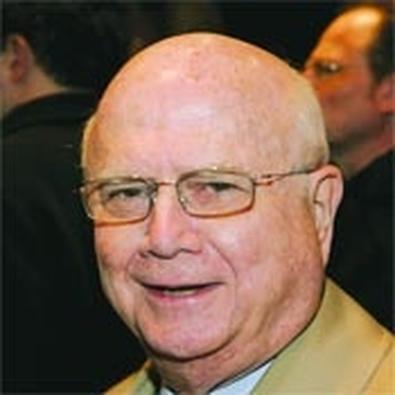
When Gerald Schoenfeld, the chairman and CEO of the Shubert Organization, died on Nov. 25, 2008, I thought of President Franklin Delano Roosevelt. An odd comparison but an apt one. Roosevelt saved America through government action, and Schoenfeld saved the theatre industry through private capital partnerships. In 1976, as Gotham was facing bankruptcy, Gerry galvanized Broadway when another Gerry --
President Ford -- was telling New York to "drop dead." Ironically, Schoenfeld's death occurred as New York faced a similar financial crisis.
Today, the theatre industry brings an estimated billion dollars a year into New York City and is not looking for a bailout. Those commentators who are laying a wreath over Duffy Square, the center of Broadway/Times Square, should remember how Gerry transformed the shabby Shubert theatres of the 1960s into the dynamic
Shubert Organization; cleaned up the ghoulish Times Square area with the Association for a Better New York, the Times Square Alliance, and the Times Square Business Improvement District; gave grants to Off-Broadway theatres along Theatre Row; and welcomed Disney into the theatre business.
I knew Gerry for more than 40 years, first through my father, Arnold Lewis, who was the trust officer for the Shubert Organization account at Morgan Guaranty, and later through my employment with the Shuberts and as a reporter for Local 700, the Motion Picture Editors Guild. Gerry and Bernard Jacobs, who died in 1996, were the legal counsels for the original Shubert brothers, Lee and J.J. Shubert. Gerry and Bernie were practical rather than pragmatic and were recognized as the saviors of the Broadway theatres by the Shubert board of directors, by the International Alliance of Theatrical Stage Employees, by Actors' Equity Association, by playwrights, and by the League of American Theatres and Producers. Power did not change Gerry, who became chairman in 1972, and his loyalty to those who were vulnerable or even powerless was remarkable.
Gerry could be tough, because he controlled the 17 theatres necessary for the employment of IATSE and Equity members, but he appreciated unions. I know because he told me it would be chaos without them. When he died in the midst of a growing recession, reporters were focused on the number of shows that were closing. But Broadway has weathered two crises in the last seven years: 9/11 in 2001 and the stagehands strike in 2007.
What should be remembered is the number of shows that ran for decades in Shubert theatres, such as Cats, A Chorus Line, Les Misテゥrables, and the currently running shows The Phantom of the Opera and Mamma Mia!. Some call these "theme-park productions," but Gerry kept these shows open in his theatres and created stable jobs for thousands of performers, stage crews, and crafts union workers. Before the Shubert Organization was formed, the longest runs were a maximum eight years.
Gerry's gift was that he was a team player, but his real genius was that he recognized he was a realtor first and a producer second. Gerry never thought of the Shubert theatres in Manhattan as 17 separate pieces of land but as part of the adjoining neighborhood. He remembered that his boss J.J. Shubert bought undesirable properties over the years in cities where his productions were playing, bought adjoining properties when they were on the market, and eventually owned a block worth many times the price he'd paid. Gerry, with Lewis Rudin of the Association for a Better New York, the Times Square Alliance, and the Times Square Business Improvement District, envisioned an extreme makeover of Times Square and 42nd Street, despite the indifference of Mayors Lindsay, Koch, and Dinkins.
Private capital saved New York after 1976 through the vision of these realtors, and Disney later became another partner in the theatre district with such hits as Beauty and the Beast and the still-running The Lion King. Gerry didn't regard Disney as a competitor but as a colleague, and the theatres along 42nd Street are the result of that Disney connection. Tourists bring that estimated billion dollars a year into New York City partially because of the theatres.
What is Broadway's future? Philip Smith and Robert Wankel, the co窶田hief executive officers of the Shubert Organization, are producers and realtors very much in the Schoenfeld mold. They will continue to reach out to those who believe in the Broadway dream. The Fabulous Invalid will not need government-issue crutches, because the Shubert Organization will be there to keep it healthy.
Kevin Lewis is a contributing writer for the Motion Picture Editors Guild Magazine (Local 700, IATSE) and was a contributing writer for DGA Magazine and International Documentary Magazine. During the 1980s, he was a special projects coordinator for the Shubert Archive and the American Theatre Wing.
An invitation-only memorial for Gerald Schoenfeld will be held Feb. 9 at 1 p.m. at the Majestic Theatre,
247 W. 44th St., NYC.