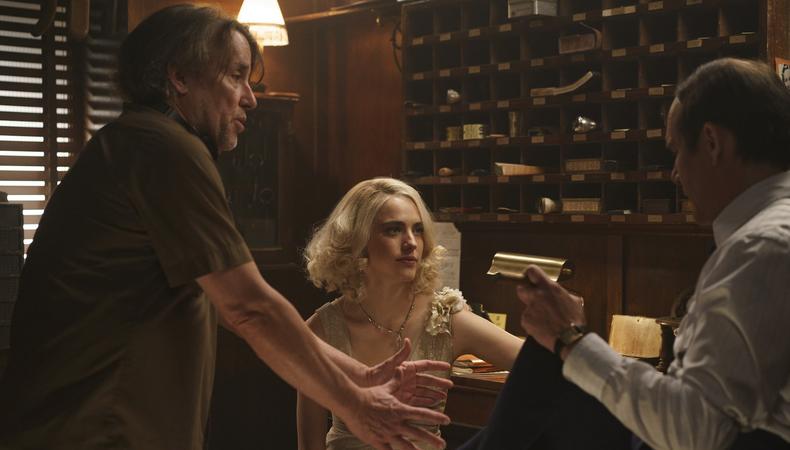
Richard Linklater has a trusty method for capturing an era’s look and feel: Find the right moment and just hang out.
“With my period films, even things that are based on my own life, I say I’m going back in time and I’m dropping a camera down.”
The Austin-based director has proven that yesteryear really can be a whole vibe. Films like “Dazed and Confused,” “Everybody Wants Some!!” and “Apollo 10½: A Space Age Childhood” channeled different periods of his own life in Texas. He also charted the passage of time in ambitious, decade-spanning projects like the “Before” trilogy and “Boyhood,” which nabbed him three Oscar nominations, for best picture, director, and original screenplay.
This year, Linklater will send audiences on two more time machine trips. In the drama “Blue Moon,” released by Sony Pictures Classics and in theaters nationwide Oct. 24, his longtime collaborator, Ethan Hawke, transforms into songwriter Lorenz Hart to recreate one lonely night in 1943. A few weeks later, on Nov. 14, Netflix will release “Nouvelle Vague,” a comedy that follows French filmmaker Jean-Luc Godard (Guillaume Marbeck) as he directs his debut feature, “Breathless,” in 1959.
RELATED: Ethan Hawke on ‘Blue Moon’ + His Longtime Creative Relationship With Richard Linklater
It’s not lost on Linklater that both of his new films center on artists. After a four-decade career, he knows a thing or two about that life; and yet, until now, his work has rarely explored the creative process.
“Me and Orson Welles,” his 2008 film about the titular director’s 1937 staging of “Julius Caesar,” is a notable exception. “Even at the time, I was like, I may never make a film about filmmaking,” he says, “but this might be the closest I get to the actor-director relationship.”
On films set in the past, Linklater directs his cast to immerse themselves in the language and attitudes of the time, but he goes out of his way to discourage them from acting like they’re in “a period film.” That mindset can lead to affectation—“ratcheting up the knob of importance,” as he puts it.
Linklater continually reminded the “Nouvelle Vague” cast—which includes Zoey Deutch as Jean Seberg, and Aubry Dullin as Jean-Paul Belmondo—that they weren’t playing icons. The film is a story about a guy no one knows, whom no one believes in, who’s making a movie that no one thinks will be any good.
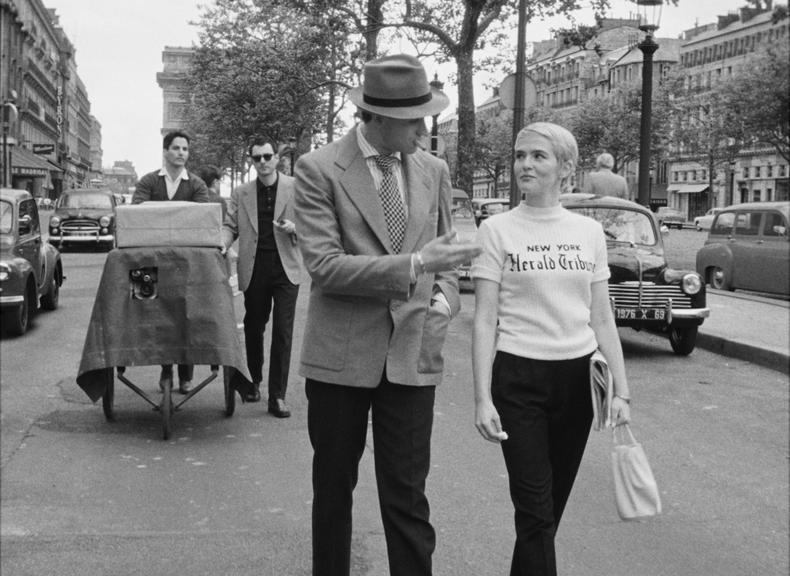
“Nouvelle Vague” Courtesy Netflix
He took the same in-the-moment approach to directing the cast of “Blue Moon.” Set just months before Hart’s death, the film finds the lyricist dreaming from a bar stool. He desperately seeks plans for the future with songwriting partner Richard Rodgers (Andrew Scott) and a young protégé (Margaret Qualley).
“Anything could go any way, at any time. You just don’t know. It’s humbling to see them in their moment—vulnerable,” Linklater says.
Despite their thematic connection, both of Linklater’s new films look beautifully distinct. The black-and-white “Nouvelle Vague” emulates the aesthetic of a French New Wave film with a meticulously faithful wink. Linklater describes it as “an artifact from 1959—a film we discovered in an attic.”
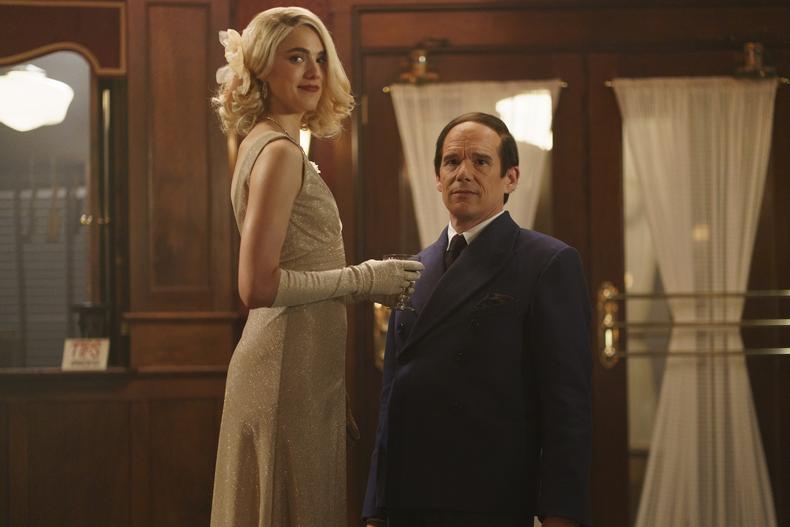
The warmly lit, intimately staged “Blue Moon” doesn’t look like a studio release from 1943, but the director wanted a stately elegance to evoke the age. “My metaphor was a Rodgers and Hart song, which to me is a lot of things,” he says. “It has a nice melody. It’s beautiful. But it’s also sad and witty.”
Ever since “Blue Moon” premiered in February at the Berlin International Film Festival, Oscar buzz has circled Hawke. He and Linklater have crafted characters together over nine films; conjuring the ghost of Lorenz Hart proved their most ambitious collaboration yet.
Hawke physically disappeared into the role of a closeted poet filled with booze and yearning. Linklater had him shave his head to appear balding. Stagecraft trickery made the star appear almost a foot shorter. When Hawke felt the urge to deliver a line emphatically or with a big gesture, Linklater pulled him back. Hart was a lyrical genius; he’d let his words do all the work on their own.
“For me, it was a deductive process,” Linklater says. “This is where I was kind of a naggy director this time around.”
The portrayal also needed to reflect a lifetime of romantic and sexual frustration. Linklater didn’t think of the character as self-loathing, necessarily, but simply lacking the confidence that anyone would ever love him. He remembers telling Hawke: “Always remember, no one ever wants to sleep with you. Nobody your whole life. Not once.”
“It’s all there in the lyrics,” he says. “A little raw open wound is all that’s left once you take away everything. It’s a brain and an open wound.”
While the portrayal of Hart reunited Linklater with Hawke for the first time in a decade, the role of Godard helped the filmmaker get reacquainted with his past self.
“In a way, ‘Nouvelle Vague’ is so personal. It’s about someone making their first film, drawing on the resources of community. When I was doing ‘Slacker’ back in ’89, it was an outgrowth of the Austin Film Society,” he says.
Linklater is quick to clarify: He’s not comparing the Texas cinephile collective he co-founded in 1985 to Cahiers du Cinéma, the Parisian film journal that launched Godard and his artistic generation. Still, he feels a kinship with those scrappy young film critics who took moviemaking into their own hands.
After all, you can’t have a future without a past.
“They were writers, but they were also future filmmakers. That’s how they saw themselves,” he says. “When I was programming films and creating that community, it was all as a future filmmaker.”
This story originally appeared in the October 20 issue of Backstage Magazine.