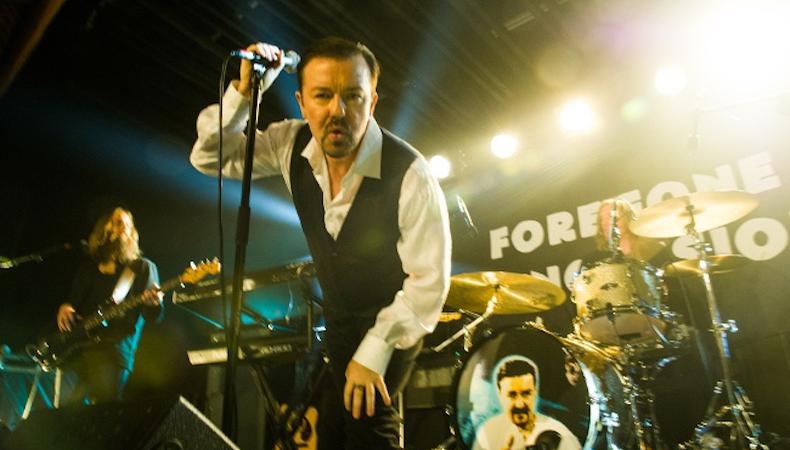
Ricky Gervais notes, with apathy, two apparent cultural shifts since the original English “The Office” debuted in 2001: “People are satisfied with their 15 minutes of fame now, [and] people will do anything to be famous and stay famous,” he says.
Gervais, who created the mockumentary series inspired by the 10 years he spent working in an actual office, also portrayed its bumbling protagonist, David Brent, throughout its three-season run. In Gervais’ new feature-length film, “David Brent: Life on the Road,” he revives the well-intentioned buffoon, but not without imbuing the material with the world’s current climate.
The film depicts David as he pursues his dream of being a musician, enlisting a film crew to document the journey. It provides a funny, raw, and ultimately moving portrait of the frequently ill-advised David, as well as an unsettling look at the ways in which society shapes content and vice versa. “The thing that’s changed is how demanding and insatiable the makers of these documentaries are now,” Gervais observes. “The documentary has changed. It’s more demanding and intrusive. And the world’s changed. It’s a dog-eat-dog world now.”
READ: The 7 Documentaries Every Actor Should See
Gervais, like many, is reconciling his work with the age of Donald Trump, which includes likening the new president to his fictional counterpart. “We’ve had literally a whole generation of people seeing fame as the biggest vocation,” he says. “[Trump] has got more in common with David Brent than he has [with] JFK. All his life, he’s wanted to be famous. He had everything, but he wanted to host ‘The Apprentice.’ ”
Gervais even parallels David’s rock-star pursuits to Trump’s pursuit of the presidency (though he maintains that David is less detestable). “Usually that’s what comedy is: an ordinary person trying to do something they’re not equipped to do,” he says. “But it takes on a sadder edge because Brent is trying as hard as he can, and he’s an OK bloke, particularly compared to the modern narcissist. Now we have a president of the United States who’s not equipped to do what he’s trying to do—but he’s done it!”
Through the changes of the past 16 years, Gervais insists the one constant is David himself. The challenge of the film, therefore, was to keep the character true to himself while still taking him and the audience on an adventure. “With a movie, it’s not enough to watch your favorite character bopping around. With a movie you have to go on a real journey,” he explains. “Playing him and being him is like putting on an old pair of slippers…but now, I’ve got to go and do something different in them. That’s the scary bit.”
READ: Taking Risks: 5 Ways to Grow as an Actor and Person
Gervais doesn’t let the prospect of his work’s reception quell his pursuits. In fact, he embraces the inevitability of polarity, something he credits to being a prolific creator of his own content. Recalling his stint as a four-time host of the Golden Globes, for example, he confesses, “I didn’t care what a producer thought of me, or a director, because I write and produce my own stuff…. It would be a lot easier for me to just pop up in films [or] pop up on adverts, [but] it takes me two years to write the thing and to direct it, so I have to love that bit of it.”
Gervais upholds that passion by prioritizing his personal satisfaction with the work, something he encourages all artists to strive for. “The most important thing for me is [the film] turned out how I wanted it to, and I couldn’t have had a better time doing it,” he says of “Life on the Road.” “The more you polarize, the more you’ve done something slightly different, slightly challenging, and not homogenized. Do everything artistic for yourself. And if you believe in God, do it for yourself and God.”
Check out our film audition listings!