Choreographer Danny Mefford says that his experience in the theater world with Broadway hits (and best musical Tony winners) “Dear Evan Hansen” and “Fun Home” prepared him for his foray into television with NBC’s musical drama “Rise.” The multimedium talent spoke with Backstage about using movement to enforce performative truths and the one way he makes all actors feel comfortable in the rehearsal room.
As the choreographer, what is your working relationship to actors?
Because I come from the acting world rather than the dance world, I really empathize with what actors are going through. I imagine I’m the person performing it and think about what I would want to do that makes me feel like I am completely physically telling the truth. I feel very sensitive to what I call ‘physical lies,’ which I am avoiding at all costs. As soon as I feel someone lies to me physically, I’ve got to figure out a way to change it. I get in front of the people who are going to do it and look at what they have to offer, and we talk about the social events [surrounding the moment]. We collaborate together to make something that feels like it’s really nailing that storytelling or character development point down.
READ: How to Train Non-Dancers for Screen + Stage
What are the major differences in choreographing for the stage versus for television?
The major difference between choreographing for television and theater is time. In the theater, you’re getting it to a place where you can repeat pretty close to the same thing every single night. In TV, that’s not what you’re trying to do. You make episodes so quickly, and there’s not a lot of rehearsal time. You have to come in with a very clear idea of what you want this to look like. There’s not a lot of time to make mistakes or try different ideas—which is something I love to do in the theater. The basic structure is different, too. Things that look good on camera don’t necessarily look good when you’re standing back in an audience looking at the stage. It’s understanding what the writers are trying to do with the moment.
Realism is a signature characteristic of your work. How do you ensure your choreography stays grounded?
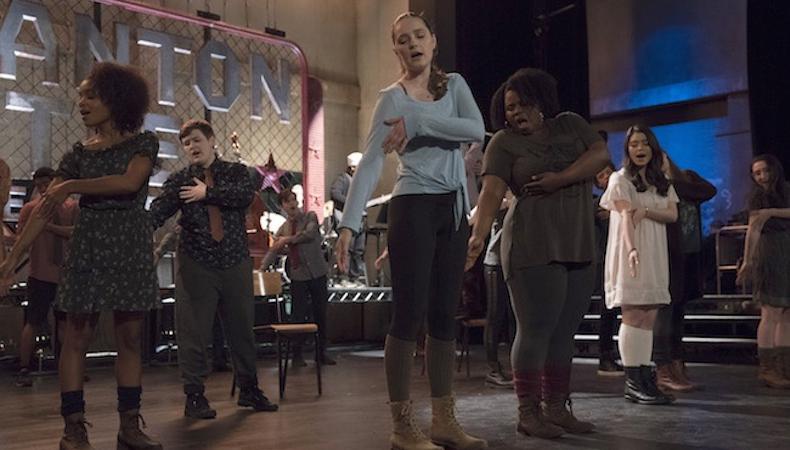
My goal is always to make sure that everyone in the audience believes these people are who they are being told they are. I really think dance is one of the things that can very easily kick it over into [thoughts like], “But I thought this was just supposed to be a high school kid in a nondescript place in America. Why all of a sudden would they all be able to dance?” In “Rise,” it’s very much about sculpting from the beginning of the season to the end of the season how they improve, and allowing that to be embedded in the way that I’m staging it. That was one of the beautiful challenges.
How did you make the leap from theater to “Rise”?
I went in and met with [creator] Jason Katims and [producer] Jeffrey Seller and some other producers, and we had this great conversation where I said a lot of the things that I love to say to people, which is that I believe everyone can dance, that I believe watching any human being dance and perform is delightful in some way, and how I thought that lined up with what they were trying to do. They wanted something very realistic, and the kind of realism they were talking about is a palette that prioritizes character development and storytelling and not a movement palette that prioritizes spectacle and trained dance.
Since “Rise” revolves around a high school production of “Spring Awakening,” how much attention did you pay to the musical’s original choreography?
Every original production team leaves an indelible stamp on the piece. It becomes a little bit hard to separate those two things. I am a huge fan of “Spring Awakening,” both the original production and the Deaf West Broadway revival. As soon as I got this job, I just didn’t watch any of that. I said, “What I have in my mind is what I have in my mind and now I just have to react to the script I see in front of me and the people I see in front of me.” I tried to imagine that I was really staging a high school production of “Spring Awakening.” While I do think it definitely pays homage to the original production, it is wholly our own, too.
Because you work with so many actors who are not necessarily “dancers,” do you have any tricks to make them feel more comfortable with movement?
Humor! I just try to stay very calm and I try to really seep into the undercurrent of the rehearsal room a sense of joy and lightness and the idea that we’re all here to do a job, but isn’t this job amazing? I don’t want anybody to shut down. People usually shut down when they feel afraid and they might feel afraid that they’re going to look stupid or feel that they don’t trust you. I try to gain their trust immediately and make them feel not afraid. I try to create an environment where there is trust and joy and people can enter into it freely. That’s also what an audience wants to see. I truly believe that an audience is way less interested in a triple turn than they are in seeing someone open up in front of them.
Do you have any advice for someone looking to break into the world of choreography?
My advice is just the same as my advice for someone who wants to be in any area of the entertainment industry: Follow your passion and allow those passions to be outside of the theater when they are outside of the theater and inside of the theater when they are inside of the theater. Don’t squash your curiosity in any way. It’s luck mixed with preparation. Devoting your life to the arts is really about your curiosity and remaining open to things. Know that things are going to change and your feelings about things are going to change and something you liked one year, you may not like in another year. Just be along for the ride.
On the hunt for an acting gig? Apply to casting calls on Backstage.