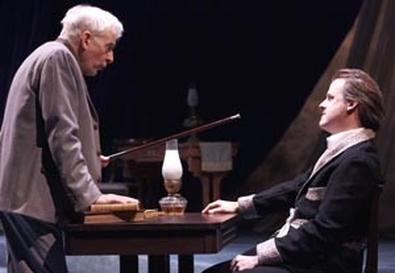
Something must be wrong. All accounts list 1886 as the date of Henrik Ibsen’s “Rosmersholm.” On the basis of the Pearl Theatre Company’s riveting production, however, the date must surely be 2010. Not that Mike Poulton’s new adaptation (first seen at London’s Almeida in 2008) is anachronistic. Neither stilted nor slangy, it finds a middle road that makes the work as fresh in our times as it was in Ibsen’s. The play is acted with passion and commitment, and the evening is a powerful reminder of how really great Ibsen can be given the kind of devotion he gets here. Although "Rosmersholm" has elements of both realism and symbolism (a white horse figures prominently as a precursor of doom), in the hands of the Pearl cast and director, they balance each other believably.
The story of how public quarrels have an impact on private mores, and vice versa, is newly laundered. On one side, conservatives; on the other, liberals. Rumors, character assassinations, and political shenanigans abound, but the play’s shock lies not in its intimations of adultery, illegitimacy, and incest, but in its implication that little has changed.
Johannes Rosmer’s family has always been at the top of the heap, a conservative clan that patronizes those less fortunate. But two events have shaken the family’s traditions. A year before the action begins, Rosmer’s wife, Beata, committed suicide. Also, Rosmer, once a pastor, has lost his faith and now questions the hold that both conservatism and religion have had on him and his ancestral family. His confusion is abetted by young Rebecca West, who lived in the house as Beata’s companion and stayed on. Her motives are complex. She is attracted to Rosmer, but she is even more determined to turn his beliefs around.
Baffled by personal stirrings, the pair is also embattled by Dr. Kroll, Beata’s brother, a reactionary force for the status quo. Kroll’s nemesis is Peder Mortensgaard, a crusading newspaperman, ostensibly liberal but easily prone to ruining reputations if it serves his needs. Neither is above dirty tricks. Also in the mix are Ulrik Brendel, Rosmer’s one-time tutor and a man of rough integrity, and Mrs. Helseth, the efficient housekeeper.
Kroll is incensed by Rosmer’s belief that the “people must take matters into their own hands.” Rather, says Kroll, “the rabble are incapable of thinking for themselves.” The contemporary echoes are obvious. But Rosmer is not a Tea Partier: He wants people to come together. “There must be no sides, no divisions,” he says. “Once free of slanders, the good in men will flourish.” Both Rosmer and Rebecca are eventually crushed by guilt and scandal. They are also crushed by their inability to overcome the lies, deceptions, and lack of decency that stalk their ideals. Stymied by the past, they are too innocent for a world that rules by fear.
As Rebecca, one of Ibsen’s strong and independent women, Margot White is restless, fiery, romantic, and empowered. Her scenes with the beset, confused, despairing, but noble Rosmer of Bradford Cover are filled with power and passion. Austin Pendleton underplays Kroll, flashing his teeth, quietly savage in his thirst for revenge. Dan Daily is a wonderfully scruffy Brendel, while Dominic Cuskern is a sly Mortensgaard and Robin Leslie Brown a wily but empathetic Mrs. Helseth, with touches of Daphne du Maurier’s Mrs. Danvers.
Director Elinor Renfield has a firm grasp on the play’s psychological and political tensions, keeping melodrama at bay. Helping is Stephen Petrilli’s moody lighting, which ranges from claustrophobic to promising of sunshine.
This is a rare chance to see an eloquent production of one of Ibsen’s least-produced masterworks.
Presented by the Pearl Theatre Company at New York City Center Stage II, 131 W. 55th St., NYC. Nov. 21–Dec. 19. Tue., Thu.–Sat., 7:30 p.m.; Wed., Sat., and Sun., 2:30 p.m. (No performance Thu., Nov. 25; additional performance Thu., Dec. 2, 2:30 p.m.) (212) 581-1212 or www.nycitycenter.org.