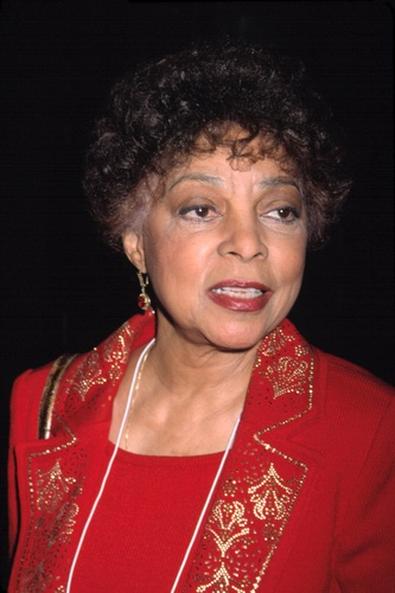
The lives of Ossie Davis and Ruby Dee, married 57 years, could be likened to an epic love story, over and above their passion for acting and activism against racial segregation. Celebrated as national treasures, Davis and Dee were granted the National Medal of Arts in 1995 for their work in the civil rights movement and crossing color lines in entertainment. In 2001 the Screen Actors Guild bestowed on the pair the Lifetime Achievement Award, its highest honor. Davis and Dee were also jointly inducted into the Theater Hall of Fame and the National Association for the Advancement of Colored People Image Awards Hall of Fame.
To many audiences of the stage and screen, Davis and Dee would always be a team. Yet following Davis' death—on Feb. 4, 2005—Dee was determined to continue with acting and the dreams the pair had shared together. Her current project, Naming Number Two, is a result of her fortitude and her commitment to telling the stories of all people truthfully. The film is set in the small community of Mount Roskill in Auckland, New Zealand, and is about Nanna Maria (Dee), a machete-wielding, Fijian-Kiwi octogenarian matriarch trying to gather her wayward brood for one last family celebration. The film won the World Cinema Audience Award (Dramatic) at the 2006 Sundance Film Festival and is scheduled to be released in August. The film is the directorial debut of playwright Toa Fraser, who adapted it from his play No. 2, originally written as a one-woman show.
Fraser approached Dee in 2005 to star in the film, and she was hooked after the first phone call. "I was so excited because of the opportunity to interrelate with other actors in the artistic community of film," she recalls. She was taken with Fraser's artfully written characters as well as the film's exotic locations. "I had to look up and see where all of the places that were referred to in the film [were], and I was just delighted. I read it, and my husband and I agreed that it was really something that I would like to do."
Describing the work, Dee reveals: "It was a family story of a matriarch trying to save the family from alienation and stressing family background and belonging. It's a very important part of being a human being—recognizing where you come from, who you are, some of the values that you have treasured that have brought you to the position that saves you. Here's a woman who wants to make sure that this traditional type of caring [continues in her family]—in the face of all the modern inventions, going away to different countries, and living their own lives. She wants to instill in her grandchildren this allegiance to belonging to each other."
Within 24 hours of arriving in Auckland to shoot the film, however, Dee received devastating news: Davis had died during the night. She immediately returned to New York to bury him, then went back to New Zealand a mere two weeks later and gave one of her most powerful performances. It earned her a best actress statue at the 2006 New Zealand Screen Awards.
Dee and Davis met while working in 1946 on the Broadway production of Jeb at the Martin Beck Theatre. At that time, Dee was a new member of the American Negro Theatre and had landed a role as an understudy. She'd read about Davis, who was cast as a lead, in a newspaper; she was less than impressed when she met him. "I thought he was really from the back of a plow someplace and had joined the Army," she recalls, laughing. "He was tall and lanky and just sort of spilled along, and his clothes didn't fit him. I thought, 'Oh, well, I guess this is what the character is; we have to be able to laugh at him,' but those were his own clothes. I learned later that things like that didn't bother him; he was a different kind of human being."
She says their partnership and marriage (in 1948) were built on friendship and a deep respect for each other. "You think you know about love before you get married, but you're really in the kindergarten of it. You go through the living. Love—like democracy, I think—is an aspiration," she says, describing her attraction to Davis as an electrifying connection. "It was while I was watching him one day and making some light jokey remark, and he was doing a scene onstage. He was in his soldier's costume, and he was tying his tie. I remember just sitting there, looking at him," Dee says softly. "I remember this extraordinary feeling that I've never felt more than once in my life, like an electric beam or a shock."
Dee and Davis became involved in the civil rights movement and served as the masters of ceremony of 1963's March on Washington for their close friend Martin Luther King Jr. Dee insists that becoming civil rights activists was not a conscious decision. "I don't remember going about the civil rights days in any kind of deliberate way, because I'd grown up in Harlem," she says. "I was born into the stupidity and the brutality and the unreasonable quality of racism. I didn't know any other address but to struggle against it when it affected me personally or the group [to] which I had been connected."
Dee says the beginning of their careers during segregation was difficult. "When I was coming along, we couldn't stay in the hotels when we went to Hollywood," she says. "When we were on tour with the play Anna Lucasta, that was in the 1940s, we couldn't stay in hotels, but there were people who had rooming houses, all over the country as a matter of fact, for people like Duke Ellington, all the name musicians, and Ella [Fitzgerald]. When they went on the road, they stayed in these absolutely stunning places, gorgeous homes. I've been to them. But they couldn't stay in the hotels. In the choruses, the only [hotels] they could [stay in] would be the whorehouses disguised as something else. It was not a comfortable thing to be on the road. If you were traveling by bus and had to go to the bathroom or get food, it was not an easy access in those areas either."
While the theatre was becoming more open racially, Dee says, "Hollywood was not paying attention to black performers, and they weren't in the magazines, and [audiences] really didn't know that they existed outside of a few people like Ethel Waters, Lena Horne, Eddie 'Rochester' [Anderson], and a few people like Stepin Fetchit."
According to Dee, Hollywood's eventual inclusion of actors of color had little to do with ethnic sensitivity and everything to do with economics. "Hollywood decided—as with baseball—that [segregation] was very un-American, and second of all it was an economic folly," she says. "Hollywood lowered the barrier, but it didn't lower its concept of how it wanted to present black people as mostly as buffoons and slaves, in ways that were not indicative of the enormous segment of the American population as intelligent, with as much aspiration and dignity as anyone else in the country." Dee, an alumna of Hunter College in New York, notes, "You could be a maid or a loose woman; you could speak as though you hadn't had any education or any aspiration. It was degrading for the most part. Not only were African Americans treated that way, but also the Chinese and other groups in the nation. They were degraded in presentation and made to look less than white Americans. It wasn't a very satisfactory arrangement, this film integration, for a very long time.
"Most of the writers in Hollywood [writing] about black people would be white, because black writers were not even heard of at that time. It was not a very easy alliance at first, because racism was still there. There were no black hairdressers, technicians, script people, and wardrobe and that kind of thing. We were treated as some sort of outside creatures, but it was the beginning of what I called getting off the potty of human relationships and trying to walk," Dee says.
Dee offers a challenge to all actors to use the craft as a medium for change. When asked what actors could do to tell the stories of all people, her advice is simple: "A musician has music to work with, the dancer has limbs and rhythms and music, the painters have paint brushes, the architect has all of the things that he uses in terms of structure and space, but an actor's text is the whole of life and everybody and everything in it."