Funny how the meaning of art changes with the times. When Howard Barker's 1985 Scenes From an Execution was seen hereabouts in 1996, its theme of an artist's conflict with the state could be read as a metaphor for the standoff battle then embroiling artists, Congress, and the NEA. Now, in light of the current administration, this revival by the self-described "unapologetically political" Potomac Theatre Company, which co-produced that earlier outing with the now-defunct Blue Light Theatre Company, has even darker overtones. Amusing though it still is, its comedy is fiercer and more sardonic as it depicts a government's attempt to crush nonconformists who dare question propagandistic prevarications. A complex disquisition on women, politics, vanity, selfishness, sensuality, and the elusiveness of truth, the play is bolstered by Jan Maxwell's performance as fictional Renaissance artist Galactia (based on real-life painter Artemisia Gentileschi). Erotic one minute, cowed the next, emotional, humane, angry, and loving, Maxwell once again shows how many colors she can extract from a role.
Galactia has been commissioned by Venice to paint a large canvas celebrating the Holy League's victory over the Turkish fleet and the Ottoman Empire at the 1571 Battle of Lepanto. Of course, what's wanted is a heroic work filled with glory and a sense of "mission accomplished." Instead, the canvas shows war in all its horrors. "Dead men float with their arses in the air," says Galactia. "Hating the living, they turn their buttocks up." Labeled "a woman and a sensualist" by her sniveling lover, the hack painter Carpeta, Galactia is admittedly ruthless and arrogant, not above exploiting her models or her family for the sake of her art. Above all, she wants to create a painting that will cause viewers to "look at their clothes to see if they have been spattered with blood or brains." Naturally, the powers that be are appalled, rejecting her work and throwing her into a lightless cell from where she cries out her fate in the evening's most harrowing scene.
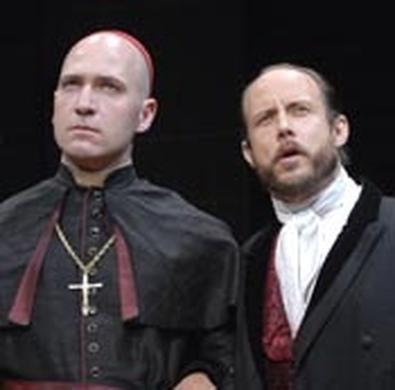
The play is dizzying with alternating moods. So much is thrown at the audience in Act 1 that the head spins. But some semblance of order is imposed by, of all people, a critic named Gina Rivera, who recognizes not only the painting's worth but the damage to the state's prestige if it's suppressed. Looking herself like a da Vinci work, Patricia Buckley plays Gina with a mixture of hauteur and sincerity. David Barlow is a volatile Carpeta, while Alex Draper gives an intricate performance as the conflicted Doge (here named Urgentino), and Timothy Deenihan is just right as the snobbish, disdainful Cardinal Ostensible.
Very much in keeping with the play's gothic comedy are Robert Zukerman as a vain admiral concerned with how his hands have been painted and Peter Schmitz, who gives an all-out performance as Prodo, a war veteran who exploits his wounds. Both reflect director Richard Romagnoli's vigorous production of a play that mocks power and weeps for truth.
Presented by Potomac Theatre Project at Atlantic Stage 2, 330 W. 16th St., NYC. July 6-26. Schedule varies. (212) 279-4200 or www.ticketcentral.com.