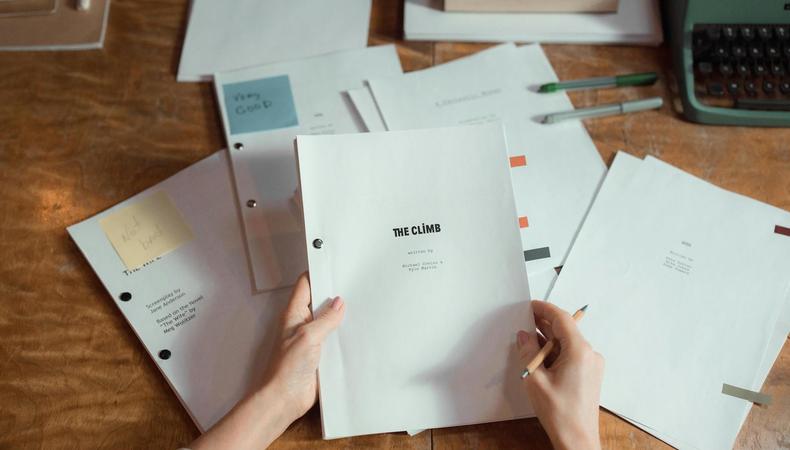
As an aspiring scribe, the amount of guidelines, rules, and terms to learn can be overwhelming. But before you know your slugline from your wrylies, you have to know the basics—and it doesn’t get more 101 than “screenplay” versus “script.” You may be thinking, Wait, is there even a difference? Let’s find out!
A screenplay is the written version of a film or an episode of television. Simple, right? Wrong.
Unlike a completed work, such as a novel or a short story, a screenplay is the first in a long series of steps. This draft is essentially the blueprint—the foundation—for what we, the audience, will ultimately see. The screenplay includes the overall story and plot, as well as the various elements that make them up:
Screenplays are intended for visualization. Anyone reading your work (such as producers, directors, actors, and the crew) should be able to see and hear the finished product in their head. But a screenplay is not, in itself, the finished product.
At this point, you might be asking yourself: Isn’t that the exact same thing as a script? Isn’t that what a Shakespearean play is? Yes… and no.
Technically, a screenplay is a script. “Script” is an all-encompassing word used to describe the written form of many different mediums: films, theatrical plays, sketches, podcasts, video games, web series, etc.
As it says in the name, a screenplay is a script that is written for the screen, which means it has some specific formatting rules. Other mediums have their own unique formats and standards. For example, a podcast script will include dialogue, but since it’s an audio medium, you won’t find any visual action lines. A script can also be something as bare bones as the talking points a pundit prepares for a news show, whether it’s detailed or just setting the stage before “going off script.”
From screenplay to script
That heading might seem a little confusing, but it’s terminology you should know before navigating a Hollywood career. Let’s say you sold your screenplay and it’s been greenlit for production. First of all, congrats! Second, your screenplay is about to go through some major changes (and that doesn’t just mean more drafts to address the story). It’s going to transform into what is called a “shooting script.”
There isn't a massive difference between your screenplay and "shooting script." It simply means production has turned what was primarily a story blueprint into something that helps all departments. This means adding annotations and elements specific camera movements, music cues, exact transitions, or blocking directions. This helps the crew get an even better understanding of what their job entails when it comes to filming.