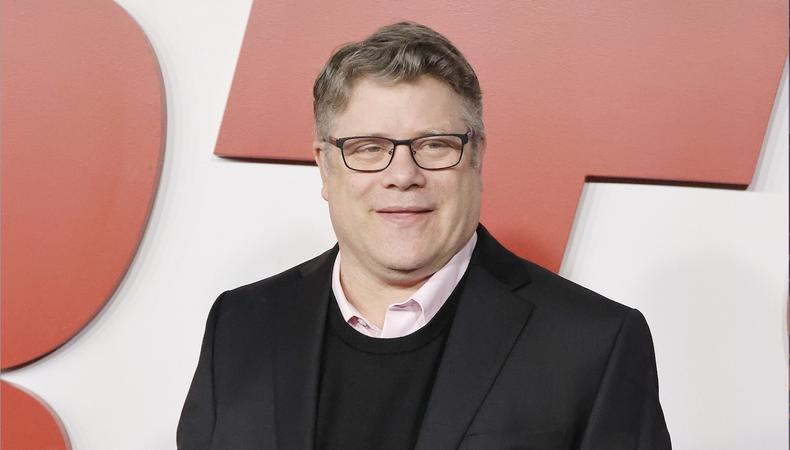
Whether Sean Astin is leading with “optimism and creativity” in his capacity as SAG-AFTRA president, completing his first Ironman triathlon in 2015 at age 44, or sincerely getting a kick out of overly enthusiastic fan interactions (like indulging my own confession about writing a bardic ballad praising Samwise Gamgee in my youth), the actor lives his own best advice: Be passionate, listen with intention, and find everything that’s awesome about the world around you.
Elected as union president in September 2025 with nearly 80% of the vote, Astin is what he calls the “first second-generation president of the union”; his mother, Oscar winner Patty Duke, served as SAG president from 1985 to 1988. But family legacy aside, Astin’s path was anything but predetermined. It took years of deep involvement in union governance, an unwavering belief that hope is currency, and a “Goonies”-style “never say die” attitude to become the leader he is today.
With the union set to enter new TV/Theatrical/Streaming contract negotiations with the Alliance of Motion Picture and Television Producers on Feb. 9, Astin sat down with Backstage to discuss how he’s addressing actors’ concerns and the importance of embracing both ambition and humility.
What initially made you become involved with union politics?
Several friends were running for office and called and asked me to get involved. That’s really the way most union service works: Somebody who’s engaged taps you on the shoulder and says, “Hey, you really ought to come to this meeting with me.” That happened, and my life had arrived at a certain point where it just made sense. I had enjoyed a consistent working career, and I felt like my contributions would be meaningful, and that my particular personality was well suited to the environment.
“[Union members] should come away knowing that they’re being valued and that they’re being treated with dignity, and that their lived experience is being edified and reflected in the contract they work under. ”
The moment I really started paying attention, there was still great internal conflict in the union. There was a lot of upset and a lot of turmoil and consternation. One of my superpowers is conflict resolution. I was really concerned that people weren’t happy—that people who understood things, who cared about the contracts, who understood the mechanics of the union were doing so much work, and they weren’t happy. So my ability to go in and help each other see each other’s points of view just really felt meaningful.
I participated in what became a renaissance of union activity and healing. Now, this term, where I’m president, is benefiting from five or six years of union healing. In 2023, the world saw just how solid and united our membership is. When people are learning and have something to contribute and their voices are appreciated, it creates a lot of opportunities.
How do you ensure that all SAG-AFTRA members have their voices heard?
I think the way to achieve people being heard is to listen. It is intentional and it takes patience, but I like to listen. Active listening, and listening with compassion and with intent—when you do that, it’s just amazing the emotional relief that people have when they see and feel that they’re being heard.
“The real watchword, particularly in an age of artificial intelligence where creators, performers, and companies are wrestling with this dragon of threat and opportunity, is ‘humility’ ..The requisite amount of humility as a guard for that process of ambition is really what will keep our civilization intact.”
When it comes to leadership, the next step after hearing and listening is trying to do something, and then doing it. That’s how goodwill is generated. People can be very forgiving of things that don’t work, as long as they sense that people of goodwill are operating in good faith and trying hard and achieving results—even if [those results are] not exactly what you might want or exactly what you might expect. It’s a much more constructive space to be in when people are willing to listen to each other.
You can make a statement or an observation, or contribute a feeling into the room, that changes the direction of the conversation or confirms a conversation, so that when it comes time to vote or get up and leave, people walk away feeling satisfied. There are very few things in this world that are as satisfying as feeling like you helped other people. That’s what it’s all about.
What is the most important thing that union members should come away with from this contract?
They should come away knowing that they’re being valued and that they’re being treated with dignity, and that their lived experience is being edified and reflected in the contract they work under.
In our organization, we represent many constituencies. We do the industry a really important service by curating and helping to specify and prioritize the needs and interests of so many different people. When we get together with the AMPTP, which represents a large number of companies with different business models, they’ve got their complex array of interests to satisfy, and we have ours. We’re talking about issues like sexual harassment prevention, all kinds of safety concerns, health plan funding, and pension plan funding.
[SAG-AFTRA members] should know that their union is fully representing each of them, that each of those interests and categorical groups are being represented to the fullest extent possible, and that should be reflected in the outcome of the negotiation.
I’m hopeful that the companies will take their responsibility to satisfy what I just said seriously, in good faith. So we’ll go in there with a spirit of good faith, earnestness, and open-mindedness, but also with the knowledge that we have extraordinary unity and can hold strong when we feel we must.
How can actors remain hopeful and navigate their careers during uncertain times in the industry?
In a time where there’s a lot of uncertainty, a lot of upset—that’s when you need hope most. Hope is the coin of the realm. Hope is currency. A lot of the characters I’ve played get to give these great, sweeping speeches about [the idea that] there’s some good left in this world that’s worth fighting for: “Goonies never say die!” There’s a constant refrain. I feel that in me. And I’ve gotten so much feedback from members who are excited about what the union’s going to do with me [leading it], because they associate me with being positive. It’s a feedback loop that reinforces itself, and I think that endures.
The real watchword, particularly in an age of artificial intelligence where creators, performers, and companies are wrestling with this dragon of threat and opportunity, is “humility.” People who want to push the boundaries of what’s possible for them, to push beyond the expectations that others might have or the limits others might place on them, to move into areas of work or whatever dreams may hold for them—that’s a good thing. The requisite amount of humility as a guard for that process of ambition is really what will keep our civilization intact.
My biggest advice: Be passionate about other people’s work. If you can be passionate about what someone else is doing, the dividends it pays for you are shockingly great. Emotional, creative, and business connections are created. A lot of times we feel like our job is to go in and look at a film and critique it; I challenge people to go into a film and find everything that’s awesome about it.
Ambition is a good thing, [so] share unabashedly what your hopes and dreams and goals and aspirations are. Be passionate about other people’s work, be open about what you’re trying to accomplish, and do it all with humility.
This interview has been edited for clarity and length.